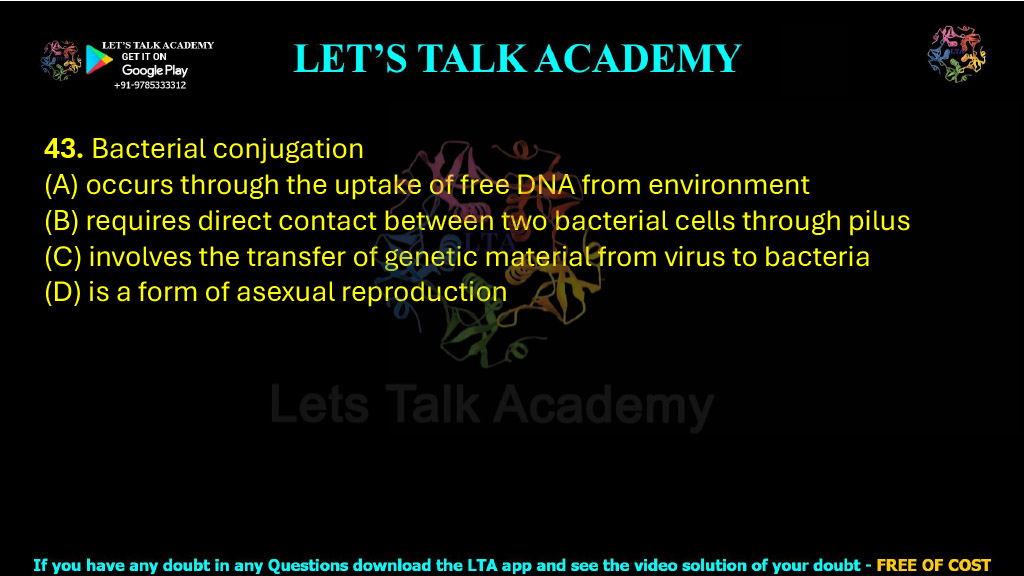
43. Bacterial conjugation
(A) occurs through the uptake of free DNA from environment
(B) requires direct contact between two bacterial cells through pilus
(C) involves the transfer of genetic material from virus to bacteria
(D) is a form of asexual reproduction
Bacterial Conjugation Explained: Mechanism, Steps, and Importance in Horizontal Gene Transfer
Introduction
Bacterial conjugation is one of the three major mechanisms of horizontal gene transfer (HGT), along with transformation and transduction. Unlike vertical gene transfer, where genetic information passes from parent to offspring during cell division, horizontal gene transfer enables bacteria to exchange DNA directly with other bacterial cells. This process plays a vital role in bacterial evolution, adaptation, and the rapid spread of beneficial traits such as antibiotic resistance, virulence factors, and specialized metabolic pathways.
Conjugation was first demonstrated by Joshua Lederberg and Edward Tatum in Escherichia coli, providing the first evidence that bacteria can exchange genetic material. The process requires direct physical contact between a donor cell carrying a conjugative plasmid (such as the F plasmid) and a recipient cell lacking the plasmid. A specialized structure known as the sex pilus establishes contact between the two cells, allowing transfer of plasmid DNA through a conjugation bridge.
Bacterial conjugation is of immense importance in medical microbiology because it contributes significantly to the emergence of multidrug-resistant bacteria. Understanding its mechanism is therefore essential for microbiology, molecular genetics, biotechnology, and infectious disease research.
Correct Answer
Correct Option: (B)
Detailed Explanation
Bacterial conjugation is a mechanism of horizontal gene transfer in which DNA is transferred directly from a donor bacterium to a recipient bacterium through cell-to-cell contact. The donor cell usually contains a conjugative plasmid, most commonly the F (fertility) plasmid, which encodes proteins required for conjugation, including the formation of the sex pilus.
The conjugation process begins when the donor bacterium extends a sex pilus that attaches to the recipient cell. The pilus retracts, bringing both cells into close contact and forming a conjugation bridge. A single strand of plasmid DNA is then transferred to the recipient while complementary DNA synthesis occurs simultaneously in both cells. At the end of the process, both donor and recipient possess a complete plasmid, making the recipient capable of acting as a donor in future conjugation events.
This mechanism allows bacteria to rapidly disseminate genes responsible for antibiotic resistance, toxin production, heavy metal resistance, and other adaptive traits across bacterial populations without reproduction.
Explanation of Each Option
Option (A): Occurs Through the Uptake of Free DNA from the Environment
This option is incorrect. Uptake of naked DNA from the surrounding environment is known as transformation, not conjugation. Transformation requires naturally competent bacteria or artificial methods such as electroporation in laboratory settings.
Option (B): Requires Direct Contact Between Two Bacterial Cells Through Pilus
This option is correct. Conjugation depends on direct physical contact between donor and recipient cells. The sex pilus, encoded by the F plasmid, establishes contact and facilitates DNA transfer through a conjugation bridge.
Option (C): Involves the Transfer of Genetic Material from Virus to Bacteria
This option is incorrect. Transfer of bacterial DNA through bacteriophages is called transduction. In transduction, bacteriophages act as vectors carrying bacterial genes between cells.
Option (D): Is a Form of Asexual Reproduction
This option is incorrect. Conjugation does not produce new bacterial cells. Instead, it exchanges genetic information between existing bacteria. Bacterial reproduction occurs through binary fission, whereas conjugation is solely a mechanism of horizontal gene transfer.
Why Option (B) is Correct
The defining characteristic of bacterial conjugation is the requirement for direct cell-to-cell contact. The donor cell forms a sex pilus that attaches to the recipient, allowing transfer of plasmid DNA through a conjugation bridge. Without physical contact, conjugation cannot occur.
Comparison of Horizontal Gene Transfer Mechanisms
| Mechanism | Source of DNA | Requires Cell Contact? |
|---|---|---|
| Transformation | Free DNA from the environment | No |
| Conjugation | Living donor bacterium | Yes |
| Transduction | Bacteriophage-mediated transfer | No |
Steps of Bacterial Conjugation
| Step | Process |
|---|---|
| 1 | Donor cell forms sex pilus |
| 2 | Pilus attaches to recipient cell |
| 3 | Cells come into direct contact |
| 4 | Single-stranded plasmid DNA is transferred |
| 5 | DNA replication restores double-stranded plasmid in both cells |
| 6 | Recipient becomes capable of future conjugation |
Importance of Bacterial Conjugation
| Role | Biological Importance |
|---|---|
| Antibiotic resistance | Rapid spread of multidrug resistance genes |
| Virulence factors | Transfer of toxin and pathogenicity genes |
| Metabolic adaptation | Acquisition of novel metabolic pathways |
| Genetic diversity | Enhances bacterial evolution and adaptation |
| Biotechnology | Used in genetic engineering and molecular cloning |
Conjugation vs Transformation vs Transduction
| Feature | Conjugation | Transformation | Transduction |
|---|---|---|---|
| DNA Source | Donor bacterium | Free DNA | Bacteriophage |
| Cell Contact | Required | Not required | Not required |
| Main Structure | Sex pilus | Competence proteins | Bacteriophage |
| Example | F plasmid transfer | DNA uptake by competent cells | Generalized or specialized transduction |
Biological Significance
Bacterial conjugation is one of the primary mechanisms responsible for the rapid evolution of bacterial populations. By enabling the exchange of plasmids carrying antibiotic resistance genes, virulence determinants, and specialized metabolic functions, conjugation allows bacteria to adapt quickly to environmental stress and antimicrobial agents. This process has major implications for public health because it contributes to the emergence and global spread of multidrug-resistant pathogens.
Final Answer
Bacterial conjugation is a process of horizontal gene transfer that requires direct physical contact between donor and recipient bacterial cells through a sex pilus.
Correct Option: (B)


