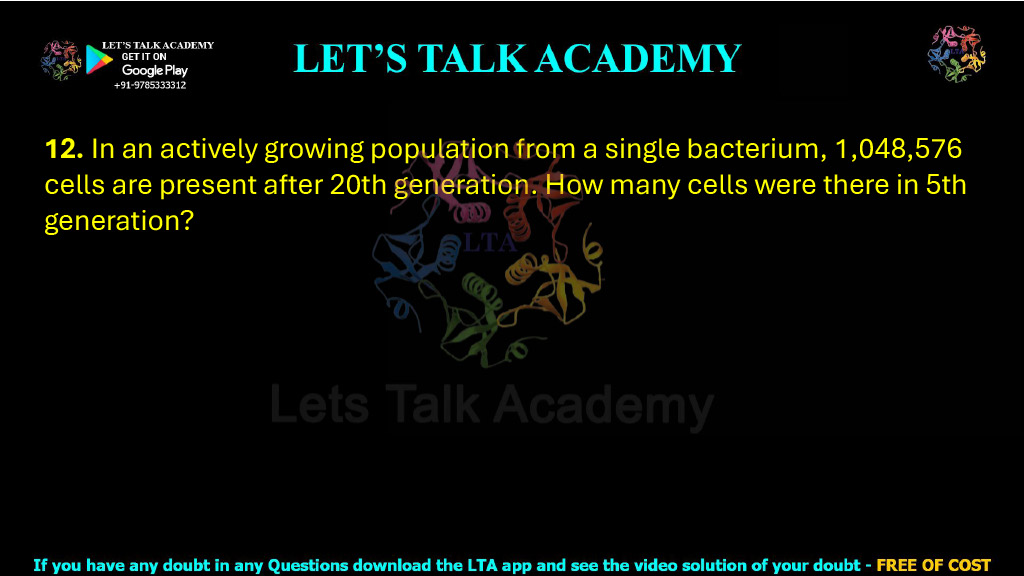
12. In an actively growing population from a single bacterium, 1,048,576 cells are present after 20th generation. How many cells were there in 5th generation?
Bacterial Growth Calculation: Cells Present in the 5th Generation
Introduction
Bacteria reproduce primarily through binary fission, a simple yet highly efficient process in which one bacterial cell divides into two genetically identical daughter cells. Under ideal environmental conditions, bacterial populations increase exponentially because every newly formed cell continues to divide independently.
Questions involving bacterial generation calculations test the understanding of exponential growth equations, powers of two, and logarithmic relationships. These problems are relatively straightforward once the mathematical relationship between the number of generations and the total number of cells is understood.
Correct Answer
Correct Answer: 32 Cells
Detailed Explanation
Bacterial cells divide by binary fission, where each generation doubles the number of cells present. Therefore, the number of cells after n generations is calculated using the exponential growth equation:
Number of Cells (N) = N0 × 2n
Where:
- N = Final number of cells
- N0 = Initial number of cells
- n = Number of generations
Since the bacterial population begins with a single bacterium:
N0 = 1
Therefore, after 20 generations:
N = 220 = 1,048,576 cells
The question asks for the number of cells after the 5th generation.
Using the same equation:
N = 25
N = 32 cells
Thus, there were 32 bacterial cells at the end of the fifth generation.
Step-by-Step Calculation
Initial Cells = 1
Growth Formula:
N = 2n
For the fifth generation:
N = 25
= 32
Answer = 32 Cells
Generation-wise Cell Number
| Generation | Number of Cells |
|---|---|
| 0 | 1 |
| 1 | 2 |
| 2 | 4 |
| 3 | 8 |
| 4 | 16 |
| 5 | 32 |
| 10 | 1,024 |
| 15 | 32,768 |
| 20 | 1,048,576 |
Important Formula Used in Bacterial Growth
| Formula | Application |
|---|---|
| N = N0 × 2n | Calculating final bacterial population |
| n = log(N/N0) / log2 | Calculating number of generations |
| Generation Time = Time / Number of Generations | Determining generation time |
Why Binary Fission Produces Exponential Growth
Binary fission is a process in which each bacterial cell divides into two identical daughter cells. Since every newly formed daughter cell also undergoes division, the population doubles during every generation. This doubling pattern results in exponential growth, represented mathematically by powers of two. Consequently, even a single bacterium can produce millions of cells within a relatively short period under optimal conditions.
Applications of Bacterial Growth Calculations
| Field | Application |
|---|---|
| Clinical Microbiology | Estimating bacterial multiplication during infection |
| Industrial Biotechnology | Optimizing fermentation processes |
| Food Microbiology | Predicting microbial spoilage |
| Environmental Microbiology | Monitoring microbial population growth |
| Molecular Biology | Designing bacterial culture experiments |
Final Answer
Number of cells after the 5th generation = 25 = 32
Correct Answer: 32 Cells


