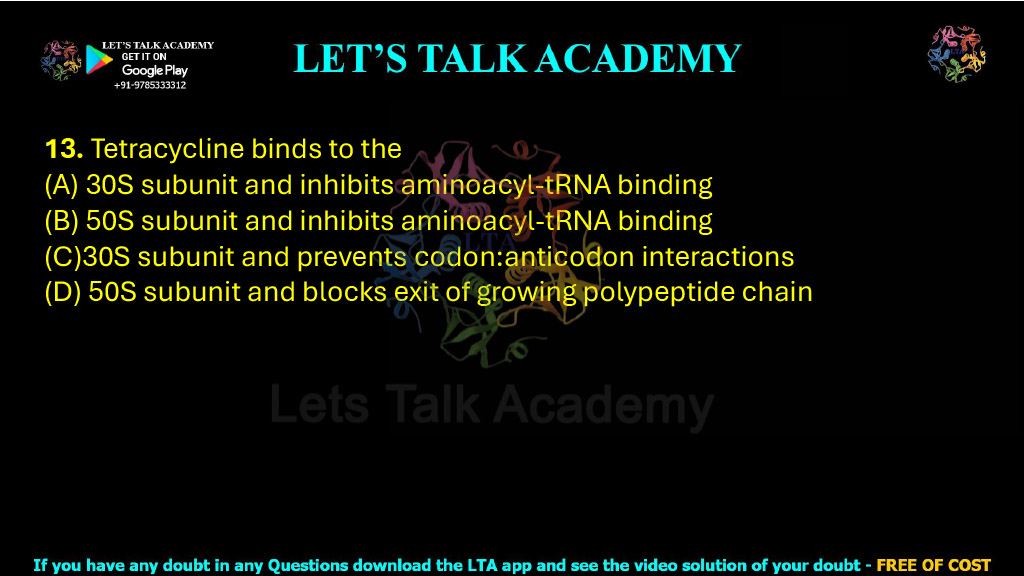
13. Tetracycline binds to the
(A) 30S subunit and inhibits aminoacyl-tRNA binding
(B) 50S subunit and inhibits aminoacyl-tRNA binding
(C)30S subunit and prevents codon:anticodon interactions
(D) 50S subunit and blocks exit of growing polypeptide chain
Tetracycline Mechanism of Action: 30S Ribosomal Subunit and Aminoacyl-tRNA Binding
Introduction
Protein synthesis is one of the most important biological processes in living cells, making it an excellent target for antibiotics. Many antibacterial drugs selectively inhibit bacterial ribosomes because bacterial ribosomes (70S) differ structurally from eukaryotic ribosomes (80S). This selective toxicity enables antibiotics to eliminate bacteria without significantly affecting host cells. Among the most widely used broad-spectrum antibiotics is Tetracycline, which inhibits bacterial protein synthesis by preventing the addition of amino acids to the growing polypeptide chain.
Tetracycline is active against a wide range of Gram-positive bacteria, Gram-negative bacteria, intracellular pathogens, and atypical microorganisms. It is commonly used to treat infections caused by Rickettsia, Chlamydia, Mycoplasma, Borrelia, and several other bacterial pathogens.
Correct Answer
Correct Option: (A) 30S subunit and inhibits aminoacyl-tRNA binding
Detailed Explanation
Tetracycline is a broad-spectrum bacteriostatic antibiotic that specifically binds to the 30S subunit of the bacterial ribosome. Its primary action is to prevent the binding of aminoacyl-tRNA to the A (aminoacyl) site of the ribosome. As a result, newly activated amino acids cannot be incorporated into the growing polypeptide chain, effectively stopping protein synthesis.
During normal bacterial translation, aminoacyl-tRNA carrying a specific amino acid enters the A-site of the ribosome and pairs its anticodon with the corresponding codon on messenger RNA. Tetracycline blocks this step by occupying a region of the 30S ribosomal subunit that prevents aminoacyl-tRNA from accessing the A-site. Since peptide elongation cannot proceed without the entry of aminoacyl-tRNA, bacterial protein synthesis is arrested, thereby inhibiting bacterial growth.
Because tetracycline inhibits bacterial growth without directly killing bacteria, it is classified as a bacteriostatic antibiotic. Its selective action results from structural differences between bacterial and eukaryotic ribosomes, allowing effective treatment with minimal toxicity to human cells.
Explanation of Each Option
Option (A): 30S Subunit and Inhibits Aminoacyl-tRNA Binding
This option is correct. Tetracycline binds reversibly to the bacterial 30S ribosomal subunit and prevents aminoacyl-tRNA from entering the A-site, thereby inhibiting peptide elongation.
Option (B): 50S Subunit and Inhibits Aminoacyl-tRNA Binding
This option is incorrect. Tetracycline acts on the 30S ribosomal subunit, not the 50S subunit.
Option (C): 30S Subunit and Prevents Codon:Anticodon Interactions
This option is incorrect. Prevention of codon-anticodon recognition is primarily associated with aminoglycosides such as Streptomycin, which interfere with translation initiation and mRNA decoding.
Option (D): 50S Subunit and Blocks Exit of Growing Polypeptide Chain
This option is incorrect. Blocking the exit tunnel of the growing peptide chain is the mechanism of action of macrolide antibiotics such as erythromycin, not tetracycline.
Why Option (A) is Correct
Tetracycline specifically targets the 30S ribosomal subunit and blocks the entry of aminoacyl-tRNA into the ribosomal A-site. Without aminoacyl-tRNA, peptide elongation cannot occur, leading to inhibition of bacterial protein synthesis.
Why the Other Options are Incorrect
Why Option (B) is Incorrect
Tetracycline has no affinity for the bacterial 50S ribosomal subunit. The 50S subunit is the target of antibiotics such as chloramphenicol, clindamycin, and macrolides.
Why Option (C) is Incorrect
Although tetracycline binds to the 30S subunit, its mechanism involves blocking aminoacyl-tRNA binding rather than directly preventing codon-anticodon pairing.
Why Option (D) is Incorrect
Macrolide antibiotics inhibit protein synthesis by blocking the peptide exit tunnel of the 50S subunit. Tetracycline does not affect peptide exit.
Comparison of All Options
| Option | Mechanism | Correct or Incorrect |
|---|---|---|
| A | 30S subunit; inhibits aminoacyl-tRNA binding | Correct |
| B | 50S subunit; inhibits aminoacyl-tRNA binding | Incorrect |
| C | 30S subunit; prevents codon-anticodon interaction | Incorrect |
| D | 50S subunit; blocks peptide exit tunnel | Incorrect |
Major Antibiotics that Inhibit Protein Synthesis
| Antibiotic | Target | Mechanism of Action |
|---|---|---|
| Streptomycin | 30S | Blocks initiation and causes mRNA misreading |
| Tetracycline | 30S | Blocks aminoacyl-tRNA entry into A-site |
| Chloramphenicol | 50S | Inhibits peptidyl transferase activity |
| Erythromycin | 50S | Blocks translocation and peptide exit tunnel |
| Clindamycin | 50S | Inhibits peptide elongation |
| Cycloheximide | 60S (Eukaryotes) | Inhibits peptidyl transferase activity |
Clinical Uses of Tetracycline
| Disease | Common Causative Organism |
|---|---|
| Rocky Mountain Spotted Fever | Rickettsia rickettsii |
| Lyme Disease | Borrelia burgdorferi |
| Chlamydial Infections | Chlamydia trachomatis |
| Mycoplasma Pneumonia | Mycoplasma pneumoniae |
| Acne Vulgaris | Cutibacterium acnes |
Biological Significance
Tetracycline remains one of the most important broad-spectrum antibiotics because of its ability to inhibit bacterial protein synthesis selectively. Its mechanism has also provided valuable insights into ribosomal function and translation. In molecular biology research, tetracycline-responsive regulatory systems are widely used for controlling gene expression in both prokaryotic and eukaryotic cells. Understanding tetracycline’s molecular target has contributed significantly to antibiotic development and the study of bacterial resistance mechanisms.
Final Answer
Correct Option: (A)
Tetracycline binds to the bacterial 30S ribosomal subunit and inhibits the binding of aminoacyl-tRNA to the A-site of the ribosome. This prevents peptide chain elongation and inhibits bacterial protein synthesis, making tetracycline an effective broad-spectrum bacteriostatic antibiotic.


