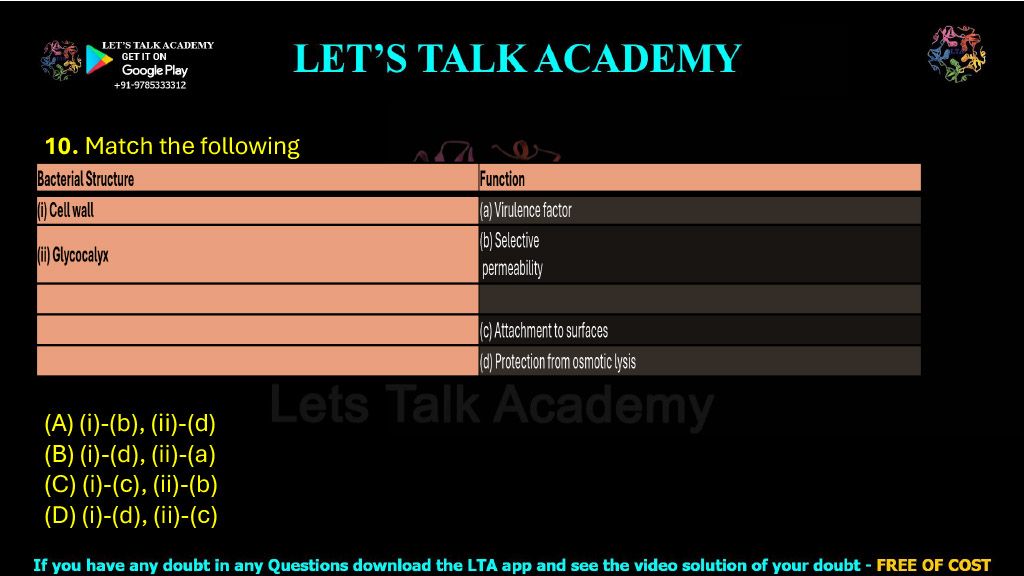
10. Match the following
| Bacterial Structure | Function |
| (i) Cell wall | (a) Virulence factor |
| (ii) Glycocalyx | (b) Selective
permeability |
| (c) Attachment to surfaces | |
| (d) Protection from osmotic lysis |
(A) (i)-(b), (ii)-(d)
(B) (i)-(d), (ii)-(a)
(C) (i)-(c), (ii)-(b)
(D) (i)-(d), (ii)-(c)
Bacterial Cell Wall and Glycocalyx Functions Explained
Introduction
The bacterial cell is composed of several structural components that work together to ensure survival, growth, protection, and successful colonization of different environments. Among these structures, the cell wall and the glycocalyx are particularly important because they provide mechanical protection and facilitate interactions with the external environment. Understanding their structure and function is fundamental in microbiology and is one of the most frequently tested topics in competitive examinations.
The bacterial cell wall is primarily responsible for maintaining cell shape and preventing osmotic rupture, while the glycocalyx, which may exist as a capsule or slime layer, protects bacteria from host immune defenses and promotes attachment to biological and non-biological surfaces. These structures play significant roles in bacterial pathogenicity, biofilm formation, antibiotic resistance, and environmental survival.
Correct Answer
Correct Option: (D)
(i) Cell wall → (d) Protection from osmotic lysis
(ii) Glycocalyx → (c) Attachment to surfaces
Detailed Explanation
The bacterial cell wall is composed mainly of peptidoglycan, a strong mesh-like polymer that surrounds the plasma membrane. One of its most important functions is protecting bacterial cells against osmotic lysis. Since bacterial cytoplasm contains a much higher solute concentration than the surrounding environment, water continuously enters the cell by osmosis. Without a rigid cell wall, this influx of water would cause the plasma membrane to burst. Therefore, the cell wall provides structural strength, maintains bacterial shape, and prevents osmotic rupture.
The glycocalyx is an extracellular layer composed primarily of polysaccharides or, in some species, polypeptides. It may exist as a well-organized capsule or a loosely attached slime layer. One of its principal functions is facilitating attachment to host tissues, medical devices, and environmental surfaces, enabling bacteria to establish colonies and form biofilms. Biofilms provide additional protection against antibiotics, disinfectants, and host immune responses.
Although the glycocalyx also acts as an important virulence factor by inhibiting phagocytosis and enhancing bacterial survival inside the host, the function listed in this matching question that best represents glycocalyx is attachment to surfaces. Therefore, the correct pairing is cell wall → protection from osmotic lysis and glycocalyx → attachment to surfaces.
Explanation of Each Match
(i) Cell Wall → Protection from Osmotic Lysis
This match is correct. The rigid peptidoglycan layer prevents bacterial cells from bursting when water enters by osmosis and helps maintain cell shape.
(ii) Glycocalyx → Attachment to Surfaces
This match is correct. The glycocalyx promotes adhesion to tissues, medical implants, teeth, and environmental surfaces, making it essential for colonization and biofilm formation.
Why Option (D) is Correct
Option (D) correctly identifies the primary functions of both structures.
| Bacterial Structure | Primary Function |
|---|---|
| Cell Wall | Protection from osmotic lysis |
| Glycocalyx | Attachment to surfaces |
Why the Other Options are Incorrect
Option (A)
This option is incorrect because selective permeability is a function of the plasma membrane, not the cell wall. The glycocalyx does not protect against osmotic lysis.
Option (B)
The first match is correct, but the glycocalyx is matched with “virulence factor.” Although glycocalyx contributes to virulence, the most appropriate functional match provided in this question is attachment to surfaces.
Option (C)
This option is incorrect because the cell wall is not primarily responsible for attachment, and selective permeability is performed by the cytoplasmic membrane.
Comparison of All Options
| Option | Matching | Status |
|---|---|---|
| A | Cell wall → Selective permeability; Glycocalyx → Osmotic protection | Incorrect |
| B | Cell wall → Osmotic protection; Glycocalyx → Virulence factor | Partially correct but not the best match |
| C | Cell wall → Attachment; Glycocalyx → Selective permeability | Incorrect |
| D | Cell wall → Osmotic protection; Glycocalyx → Attachment | Correct |
Functions of Major Bacterial Cell Structures
| Structure | Main Function |
|---|---|
| Cell Wall | Maintains shape and prevents osmotic lysis |
| Plasma Membrane | Selective permeability and transport |
| Glycocalyx | Attachment and biofilm formation |
| Flagella | Motility |
| Pili | Attachment and bacterial conjugation |
| Ribosomes | Protein synthesis |
Capsule vs Slime Layer
| Feature | Capsule | Slime Layer |
|---|---|---|
| Organization | Well organized | Loosely organized |
| Attachment | Firmly attached | Loosely attached |
| Main Function | Immune evasion | Surface attachment |
| Biofilm Formation | Yes | Yes |
Biological Significance
The bacterial cell wall and glycocalyx play complementary roles in ensuring bacterial survival. The cell wall provides mechanical strength, protects against osmotic stress, and serves as a target for antibiotics such as penicillin and vancomycin. The glycocalyx allows bacteria to adhere to host tissues, establish biofilms, resist phagocytosis, and survive in hostile environments. These structures are central to bacterial pathogenicity and are major targets for antimicrobial research and vaccine development.
Final Answer
Correct Option: (D)
(i) Cell wall → (d) Protection from osmotic lysis
(ii) Glycocalyx → (c) Attachment to surfaces
The cell wall maintains bacterial shape and prevents osmotic lysis, whereas the glycocalyx promotes bacterial adhesion to surfaces, facilitates biofilm formation, and contributes to successful colonization.


