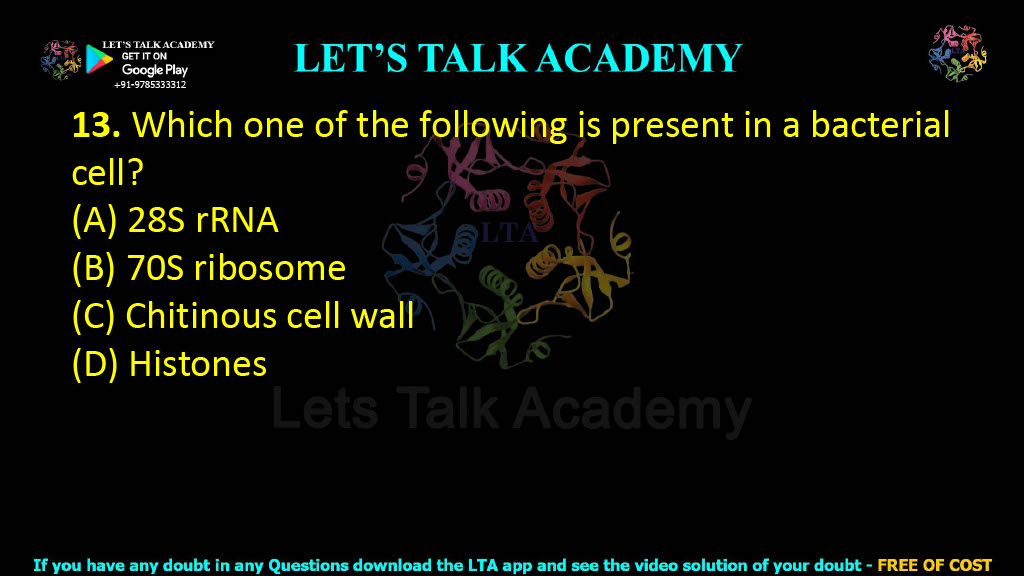
13. Which one of the following is present in a bacterial cell?
(A) 28S rRNA
(B) 70S ribosome
(C) Chitinous cell wall
(D) Histones
Bacterial Cell Structure: Presence of 70S Ribosomes
Introduction
Bacteria are prokaryotic organisms that possess a simple cellular organization compared to eukaryotic cells. Although they lack membrane-bound organelles such as the nucleus, mitochondria, Golgi apparatus, and endoplasmic reticulum, bacteria perform all essential life processes efficiently using specialized cellular components. One of the most characteristic features of bacterial cells is the presence of 70S ribosomes, which are responsible for protein synthesis. These ribosomes differ significantly from the 80S ribosomes found in the cytoplasm of eukaryotic cells, making them important targets for many antibiotics.
Correct Answer
Correct Option: (B) 70S Ribosome
Detailed Explanation
Bacterial cells belong to the domain Prokaryota and possess several structural characteristics that distinguish them from eukaryotic organisms. Their genetic material is organized within a nucleoid rather than a membrane-bound nucleus, and protein synthesis occurs on 70S ribosomes composed of a 50S large subunit and a 30S small subunit. These ribosomes contain 23S, 5S, and 16S ribosomal RNAs and numerous ribosomal proteins. Because bacterial ribosomes differ structurally from eukaryotic ribosomes, they serve as selective targets for antibiotics such as tetracycline, streptomycin, chloramphenicol, and erythromycin.
The remaining options describe structures that are characteristic of eukaryotic organisms or other kingdoms of life. Therefore, identifying the unique structural components of bacterial cells is essential for selecting the correct answer.
Explanation of Each Option
Option (A): 28S rRNA
This statement is incorrect. The 28S ribosomal RNA is a component of the 60S large subunit of eukaryotic 80S ribosomes. It is present in animals, plants, fungi, and other eukaryotic organisms. Bacterial ribosomes do not contain 28S rRNA. Instead, bacterial ribosomes possess 23S rRNA and 5S rRNA in the large subunit and 16S rRNA in the small subunit. Therefore, 28S rRNA is absent from bacterial cells.
Option (B): 70S Ribosome
This statement is correct. Protein synthesis in bacteria occurs on 70S ribosomes, which consist of a 50S large subunit and a 30S small subunit. The 50S subunit contains 23S and 5S rRNAs, whereas the 30S subunit contains 16S rRNA. These ribosomes translate messenger RNA into proteins required for growth, metabolism, and cell division. Because 70S ribosomes are a defining feature of prokaryotic cells, this option is correct.
Option (C): Chitinous Cell Wall
This statement is incorrect. Chitin is a structural polysaccharide found primarily in the cell walls of fungi and the exoskeletons of arthropods. Bacterial cell walls are composed mainly of peptidoglycan (murein), a complex polymer consisting of N-acetylglucosamine (NAG), N-acetylmuramic acid (NAM), and peptide cross-links. Therefore, bacterial cells do not possess chitinous cell walls.
Option (D): Histones
This statement is incorrect. Histone proteins are characteristic DNA-packaging proteins found in eukaryotic chromosomes. Most bacteria lack true histone proteins and instead organize their DNA using histone-like proteins such as HU, H-NS, IHF, and Fis. Although members of the domain Archaea possess histone-like proteins closely resembling eukaryotic histones, typical bacterial cells do not contain true histones.
Why Option (B) is Correct
All bacterial cells possess 70S ribosomes, which are responsible for protein synthesis. These ribosomes are structurally distinct from the 80S ribosomes of eukaryotic cells and represent one of the defining characteristics of prokaryotes. Since the remaining options describe structures absent from bacteria, Option (B) is the correct answer.
Why the Other Options are Incorrect
Why Option (A) is Incorrect
28S rRNA is a component of eukaryotic 80S ribosomes and is absent from bacterial ribosomes, which instead contain 23S, 16S, and 5S rRNAs.
Why Option (C) is Incorrect
Bacterial cell walls are composed of peptidoglycan rather than chitin. Chitin is characteristic of fungal cell walls and arthropod exoskeletons.
Why Option (D) is Incorrect
Typical bacteria lack true histone proteins. Instead, they use histone-like DNA-binding proteins to organize their chromosome within the nucleoid.
Comparison of All Options
| Option | Structure | Present in Bacteria? | Explanation |
|---|---|---|---|
| A | 28S rRNA | No | Found in the 60S subunit of eukaryotic ribosomes. |
| B | 70S Ribosome | Yes | Responsible for protein synthesis in bacteria. |
| C | Chitinous Cell Wall | No | Characteristic of fungi, not bacteria. |
| D | Histones | No | Typical bacteria lack true histone proteins. |
Comparison Between Prokaryotic and Eukaryotic Ribosomes
| Feature | Prokaryotic Ribosome | Eukaryotic Ribosome |
|---|---|---|
| Size | 70S | 80S |
| Large Subunit | 50S | 60S |
| Small Subunit | 30S | 40S |
| Large Subunit rRNA | 23S and 5S | 28S, 5.8S and 5S |
| Small Subunit rRNA | 16S | 18S |
| Location | Cytoplasm | Cytoplasm and Rough ER |
Comparison Between Bacterial and Fungal Cell Walls
| Feature | Bacteria | Fungi |
|---|---|---|
| Main Cell Wall Component | Peptidoglycan | Chitin |
| Major Sugar Units | NAG and NAM | N-acetylglucosamine |
| Cross-Linking | Peptide Bridges | Glucans and Glycoproteins |
Biological Significance of 70S Ribosomes
The structural differences between bacterial 70S ribosomes and eukaryotic 80S ribosomes provide an important basis for selective antibiotic action. Many antibacterial drugs specifically target bacterial ribosomes without significantly affecting eukaryotic cytoplasmic ribosomes, thereby inhibiting bacterial protein synthesis while minimizing toxicity to host cells. This difference is one of the fundamental principles underlying modern antimicrobial therapy.
Final Answer
Correct Option: (B) 70S Ribosome
Bacterial cells contain 70S ribosomes composed of 50S and 30S subunits, which carry out protein synthesis. They do not possess 28S rRNA, chitinous cell walls, or true histone proteins. Instead, bacteria contain peptidoglycan cell walls and histone-like DNA-binding proteins that organize the bacterial chromosome.


