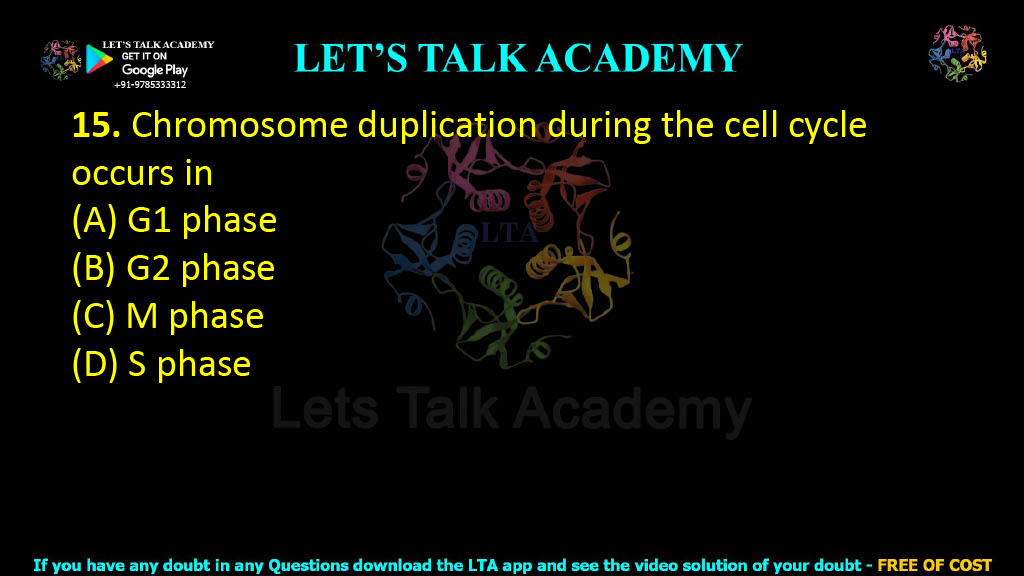
15. Chromosome duplication during the cell cycle occurs in
(A) G1 phase
(B) G2 phase
(C) M phase
(D) S phase
Chromosome Duplication During the Cell Cycle: S Phase
Introduction
The cell cycle is a highly regulated sequence of events that allows cells to grow, duplicate their genetic material, and divide into two genetically identical daughter cells. Proper chromosome duplication is essential because every daughter cell must inherit an exact copy of the genome. To achieve this, DNA replication occurs only once during each cell cycle under strict regulatory control. Any error in chromosome duplication can result in mutations, chromosomal abnormalities, genomic instability, or diseases such as cancer.
Correct Answer
Correct Option: (D) S Phase
Detailed Explanation
The S phase (Synthesis phase) is the stage of interphase during which every chromosome duplicates its DNA. DNA polymerases synthesize an identical copy of each DNA molecule so that every chromosome consists of two genetically identical sister chromatids joined together at the centromere. Although the amount of DNA in the cell doubles during this phase, the chromosome number remains unchanged because each duplicated chromosome is still counted as one chromosome until sister chromatids separate during anaphase of mitosis.
DNA replication begins simultaneously at multiple origins of replication throughout the genome, ensuring efficient duplication of the entire chromosome complement. By the end of the S phase, every chromosome has been completely replicated, preparing the cell for chromosome segregation during mitosis.
Explanation of Each Option
Option (A): G1 Phase
This statement is incorrect. The G1 (Gap 1) phase is primarily a period of cellular growth and metabolic activity. During this stage, the cell synthesizes proteins, RNA molecules, enzymes, nucleotides, and other components required for DNA replication. The G1 checkpoint also evaluates nutrient availability, growth factors, cell size, and DNA integrity before allowing the cell to enter the S phase. However, chromosome duplication does not occur during G1.
Option (B): G2 Phase
This statement is incorrect. The G2 (Gap 2) phase follows DNA replication and serves as a preparation period for mitosis. During G2, the cell synthesizes proteins required for chromosome condensation, spindle formation, and mitotic progression. The G2 checkpoint verifies that DNA replication has been completed accurately and checks for remaining DNA damage. Since chromosome duplication has already been completed during the S phase, it does not occur in G2.
Option (C): M Phase
This statement is incorrect. The M phase includes mitosis and cytokinesis. During mitosis, duplicated chromosomes condense, align at the metaphase plate, separate into daughter chromosomes during anaphase, and are distributed equally between two daughter cells. The M phase is responsible for chromosome segregation rather than chromosome duplication. Therefore, DNA replication does not occur during mitosis.
Option (D): S Phase
This statement is correct. The S (Synthesis) phase is the only phase of the cell cycle in which DNA replication occurs. During this stage, every chromosome duplicates to form two identical sister chromatids connected at the centromere. Histone proteins are synthesized simultaneously to package newly replicated DNA into chromatin. Completion of the S phase ensures that each daughter cell will receive a complete genome during mitosis.
Why Option (D) is Correct
The S phase is specifically dedicated to DNA synthesis and chromosome duplication. Every chromosome replicates exactly once during this phase, producing two genetically identical sister chromatids. These sister chromatids remain attached until anaphase, when they separate into daughter chromosomes. Since no other phase carries out DNA replication, the S phase is the correct answer.
Why the Other Options are Incorrect
Why Option (A) is Incorrect
The G1 phase prepares the cell for DNA replication by promoting growth and synthesizing proteins, but chromosome duplication has not yet begun.
Why Option (B) is Incorrect
The G2 phase occurs after DNA replication is complete. Its primary function is to verify successful replication and prepare the cell for mitosis.
Why Option (C) is Incorrect
The M phase distributes already duplicated chromosomes into daughter cells. It does not involve DNA synthesis or chromosome duplication.
Comparison of All Options
| Option | Cell Cycle Phase | Chromosome Duplication Occurs? | Main Function |
|---|---|---|---|
| A | G1 Phase | No | Cell growth and preparation for DNA replication |
| B | G2 Phase | No | Preparation for mitosis and DNA damage checkpoint |
| C | M Phase | No | Chromosome segregation and cell division |
| D | S Phase | Yes | DNA replication and sister chromatid formation |
Overview of the Eukaryotic Cell Cycle
| Cell Cycle Phase | Major Events |
|---|---|
| G1 Phase | Cell growth, RNA synthesis, protein synthesis, checkpoint regulation |
| S Phase | DNA replication, chromosome duplication, histone synthesis |
| G2 Phase | Preparation for mitosis, spindle protein synthesis, DNA repair |
| M Phase | Mitosis and cytokinesis leading to daughter cell formation |
Biological Significance of the S Phase
The S phase is essential for maintaining genetic continuity between generations of cells. Accurate DNA replication ensures that each daughter cell inherits an identical copy of the genome. During this phase, sophisticated proofreading mechanisms associated with DNA polymerases minimize replication errors, while checkpoint proteins monitor replication fidelity and repair damaged DNA before cell division proceeds. Failure of these regulatory mechanisms can lead to mutations, chromosomal instability, developmental abnormalities, and cancer.
Final Answer
Correct Option: (D) S Phase
Chromosome duplication occurs during the S (Synthesis) phase of the cell cycle, where DNA replication produces two genetically identical sister chromatids for every chromosome. These duplicated chromosomes remain joined until mitosis, ensuring that each daughter cell receives a complete and identical set of genetic information.


