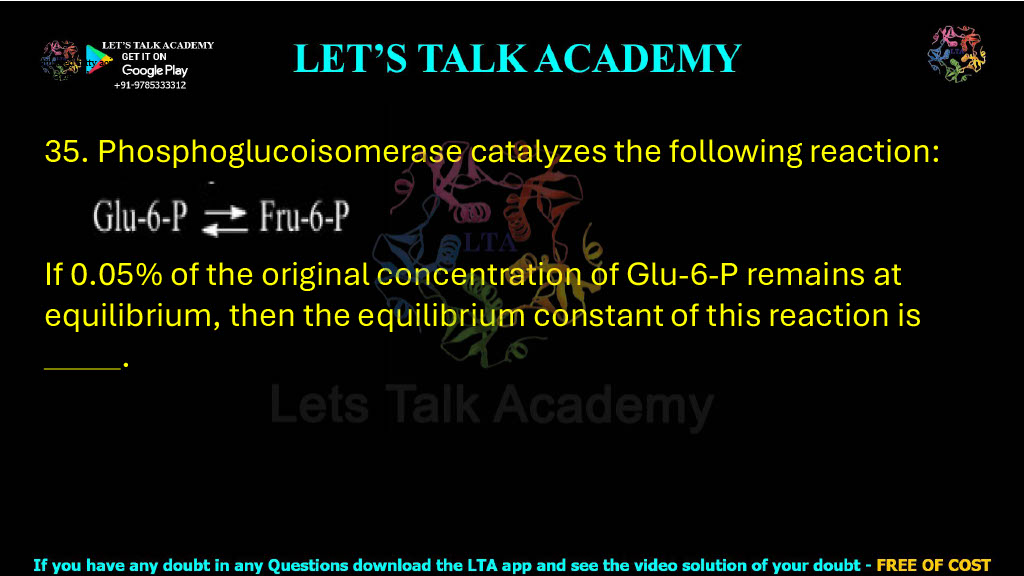
35. Phosphoglucoisomerase catalyzes the following reaction:
If 0.05% of the original concentration of Glu-6-P remains at equilibrium, then the equilibrium constant of this reaction is .
Equilibrium Constant of the Phosphoglucose Isomerase Reaction
Correct Answer
Keq = 1999 (≈ 2.0 × 10³)
Introduction
Chemical reactions occurring inside living cells are reversible, meaning they can proceed in both the forward and reverse directions until equilibrium is established. At equilibrium, the forward and reverse reaction rates become equal, although the concentrations of reactants and products may differ significantly. The relationship between these concentrations is described by the equilibrium constant (Keq), which provides valuable information about the direction in which a reaction is thermodynamically favored.
One of the important reversible reactions in glycolysis is catalyzed by the enzyme phosphoglucose isomerase, which converts glucose-6-phosphate (G6P) into fructose-6-phosphate (F6P). Although this reaction is reversible, the equilibrium position depends on the relative concentrations of the two metabolites.
Understanding the Concept Behind the Question
The reaction is:
Glucose-6-phosphate ⇌ Fructose-6-phosphate
The equilibrium constant is defined as:
Keq = [Fructose-6-phosphate] / [Glucose-6-phosphate]
The question states that:
Only 0.05% of the original glucose-6-phosphate remains at equilibrium.
This means that:
- Remaining glucose-6-phosphate = 0.05%
- Converted into fructose-6-phosphate = 99.95%
For simplicity, assume the initial concentration of glucose-6-phosphate is 100 units.
Then:
- Initial G6P = 100
- Remaining G6P = 0.05
- F6P formed = 99.95
Now substitute these values into the equilibrium equation.
Step-by-Step Solution
Step 1. Write the equilibrium expression
Keq = [F6P] / [G6P]
Step 2. Assume the initial concentration
Assume:
Initial G6P = 100 units
Step 3. Determine equilibrium concentrations
Since only 0.05% remains,
Remaining G6P = 0.05 units
Therefore,
F6P formed = 100 − 0.05
= 99.95 units
Step 4. Substitute into the equation
Keq = 99.95 / 0.05
Step 5. Calculate
Keq = 1999
or approximately
Keq ≈ 2.0 × 10³
Final Answer
Keq = 1999 (approximately 2000)
Why Is the Equilibrium Constant So Large?
An equilibrium constant much greater than 1 indicates that the reaction strongly favors product formation.
In this case,
- Nearly all glucose-6-phosphate has been converted into fructose-6-phosphate.
- Only 0.05% of the reactant remains.
Therefore,
Keq >> 1
This means equilibrium lies predominantly toward the product side.
Biological Importance of Phosphoglucose Isomerase
Phosphoglucose isomerase catalyzes the second step of glycolysis, converting glucose-6-phosphate into fructose-6-phosphate through an aldose-ketose isomerization.
This conversion is essential because fructose-6-phosphate is the substrate for phosphofructokinase-1 (PFK-1), the major regulatory enzyme of glycolysis. Without this isomerization step, glucose metabolism could not proceed efficiently toward ATP production.
The enzyme also functions in gluconeogenesis, where the reverse reaction converts fructose-6-phosphate back into glucose-6-phosphate.
Equilibrium Constant Interpretation
| Keq Value | Meaning |
|---|---|
| Keq > 1 | Products favored |
| Keq = 1 | Equal reactants and products |
| Keq < 1 | Reactants favored |
Since
Keq ≈ 2000
the equilibrium overwhelmingly favors fructose-6-phosphate.
High-Yield Points
-
Enzyme:
Phosphoglucose Isomerase
-
Reaction:
Glucose-6-phosphate ⇌ Fructose-6-phosphate
-
Equilibrium expression:
Keq = [F6P] / [G6P]
-
If product predominates,
Keq > 1
- Large Keq indicates reaction favors products.
Frequently Asked Questions
Why can we assume an initial concentration of 100?
Because only percentages are given. Assuming 100 units makes the calculation simple without affecting the final ratio.
Why is Keq so large?
Only 0.05% of glucose-6-phosphate remains, meaning almost all reactant has been converted into product. Therefore, the product-to-reactant ratio is extremely high.
Does a large Keq mean the reaction is irreversible?
No. The reaction remains reversible, but equilibrium strongly favors product formation under the stated conditions.
Key Takeaways
The equilibrium constant describes the ratio of product to reactant concentrations once equilibrium has been reached. For the phosphoglucose isomerase reaction, if only 0.05% of the original glucose-6-phosphate remains, then 99.95% has been converted into fructose-6-phosphate. Using the equilibrium expression Keq = [F6P]/[G6P], the equilibrium constant becomes 99.95/0.05 = 1999, indicating that equilibrium strongly favors product formation. Mastering percentage-based equilibrium calculations is essential for solving numerical questions in competitive biochemistry examinations.
Final Answer
Correct Answer: Keq = 1999 (≈ 2.0 × 10³)
Explanation
The equilibrium constant for the reaction is:
Keq = [Fructose-6-phosphate] / [Glucose-6-phosphate]
Assuming the initial concentration of glucose-6-phosphate is 100 units, only 0.05 units (0.05%) remain at equilibrium. Therefore, 99.95 units are converted into fructose-6-phosphate.
Substituting into the equilibrium equation:
Keq = 99.95 / 0.05
= 1999
≈ 2.0 × 10³
Thus, the equilibrium constant for the phosphoglucose isomerase reaction is 1999 (approximately 2000).


