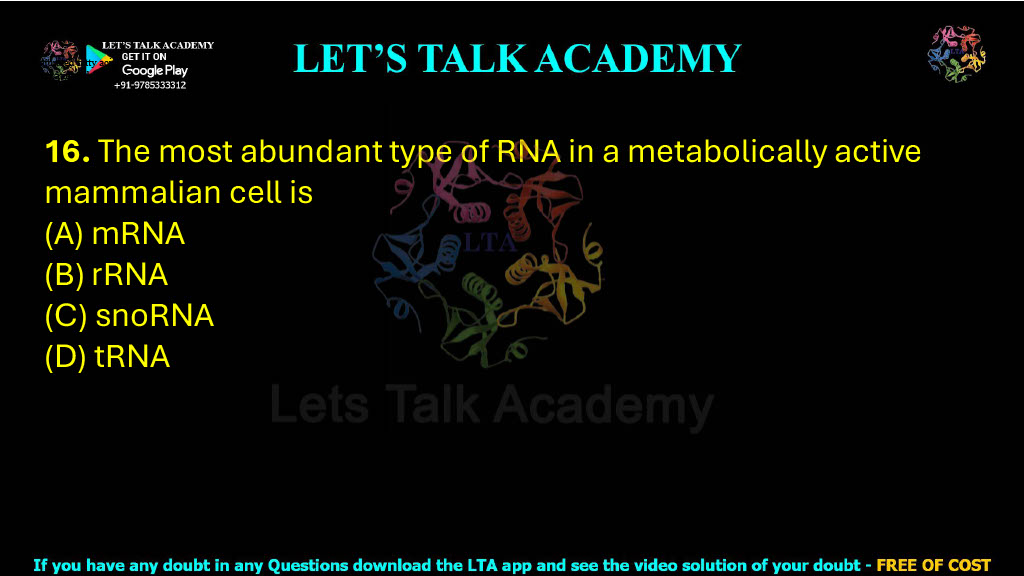
16. The most abundant type of RNA in a metabolically active mammalian cell is
(A) mRNA
(B) rRNA
(C) snoRNA
(D) tRNA
The Most Abundant RNA in a Metabolically Active Mammalian Cell
Correct Answer
(B) rRNA (Ribosomal RNA)
Introduction
RNA (Ribonucleic Acid) is one of the most essential biomolecules in living cells because it acts as the intermediary between genetic information and protein synthesis. Unlike DNA, which primarily stores genetic information, RNA performs a wide variety of structural, catalytic, and regulatory functions. A metabolically active mammalian cell continuously synthesizes proteins required for growth, repair, enzyme production, hormone synthesis, and cellular metabolism. Consequently, the demand for ribosomes is extremely high, making ribosomal RNA (rRNA) the most abundant RNA species present in such cells.
Questions regarding the abundance and functions of different RNA molecules are among the most frequently asked topics in CSIR NET Life Sciences, GATE Biotechnology, IIT JAM, CUET PG, NEET PG, and university examinations. Many students assume that messenger RNA (mRNA) is the most abundant because it carries genetic information for protein synthesis. However, in reality, mRNA represents only a small fraction of total cellular RNA. Understanding the relative abundance of different RNA classes and their biological roles is essential for answering such questions accurately.
Understanding the Different Types of RNA
Cells contain several classes of RNA, each performing a distinct biological function. The four major RNA types commonly discussed in molecular biology are ribosomal RNA (rRNA), messenger RNA (mRNA), transfer RNA (tRNA), and small nucleolar RNA (snoRNA).
Among these molecules, rRNA forms the structural and catalytic core of ribosomes, the cellular machinery responsible for protein synthesis. Since metabolically active cells require a large number of ribosomes to produce proteins continuously, rRNA accounts for the majority of total cellular RNA.
In mammalian cells, the approximate distribution of RNA is:
- rRNA: 80–85%
- tRNA: 10–15%
- mRNA: 1–5%
- Other small RNAs (including snoRNA): Less than 1%
This distribution clearly demonstrates why rRNA is the most abundant RNA species.
Why Option (A) Is Incorrect
Messenger RNA (mRNA)
Messenger RNA serves as the temporary copy of genetic information transcribed from DNA. Its primary function is to carry the genetic code from the nucleus to ribosomes, where proteins are synthesized. Although mRNA is indispensable for gene expression, it is surprisingly scarce within the cell.
The relatively low abundance of mRNA is due to its short half-life. Most mRNA molecules are rapidly degraded after translation so that cells can quickly adjust protein production in response to changing physiological conditions. Even in highly active cells, mRNA constitutes only about 1–5% of total cellular RNA.
Therefore, despite its central role in protein synthesis, mRNA is not the most abundant RNA.
Hence, Option (A) is incorrect.
Why Option (B) Is Correct
Ribosomal RNA (rRNA)
Ribosomal RNA is the most abundant RNA present in metabolically active mammalian cells because it forms the structural framework of ribosomes. Every ribosome contains multiple rRNA molecules that not only provide structural stability but also catalyze peptide bond formation during protein synthesis. In fact, the ribosome functions as a ribozyme, meaning that the catalytic activity responsible for peptide bond formation is carried out by rRNA rather than protein.
Metabolically active cells require thousands to millions of ribosomes to sustain continuous protein synthesis. As a result, cells synthesize enormous quantities of rRNA, which typically account for approximately 80–85% of the total RNA. Examples of mammalian rRNAs include 28S, 18S, 5.8S, and 5S rRNA, all of which participate in ribosome assembly and function.
Because of its overwhelming abundance and indispensable role in translation, rRNA is correctly identified as the most abundant RNA in metabolically active mammalian cells.
Therefore, Option (B) is the correct answer.
Why Option (C) Is Incorrect
Small Nucleolar RNA (snoRNA)
Small nucleolar RNAs are specialized non-coding RNA molecules primarily located within the nucleolus. Their main function is to guide the chemical modification and processing of ribosomal RNA precursors. They direct methylation, pseudouridylation, and cleavage events that are essential for producing mature rRNA molecules.
Although snoRNAs play a crucial role in ribosome biogenesis, they are present in very small quantities compared with ribosomal RNA. Their function is regulatory rather than structural, meaning that only limited numbers of snoRNA molecules are required to modify large numbers of rRNA transcripts.
Consequently, snoRNA is one of the least abundant RNA classes in mammalian cells and cannot be considered the most abundant RNA.
Hence, Option (C) is incorrect.
Why Option (D) Is Incorrect
Transfer RNA (tRNA)
Transfer RNA acts as the molecular adaptor during translation by carrying specific amino acids to the ribosome according to the codons present on messenger RNA. Each tRNA recognizes a particular codon through its anticodon loop, ensuring the correct incorporation of amino acids into the growing polypeptide chain.
Although tRNA is more abundant than mRNA, it still represents only 10–15% of the total cellular RNA. Cells require many tRNA molecules because each amino acid has one or more corresponding tRNAs, but the total amount remains much lower than that of ribosomal RNA.
Therefore, despite its essential role in protein synthesis, tRNA is not the most abundant RNA species.
Hence, Option (D) is incorrect.
Relative Abundance of Different RNA Types
| RNA Type | Approximate Percentage | Primary Function |
|---|---|---|
| rRNA | 80–85% | Structural and catalytic component of ribosomes |
| tRNA | 10–15% | Transfers amino acids during protein synthesis |
| mRNA | 1–5% | Carries genetic information from DNA to ribosomes |
| snoRNA | <1% | Processing and modification of rRNA |
Biological Importance of rRNA
Ribosomal RNA is indispensable for life because it forms the core of every ribosome, the molecular machine responsible for translating genetic information into proteins. Without rRNA, ribosomes could neither assemble correctly nor catalyze peptide bond formation. The catalytic activity of the ribosome resides in the large-subunit rRNA, demonstrating that RNA itself can function as an enzyme.
In metabolically active tissues such as the liver, pancreas, rapidly dividing embryonic cells, and certain immune cells, protein synthesis occurs at exceptionally high rates. These cells contain large numbers of ribosomes and therefore synthesize massive quantities of rRNA to meet their metabolic demands. This explains why rRNA is consistently the most abundant RNA species in actively growing cells.
Clinical Significance
The synthesis of rRNA is closely linked to cellular growth and proliferation. Rapidly dividing cells, including many cancer cells, exhibit increased nucleolar activity because they require continuous production of ribosomes. Consequently, enlarged nucleoli are often considered a hallmark of malignant cells in histopathology.
Several antibiotics also target bacterial ribosomal RNA rather than proteins. Drugs such as chloramphenicol, erythromycin, tetracycline, and aminoglycosides interfere with bacterial ribosome function by binding to specific regions of rRNA, thereby inhibiting protein synthesis. Since bacterial and mammalian ribosomes differ structurally, these antibiotics selectively affect microorganisms.
Common Mistakes in Competitive Examinations
One of the most common misconceptions is assuming that messenger RNA is the most abundant because it carries genetic information from DNA. In reality, mRNA is highly unstable and undergoes rapid degradation, making it one of the least abundant RNA species.
Another mistake is confusing abundance with functional importance. Although mRNA, tRNA, and snoRNA are all essential for gene expression, abundance depends on how many molecules the cell requires. Because every ribosome contains multiple rRNA molecules and cells possess millions of ribosomes, rRNA naturally becomes the dominant RNA species.
Students also tend to overlook the catalytic role of rRNA. The ribosome is not merely a structural complex; its catalytic activity is performed by rRNA itself, making it one of the best-known examples of a naturally occurring ribozyme.
High-Yield Exam Points
- rRNA constitutes approximately 80–85% of total cellular RNA.
- tRNA accounts for about 10–15% of total RNA.
- mRNA represents only 1–5% of total RNA.
- snoRNA is involved in rRNA processing and modification.
- rRNA forms the structural and catalytic core of ribosomes.
- The ribosome functions as a ribozyme because peptide bond formation is catalyzed by rRNA.
Frequently Asked Questions
Why is rRNA the most abundant RNA?
Every ribosome contains multiple rRNA molecules, and metabolically active cells require thousands to millions of ribosomes for continuous protein synthesis. Consequently, rRNA accounts for the majority of total cellular RNA.
Is mRNA more important than rRNA?
Both are essential but serve different functions. mRNA carries genetic information, whereas rRNA forms the ribosome and catalyzes peptide bond formation. In terms of abundance, rRNA greatly exceeds mRNA.
What is the function of snoRNA?
snoRNA participates in the processing, cleavage, and chemical modification of precursor rRNA molecules within the nucleolus.
Key Takeaways
Ribosomal RNA (rRNA) is the most abundant RNA in metabolically active mammalian cells because it forms both the structural framework and catalytic center of ribosomes. Approximately 80–85% of total cellular RNA consists of rRNA, reflecting the enormous demand for protein synthesis in active cells. In contrast, tRNA contributes about 10–15%, mRNA accounts for only 1–5%, and snoRNA is present in very small amounts primarily to facilitate rRNA processing. Understanding these relative abundances and their biological significance is essential for mastering molecular biology and solving competitive examination questions.
Final Answer
Correct Option: (B) Ribosomal RNA (rRNA)
Explanation
Ribosomal RNA (rRNA) is the most abundant RNA species in metabolically active mammalian cells because it forms the structural and catalytic core of ribosomes, which are required in large numbers for continuous protein synthesis. Approximately 80–85% of total cellular RNA is rRNA, whereas tRNA constitutes about 10–15%, mRNA only 1–5%, and snoRNA is present in very small quantities for rRNA processing. Therefore, the correct answer is Option (B) – rRNA.


