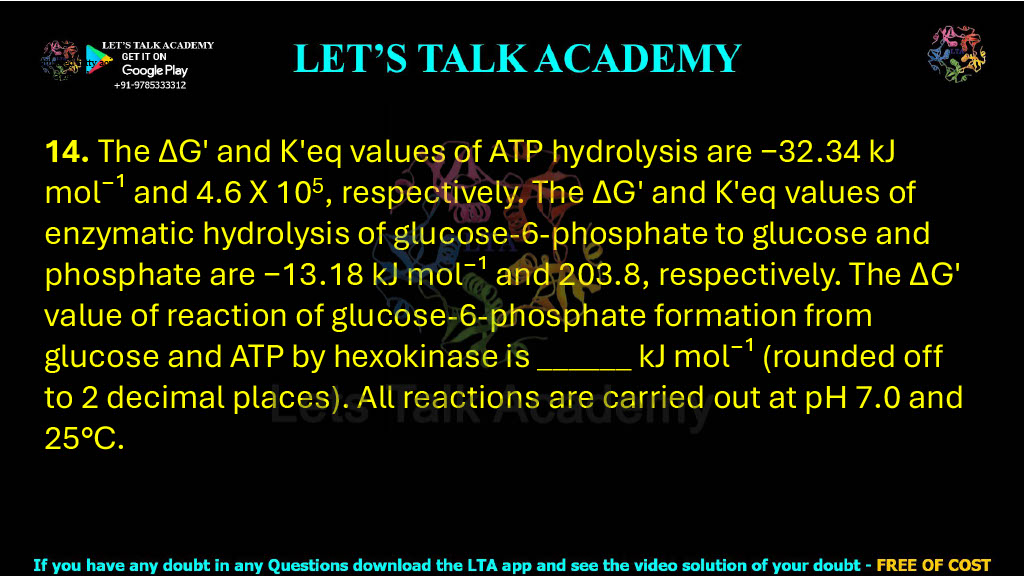
14. The ΔG′ and K′eq values of ATP hydrolysis are −32.34 kJ mol⁻¹ and 4.6 X 10⁵, respectively. The ΔG′ and K′eq values of enzymatic hydrolysis of glucose-6-phosphate to glucose and phosphate are −13.18 kJ mol⁻¹ and 203.8, respectively. The ΔG′ value of reaction of glucose-6-phosphate formation from glucose and ATP by hexokinase is ______ kJ mol⁻¹ (rounded off to 2 decimal places). All reactions are carried out at pH 7.0 and 25°C.
ΔG′ of Glucose-6-Phosphate Formation from Glucose and ATP by Hexokinase
Correct Answer
ΔG′ = −19.16 kJ mol⁻¹
Introduction
Thermodynamics is one of the most important topics in biochemistry because it explains whether a biochemical reaction can occur spontaneously under physiological conditions. Living cells rarely rely on a single reaction to perform biological work. Instead, they combine or couple reactions so that an energetically unfavorable reaction becomes favorable through the energy released by another reaction. One of the best-known examples of this principle is the phosphorylation of glucose by the enzyme hexokinase, which represents the first committed step of glycolysis.
In this reaction, the direct phosphorylation of glucose by inorganic phosphate is not energetically favorable. However, cells overcome this problem by coupling glucose phosphorylation with the highly exergonic hydrolysis of ATP. The overall free energy change of the coupled reaction is obtained by applying Hess’s Law, which states that the free energy changes of individual reactions can be added algebraically to obtain the free energy change of the overall reaction. Questions based on this principle are frequently asked in CSIR NET Life Sciences, GATE Biotechnology, IIT JAM, CUET PG, NEET PG, and university entrance examinations.
Understanding the Concept Behind the Question
The reaction catalyzed by hexokinase is:
Glucose + ATP → Glucose-6-phosphate + ADP
This reaction is not measured directly in the question. Instead, the standard free energy changes of two related reactions are provided. The first is the hydrolysis of ATP, while the second is the hydrolysis of glucose-6-phosphate. By reversing one reaction and adding it to the other, the overall free energy change can be calculated using Hess’s Law.
The key concept to remember is that when a reaction is reversed, the sign of ΔG′ also reverses. Therefore, careful attention must be paid to the direction of each reaction before performing the calculation.
Step 1: Write the Given Reactions
ATP Hydrolysis
ATP + H₂O → ADP + Pi
ΔG′ = −32.34 kJ mol⁻¹
Glucose-6-Phosphate Hydrolysis
Glucose-6-phosphate + H₂O → Glucose + Pi
ΔG′ = −13.18 kJ mol⁻¹
Step 2: Reverse the Second Reaction
The required reaction is the formation of glucose-6-phosphate.
Therefore, reverse the second reaction:
Glucose + Pi → Glucose-6-phosphate + H₂O
When a reaction is reversed,
ΔG′ changes its sign.
Therefore,
ΔG′ = +13.18 kJ mol⁻¹
Step 3: Add the Two Reactions
Now combine:
ATP + H₂O → ADP + Pi
ΔG′ = −32.34 kJ mol⁻¹
Glucose + Pi → Glucose-6-phosphate + H₂O
ΔG′ = +13.18 kJ mol⁻¹
Cancel the common species:
- Pi cancels.
- H₂O cancels.
The overall reaction becomes:
Glucose + ATP → Glucose-6-phosphate + ADP
This is exactly the reaction catalyzed by hexokinase.
Step 4: Calculate the Overall ΔG′
According to Hess’s Law,
Overall ΔG′ = ΔG′₁ + ΔG′₂
Substitute the values:
ΔG′ = (−32.34) + (+13.18)
ΔG′ = −19.16 kJ mol⁻¹
Final Answer
ΔG′ = −19.16 kJ mol⁻¹
Why Is the Overall ΔG′ Negative?
The hydrolysis of ATP releases a large amount of free energy (−32.34 kJ mol⁻¹). In contrast, the synthesis of glucose-6-phosphate from glucose and inorganic phosphate requires energy (+13.18 kJ mol⁻¹). When these two reactions are coupled, the energy released by ATP hydrolysis is greater than the energy required for glucose phosphorylation.
As a result, the overall reaction has a negative free energy change, indicating that it is thermodynamically favorable under standard biochemical conditions. This is why ATP serves as the universal energy currency of the cell, driving numerous biosynthetic and metabolic reactions.
Biological Significance of the Hexokinase Reaction
The phosphorylation of glucose by hexokinase is the first irreversible step of glycolysis and plays a critical role in cellular metabolism. By converting glucose into glucose-6-phosphate, the cell effectively traps glucose inside the cytoplasm because glucose-6-phosphate cannot freely cross the plasma membrane through glucose transporters.
This reaction also commits glucose to intracellular metabolic pathways such as glycolysis, glycogen synthesis, and the pentose phosphate pathway. The coupling of ATP hydrolysis with glucose phosphorylation ensures that the reaction proceeds efficiently despite the unfavorable energetics of phosphate transfer from inorganic phosphate alone.
Understanding Hess’s Law in Biochemistry
Hess’s Law states that the total free energy change of a reaction depends only on the initial and final states, regardless of the pathway taken. Therefore, if a reaction is carried out in multiple steps, the overall ΔG′ is simply the algebraic sum of the ΔG′ values of each individual step.
This principle is extensively used in biochemistry to determine the energetics of coupled reactions. Whenever ATP hydrolysis is linked to another reaction, the individual ΔG′ values can be added after ensuring that all reactions are written in the correct direction.
Common Mistakes in Competitive Examinations
One of the most common mistakes is forgetting to reverse the sign of ΔG′ when reversing the glucose-6-phosphate hydrolysis reaction. Many students incorrectly add −32.34 and −13.18, obtaining an incorrect value of −45.52 kJ mol⁻¹.
Another frequent error is failing to cancel common reactants and products after adding the reactions. Hess’s Law requires the cancellation of species that appear on both sides of the combined equation to obtain the correct net reaction.
Some students also attempt to calculate the answer using equilibrium constants (K′eq). Although this approach is theoretically correct, the problem already provides ΔG′ values, making direct addition the simplest and fastest method.
High-Yield Points
-
ATP hydrolysis:
ΔG′ = −32.34 kJ mol⁻¹
-
Glucose-6-phosphate hydrolysis:
ΔG′ = −13.18 kJ mol⁻¹
- Reverse reaction → Change the sign of ΔG′
- Overall ΔG′ is obtained by adding individual ΔG′ values
-
Hexokinase catalyzes:
Glucose + ATP → Glucose-6-phosphate + ADP
-
Final ΔG′:
−19.16 kJ mol⁻¹
Frequently Asked Questions
Why is ATP hydrolysis coupled with glucose phosphorylation?
Direct phosphorylation of glucose by inorganic phosphate is thermodynamically unfavorable. Coupling it with ATP hydrolysis supplies sufficient free energy to make the overall reaction spontaneous.
Why does the sign of ΔG′ change when reversing a reaction?
The free energy change depends on the direction of the reaction. Reversing the reaction changes products into reactants, so the sign of ΔG′ must also reverse.
Can the equilibrium constants be used to solve this problem?
Yes. Since ΔG′ = −RT ln K′eq, the equilibrium constants can be combined to determine the overall ΔG′. However, because the ΔG′ values are already provided, using Hess’s Law is much faster and simpler.
Key Takeaways
The hexokinase reaction demonstrates one of the most important principles of biochemical thermodynamics: energy coupling. ATP hydrolysis releases −32.34 kJ mol⁻¹, while the reverse of glucose-6-phosphate hydrolysis requires +13.18 kJ mol⁻¹. Applying Hess’s Law and adding these free energy changes gives an overall ΔG′ of −19.16 kJ mol⁻¹, indicating that the phosphorylation of glucose by ATP is thermodynamically favorable. This concept forms the basis of ATP-dependent reactions throughout metabolism and is a recurring topic in competitive examinations.
Final Answer
Correct Answer: ΔG′ = −19.16 kJ mol⁻¹
Explanation
The reaction catalyzed by hexokinase is obtained by combining ATP hydrolysis with the reverse of glucose-6-phosphate hydrolysis. Since reversing a reaction changes the sign of its free energy change, the ΔG′ for glucose-6-phosphate formation becomes +13.18 kJ mol⁻¹. Applying Hess’s Law, the overall free energy change is calculated as:
ΔG′ = (−32.34) + (+13.18) = −19.16 kJ mol⁻¹
The negative value indicates that ATP hydrolysis provides sufficient energy to drive the phosphorylation of glucose, making the overall reaction spontaneous under standard biochemical conditions.


