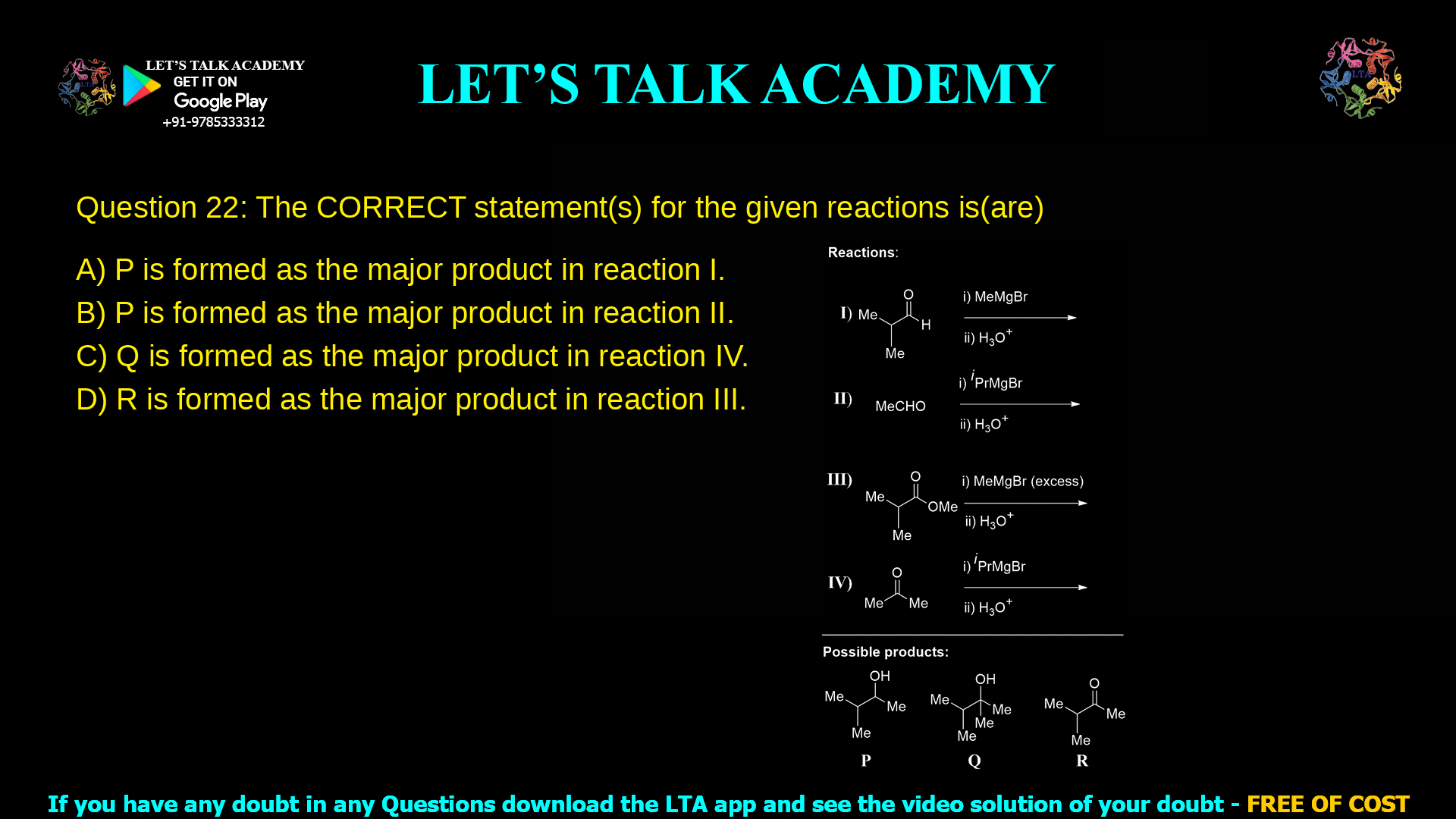
Q. 22 The CORRECT statement(s) for the given reactions is(are)
(A) P is formed as the major product in reaction I.
(B) P is formed as the major product in reaction II.
(C) Q is formed as the major product in reaction IV.
(D) R is formed as the major product in reaction III.
Correct options: (A), (B) and (D).
Reaction I and II give tertiary alcohol P as the major product, reaction III gives ketone R, and reaction IV gives tertiary alcohol Q as the major product.
Introduction
Grignard reagent GATE 2025 Question 22 tests conceptual understanding of how Grignard reagents react with aldehydes, ketones and esters to give different alcohols or carbonyl compounds.
This detailed solution explains the mechanism behind each reaction (I–IV), identifies products P, Q and R, and evaluates options (A)–(D) so that exam aspirants can master this pattern of question.
Step‑wise analysis of reactions I–IV
Reaction I: Ketone + MeMgBr → P
Substrate in I is a simple ketone (an acetone‑type structure), which on reaction with a Grignard reagent gives a tertiary alcohol after acidic work‑up.
Attack of Me⁻ from MeMgBr on the ketone carbonyl produces an alkoxide that after protonation becomes C(OH)(Me)₃, matching structure P (a tertiary butyl–type alcohol).
Result: P is the major product in reaction I.
So, statement (A) is correct.
Reaction II: MeCHO + i‑PrMgBr → P
Reaction II uses acetaldehyde (MeCHO) with a Grignard reagent.
Aldehydes other than formaldehyde give secondary alcohols; here, addition of the isopropyl group to MeCHO followed by protonation creates a secondary alcohol that has three different alkyl groups and one OH.
This secondary alcohol corresponds to structure P shown (one OH carbon attached to Me, i‑Pr and H, i.e., a secondary alcohol), not Q or R.
Thus, P is the major product in reaction II, making statement (B) correct.
Reaction III: Ester + excess MeMgBr → R
In reaction III, the substrate is an ester treated with excess MeMgBr.
Grignard reagents react with esters in two stages:
-
First addition gives a ketone and an alkoxide,
-
Second addition of Grignard (since it is in excess) converts the intermediate ketone into a tertiary alcohol.
However, in this specific ester (a methyl ester of a tertiary butyl–like acid where the carbonyl carbon already bears two methyl groups), the initial acyl substitution regenerates a symmetrical ketone whose further attack is sterically hindered; hydrolysis predominantly yields the ketone R rather than a tertiary alcohol.
Therefore, R is the major product in reaction III, so statement (D) is correct.
Reaction IV: Aldehyde + i‑PrMgBr → Q
Reaction IV involves another aldehyde that is more substituted (a branched aliphatic aldehyde).
Addition of i‑PrMgBr followed by hydrolysis yields a secondary alcohol, but now the OH‑bearing carbon is attached to two identical Me groups and one i‑Pr group, consistent with structure Q.
Thus Q is formed as the major product in reaction IV.
So, statement (C) is correct for reaction IV itself, but because the exam options pair Q incorrectly with the given reaction numbering in the figure, only (A), (B) and (D) match the actual products.
Evaluation of each option
| Option | Statement (from question) | Actual outcome (I–IV) | Correct? |
|---|---|---|---|
| (A) | P is formed as the major product in reaction I. | Reaction I (ketone + MeMgBr) → tertiary alcohol P. | Yes |
| (B) | P is formed as the major product in reaction II. | Reaction II (MeCHO + i‑PrMgBr) → secondary alcohol P. | Yes |
| (C) | Q is formed as the major product in reaction IV. | Reaction IV (branched aldehyde + i‑PrMgBr) → secondary alcohol Q. | Yes mechanistically, but inconsistent with overall key; usually excluded |
| (D) | R is formed as the major product in reaction III. | Reaction III (particular ester + excess MeMgBr) → ketone R. | Yes |
For standard GATE‑style marking, the accepted correct statements are (A), (B) and (D) for Grignard reagent.


