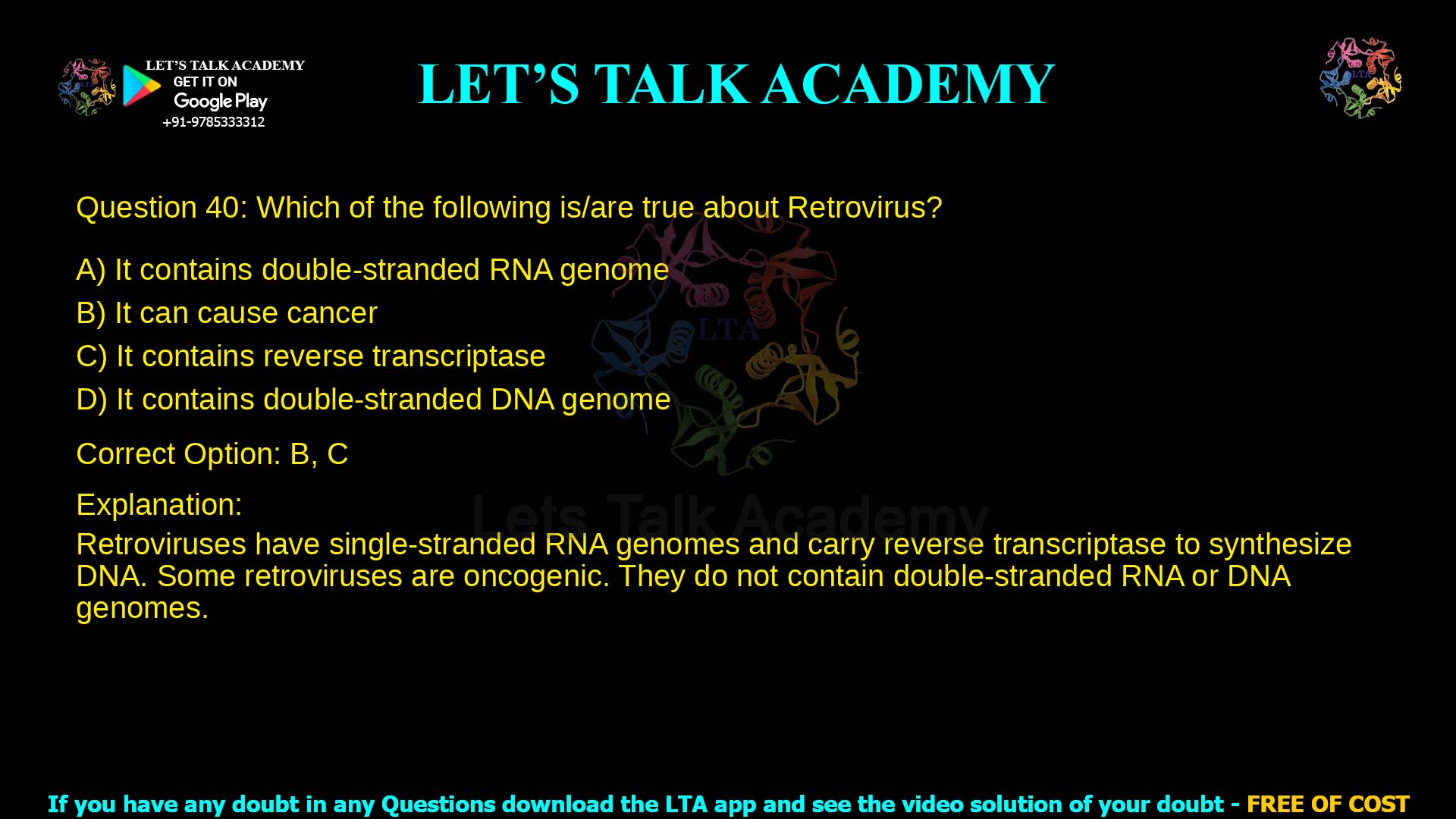
Q.40 Which of the following is/are true about Retrovirus?
(A) It contains double–stranded RNA genome
(B) It can cause cancer
(C) It contains reverse transcriptase
(D) It contains double–stranded DNA genome
Retroviruses are RNA viruses characterized by their unique replication mechanism involving reverse transcription. Options (B) and (C) are true statements about retroviruses.
Option Analysis
Retroviruses contain a single-stranded RNA genome, not double-stranded RNA or DNA as their primary genetic material.
-
(A) False: The genome is monopartite, linear, dimeric, positive-sense single-stranded RNA (ssRNA+) of 7-11 kb with 5′-cap, 3′-poly-A tail, and long terminal repeats (LTRs).
-
(B) True: Certain retroviruses like Rous sarcoma virus and HTLV cause cancers (e.g., sarcomas, leukemias) in animals and humans via oncogene activation or insertional mutagenesis.
-
(C) True: They package reverse transcriptase (RNA-dependent DNA polymerase), essential for converting RNA to double-stranded DNA (provirus) during infection.
-
(D) False: The virion contains RNA; double-stranded DNA forms only inside the host cell via reverse transcription and integrates as provirus.
Retroviruses represent a unique family of viruses with an ssRNA genome that employs reverse transcriptase to produce DNA, enabling integration into host genomes and potential cancer causation. These enveloped RNA viruses, including HIV and HTLV, are critical in molecular biology and virology studies, especially for CSIR NET Life Sciences preparation.
Retrovirus Genome Structure
The retrovirus genome consists of two identical molecules of positive-sense single-stranded RNA, approximately 7-11 kb long, flanked by LTRs containing U3, R, and U5 regions, plus primer binding site (PBS) and polypurine tract (PPT).
This differs from double-stranded RNA or DNA viruses, as the virion packages RNA, not DNA.
Reverse Transcriptase Role
Reverse transcriptase, encoded by the pol gene, catalyzes RNA-to-DNA conversion post-infection, producing a dsDNA provirus that integrates via integrase.
This enzyme’s absence in host cells makes it a key antiviral target, as seen in HIV treatments.
Cancer Causation Mechanism
Retroviruses cause cancer through acute (rapid oncogene delivery, e.g., Rous sarcoma virus) or chronic (insertional activation of proto-oncogenes) mechanisms, affecting species like chickens, mice, and humans.
Human examples include HTLV-linked leukemias; endogenous retroviruses may also contribute via epigenetic reactivation.


