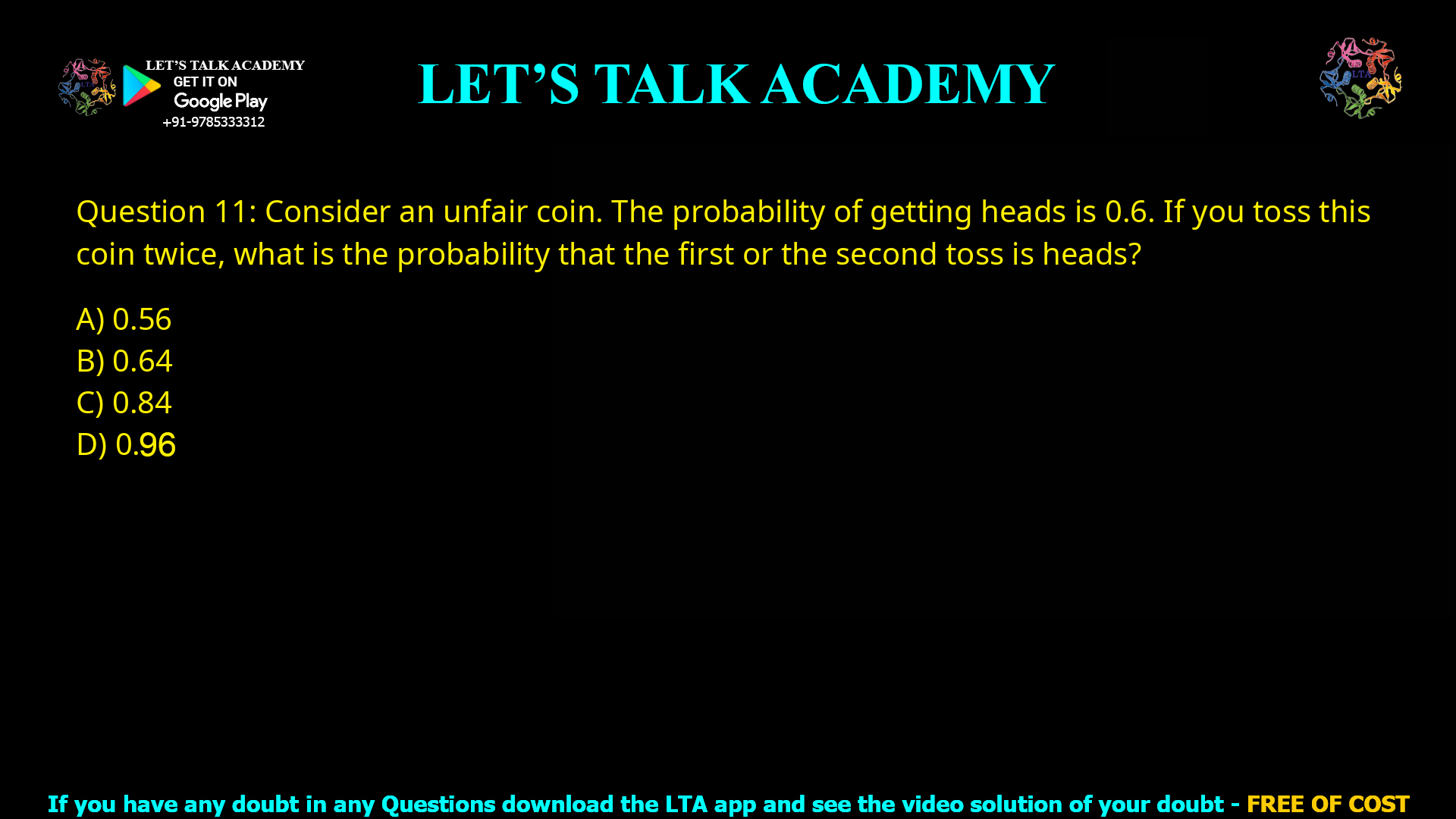
Q.11 Consider an unfair coin. The probability of getting heads is 0.6. If you toss this coin twice,
what is the probability that the first or the second toss is heads?
(A) 0.56 (B) 0.64 (C) 0.84 (D) 0.96
Solution Method
The event “first or second toss is heads” means at least one heads (HH, HT, TH). Tosses are independent, so P(H) = 0.6 and P(T) = 0.4 each time.
Easiest approach: 1 – P(no heads) = 1 – P(TT) = 1 – (0.4 × 0.4) = 1 – 0.16 = 0.84.
Direct calculation: P(HH) + P(HT) + P(TH) = (0.6²) + (0.6×0.4) + (0.4×0.6) = 0.36 + 0.24 + 0.24 = 0.84.
Option Analysis
- (A) 0.56 equals 0.6 + 0.4 – (0.6×0.4) = 0.76? No, ignores double-counting correctly but wrong arithmetic; actually 0.6 + 0.4 – 0.24 = 0.76, still incorrect.
- (B) 0.64 equals 0.6 + 0.4 – 0.6 = wrong inclusion-exclusion; or (0.8)², as if P(H or T first) wrongly reapplied.
- (C) 0.84 is correct, as shown above.
- (D) 0.96 equals (0.6 + 0.4)² or 1 – (0.2)², overestimates by ignoring true P(T).
Probability Calculation
Sample space: HH, HT, TH, TT (each toss independent).
P(TT) = 0.4 × 0.4 = 0.16.
P(first or second heads) = 1 – 0.16 = 0.84.
Why Options Fail
| Option | Value | Common Mistake |
|---|---|---|
| (A) | 0.56 | Wrong: Pboth tails miscalc or 0.6×0.4×2 – overlap error |
| (B) | 0.64 | Wrong: (0.6+0.4)×0.4 or P(exactly one) underextimate |
| (C) | 0.84 | Correct: 1 – P(TT) |
| (D) | 0.96 | Wrong: 1 – (0.2)^2, wrong P(T) |


