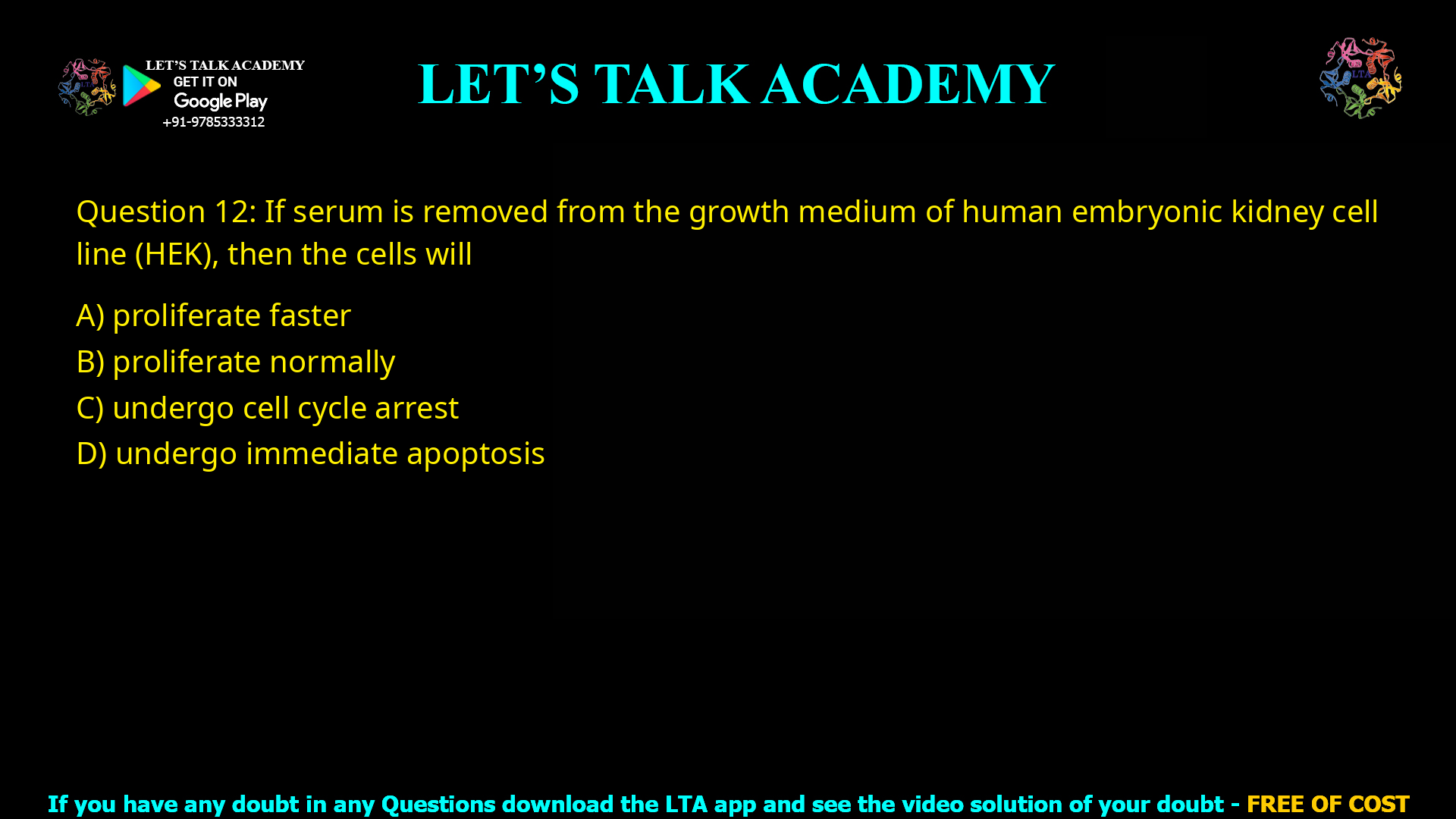
Q.12 If serum is removed from the growth medium of human embryonic kidney cell line (HEK),
then the cells will
(A) proliferate faster
(B) proliferate normally
(C) undergo cell cycle arrest
(D) undergo immediate apoptosis
Correct Answer: (C) undergo cell cycle arrest
Serum removal from the growth medium of HEK cells halts progression through the cell cycle due to lack of essential growth factors. Multiple sources from GATE biotechnology exams and cell culture studies confirm this outcome.
Option Analysis
-
(A) Proliferate faster: Serum contains growth factors like EGF and PDGF that drive proliferation; their absence slows division, not accelerates it.
-
(B) Proliferate normally: Normal proliferation requires serum-supplied nutrients and mitogens; without them, HEK cells cannot sustain standard growth rates.
-
(C) Undergo cell cycle arrest: HEK cells arrest in G0/G1 phase upon serum starvation, a standard quiescence mechanism reversible by serum re-addition.
-
(D) Undergo immediate apoptosis: Apoptosis requires prolonged stress; initial serum removal triggers reversible arrest, not instant death.
Human embryonic kidney (HEK) cells represent a cornerstone in biotechnology research, yet serum removal from their growth medium triggers precise cellular responses. When serum is removed from the growth medium of human embryonic kidney cell line (HEK), the cells undergo cell cycle arrest, halting proliferation in G0/G1 phase due to depleted growth factors. This phenomenon underscores serum’s role as a mitogen source, vital for lab-cultured mammalian cells.
Role of Serum in HEK Cell Culture
Fetal bovine serum (FBS) supplies amino acids, hormones, and growth factors essential for HEK cell attachment, survival, and division. Without it, signaling pathways like MAPK/ERK shut down, preventing S-phase entry. Studies on HEK293 lines confirm viability drops gradually, prioritizing quiescence over death.
Mechanisms of Cell Cycle Arrest
Serum starvation synchronizes HEK cells by upregulating CDK inhibitors like p21 and p27, enforcing G1 arrest. This reversible state allows researchers to study cycle regulation; re-adding 10% FBS restarts progression within hours. Unlike cancer lines, HEK cells rarely bypass this checkpoint.
Experimental Implications
In biotech protocols, serum removal induces quiescence for transfection or differentiation assays. Prolonged deprivation (>48 hours) risks apoptosis, but immediate effects favor arrest, as seen in GATE biotech questions targeting this concept. For molecular biology experts, this highlights nutrient signaling in renal cell physiology.


1 Comment
Ankita Pareek
June 6, 2026Cell cycle arrest because serum is a growth medium or we can say mitogen stimulus if it is absent cell cycle will arrest by making their inhibitors or cki