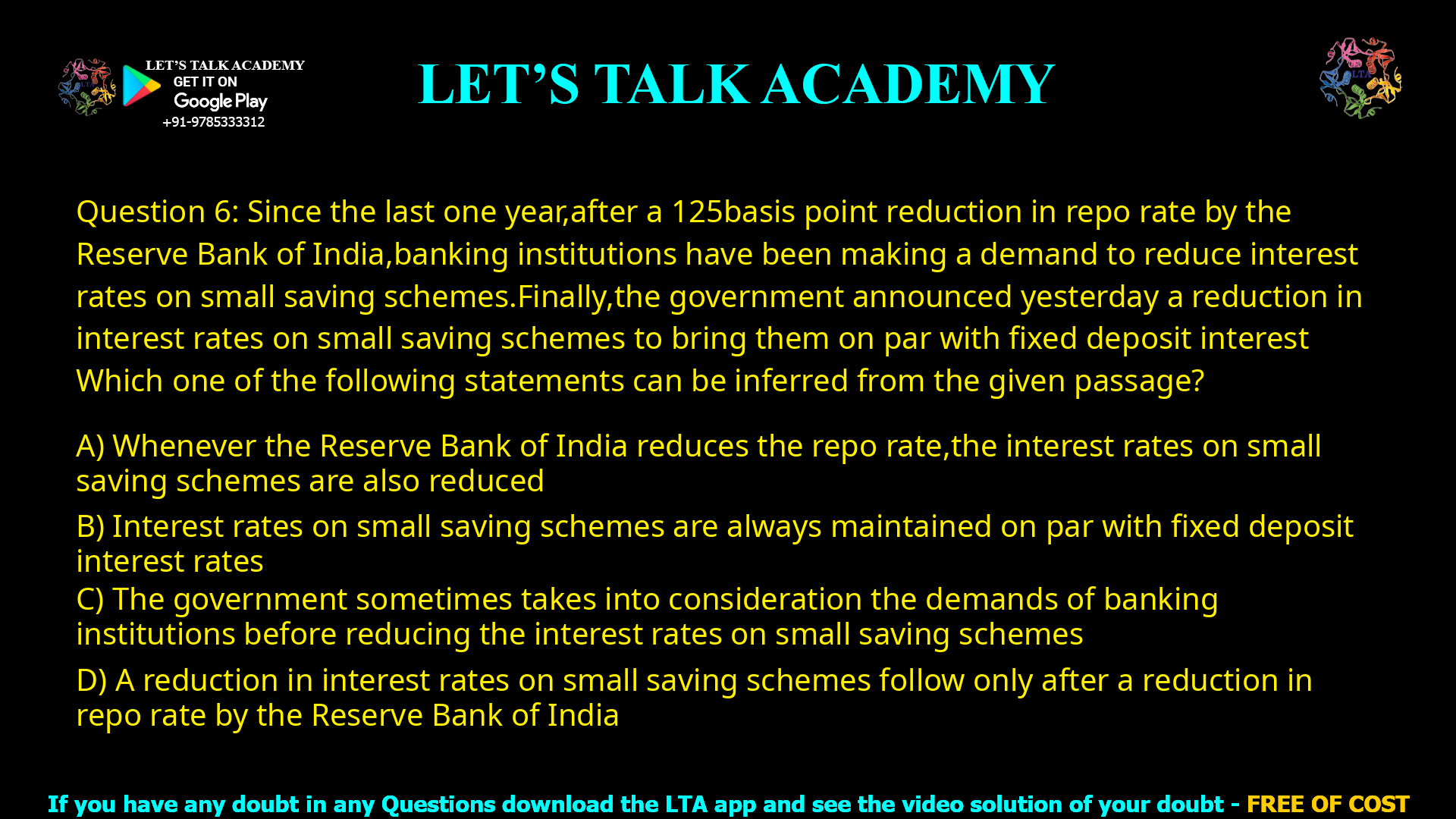
Q.6 Since the last one year, after a 125 basis point reduction in repo rate by the Reserve Bank
of India, banking institutions have been making a demand to reduce interest rates on small
saving schemes. Finally, the government announced yesterday a reduction in interest rates
on small saving schemes to bring them on par with fixed deposit interest rates.
Which one of the following statements can be inferred from the given passage?
(A) Whenever the Reserve Bank of India reduces the repo rate, the interest rates on small
saving schemes are also reduced
(B) Interest rates on small saving schemes are always maintained on par with fixed deposit
interest rates
(C) The government sometimes takes into consideration the demands of banking
institutions before reducing the interest rates on small saving schemes
(D) A reduction in interest rates on small saving schemes follow only after a reduction in
repo rate by the Reserve Bank of India
Correct Answer: (C)
The passage describes a specific sequence where RBI cut the repo rate by 125 basis points over the last year, banks demanded lower small savings rates, and the government finally reduced them yesterday to match fixed deposit rates.
Passage Analysis
The key inference comes from linking the banks’ “demand” to the government’s action. This shows responsiveness, but not a rigid rule. Small savings rates are set quarterly by the Ministry of Finance based on government security yields, not directly tied to repo rates, though economic pressures like bank lobbying can influence timing.
Option Breakdown
-
(A) Incorrect: Claims “whenever” RBI cuts repo rate, small savings rates drop. Passage shows one instance after a year’s delay, not a universal pattern. “Since the last one year” implies it’s not routine.
-
(B) Incorrect: Says rates are “always” on par with fixed deposits. Passage notes reduction “to bring them on par,” proving they weren’t equal before.
-
(C) Correct: Government acted on banks’ demands “sometimes,” as this case shows consideration after persistent requests, without claiming always.
-
(D) Incorrect: No evidence reductions “only” follow repo cuts. Passage lacks info on other triggers, like quarterly reviews.
RBI repo rate reduction often sparks debates on small savings schemes interest rates. In this analysis, explore how a 125 basis point cut led banks to demand parity with fixed deposit rates, and what competitive exams test via inference.
RBI Repo Rate and Savings Link
Reserve Bank of India repo rate cuts lower bank borrowing costs, prompting fixed deposit rate drops. Banks then push for small savings schemes—like PPF, NSC—to align, easing deposit competition. Passage highlights this dynamic over one year.
Decoding the Inference Question
Competitive exams like GATE test reading comprehension on RBI repo rate reduction impact. Passage infers government weighs bank demands selectively, not mechanically. Option C fits: “sometimes takes into consideration.”
-
Key trigger: Persistent bank demands post-repo cut.
-
Outcome: Rates aligned “yesterday” with fixed deposits.
-
Exam tip: Eliminate absolutes like “whenever,” “always,” “only.”
Exam Strategy for Finance Questions
For IIT JAM or GATE, break inferences: Identify cause (repo cut + demands), effect (rate parity), avoid overgeneralizing. Practice spotting “sometimes” from specific events.


