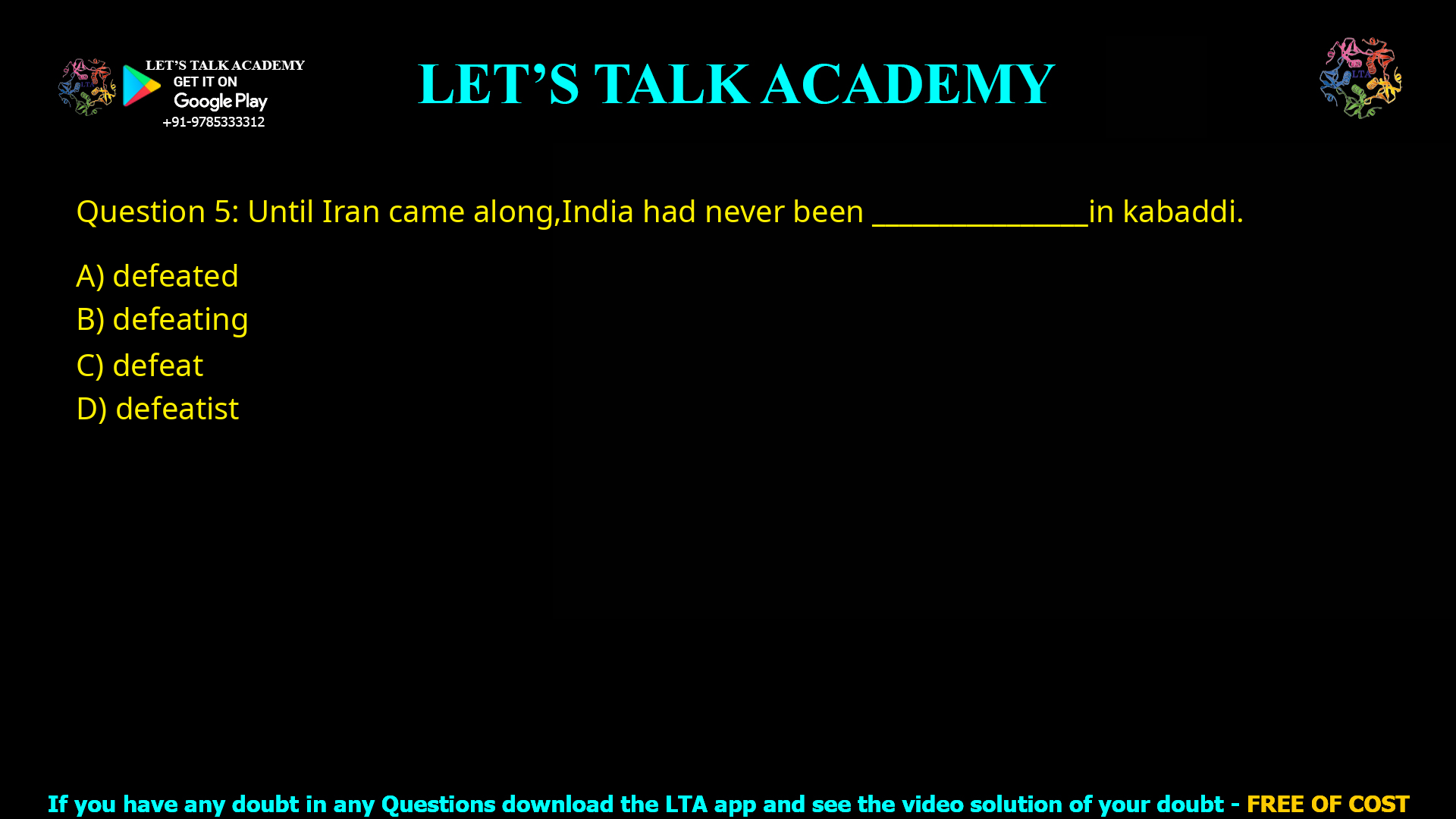
Q.5 Until Iran came along, India had never been ________________ in kabaddi.
(A) defeated (B) defeating (C) defeat (D) defeatist
Question Analysis
This sentence completion question tests understanding of verb forms in perfect tenses, specifically the structure “have/has/had + past participle” for passive voice. The blank requires a word that fits grammatically and semantically in the context of kabaddi (a contact team sport popular in India). The full sentence implies India was unbeatable until Iran defeated them.
Correct Answer: (A) defeated
-
Full sentence: “Until Iran came along, India had never been defeated in kabaddi.”
-
Explanation: “Had never been defeated” uses the past perfect passive (“had been + past participle ‘defeated'”). This conveys that up to a certain past point (Iran’s arrival), India had not experienced defeat. It matches historical kabaddi context, where India dominated internationally until Iran’s rise (e.g., in Asian Games or World Cups).
Option Breakdown
-
(A) defeated: Correct. Past participle form completes the passive past perfect “had never been defeated,” meaning “India had not lost.”
-
(B) defeating: Incorrect. Present participle; would imply “had never been defeating,” which is grammatically invalid (no such passive structure exists here) and semantically odd (India can’t “be defeating” itself).
-
(C) defeat: Incorrect. Base verb/noun form; “had never been defeat” is ungrammatical (requires past participle after “been”).
-
(D) defeatist: Incorrect. Adjective meaning pessimistic; “had never been defeatist” changes meaning to a mindset, not a result like losing a match, and doesn’t fit sports context.
This highlights passive voice rules: Use past participles (e.g., defeated, beaten) after “be” verbs in perfect tenses.
India Had Never Been Defeated in Kabaddi Until Iran Came Along: Grammar Question Solved
In competitive exams like IIT JAM or English proficiency tests, questions like “Until Iran came along, India had never been defeated in kabaddi” test verb tenses and passive voice. The correct choice is (A) defeated, forming the past perfect passive “had never been defeated.” This phrase captures India’s unbeaten streak in kabaddi until Iran’s emergence as a powerhouse.
Kabaddi, India’s national sport, saw the country dominate international arenas for decades. Teams from Iran first challenged this in events like the Asian Games (gold in 2014) and Kabaddi World Cup. The sentence uses passive voice to emphasize the action on India (being defeated), not who did it.
Why “Defeated” Fits Perfectly
The structure “had never been + past participle” is key:
-
Past perfect passive: Describes a past state unfinished until another past event (“Iran came along”).
-
Alternatives fail grammatically:
Option Form Why Wrong? (A) Defeated Past participle Correct: “Had been defeated” = received defeat. (B) Defeating Present participle Invalid: “Been defeating” doesn’t exist in passive. (C) Defeat Base/noun Grammatical error: Needs participle after “been.” (D) Defeatist Adjective Wrong meaning: Implies attitude, not game loss.
This mirrors real kabaddi history—India’s Pro Kabaddi League and world titles remained unchallenged until Iran’s tactical raids broke through.
Master Passive Voice for Exams
Passive voice shifts focus: Active (“Iran defeated India”) vs. Passive (“India was defeated by Iran”). In perfect tenses:
-
Present: Has been defeated.
-
Past: Was defeated.
-
Past perfect: Had been defeated.
Practice tip: Identify “be” verb + past participle (e.g., defeated, beaten, won).
India’s kabaddi legacy endures, but grammar questions like “had never been defeated in kabaddi” remind us language evolves too. Perfect for exam prep!


