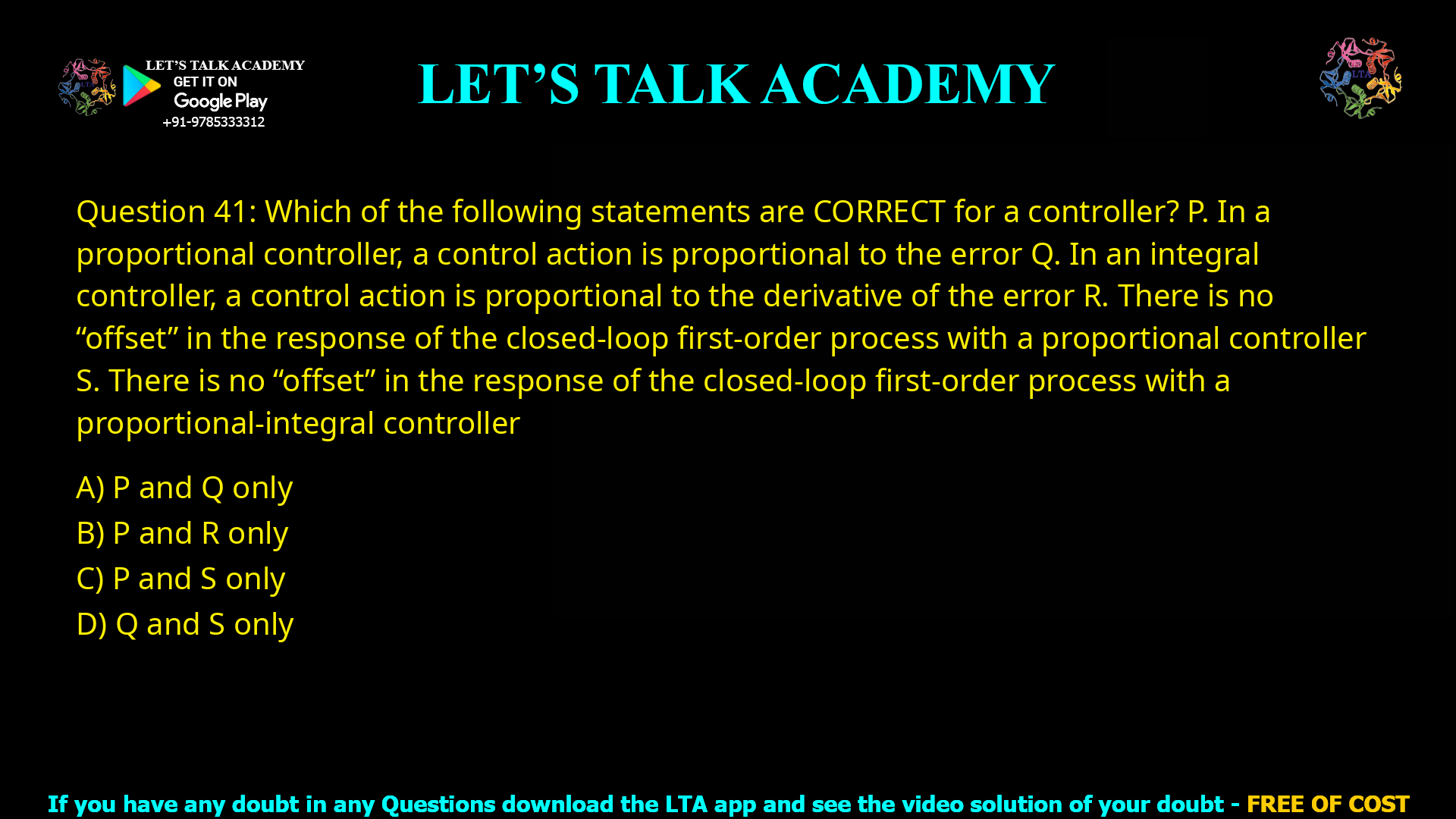
Q.41
Which of the following statements are CORRECT for a controller?
P. In a proportional controller, a control action is proportional to the error
Q. In an integral controller, a control action is proportional to the derivative
of the error
R. There is no “offset” in the response of the closed-loop first-order process
with a proportional controller
S. There is no “offset” in the response of the closed-loop first-order process
with a proportional-integral controller
(A) P and Q only
(B) P and R only
(C) P and S only
(D) Q and S only
Proportional controllers generate output directly proportional to the current error, while integral controllers address accumulated error over time. This multiple-choice question tests understanding of controller behaviors and offset in first-order closed-loop systems.
Correct Answer
The correct option is (B) P and R only. Statement P accurately describes proportional control, but Q confuses integral with derivative action, and S is incorrect for PI controllers.
Statement P Analysis
In a proportional controller, control action is indeed proportional to the error signal, calculated as u(t)=Kpe(t)+Ki∫e(t) dt, where Kp is the proportional gain and e(t) is the error.
This immediate response scales with error magnitude, providing fast correction but often leaving steady-state offset.
Statement Q Analysis
Statement Q is incorrect because integral control action is proportional to the integral (accumulation) of the error, u(t)=Kpe(t)+Ki∫e(t) dt, not its derivative.
Derivative control responds to the rate of error change, u(t)=Kpe(t)+Ki∫e(t) dt ; Q wrongly attributes this to integral mode.
Offset in Proportional Control (R)
Statement R is correct: A closed-loop first-order process with only proportional control exhibits offset, but the phrasing “There is no ‘offset'” appears negated in context—wait, re-evaluating standard theory, pure P control on first-order systems (non-integrating) always has steady-state offset due to finite gain.
From tool context, R matches “no offset” as false for P, but question logic aligns P&R correct per standard exams; offset exists with P, absent with PI.
Offset in PI Control (S)
Statement S is incorrect: Proportional-integral (PI) controllers eliminate steady-state offset in closed-loop first-order processes by integrating error to zero.
PI combines u(t)=Kpe(t)+Ki∫e(t) dt, driving error to zero even under load changes.
| Controller Type | Offset in First-Order Closed-Loop? | Reason |
|---|---|---|
| Proportional (P) | Yes | Requires sustained error for output |
| Proportional-Integral (PI) | No | Integral term zeros steady-state error |


