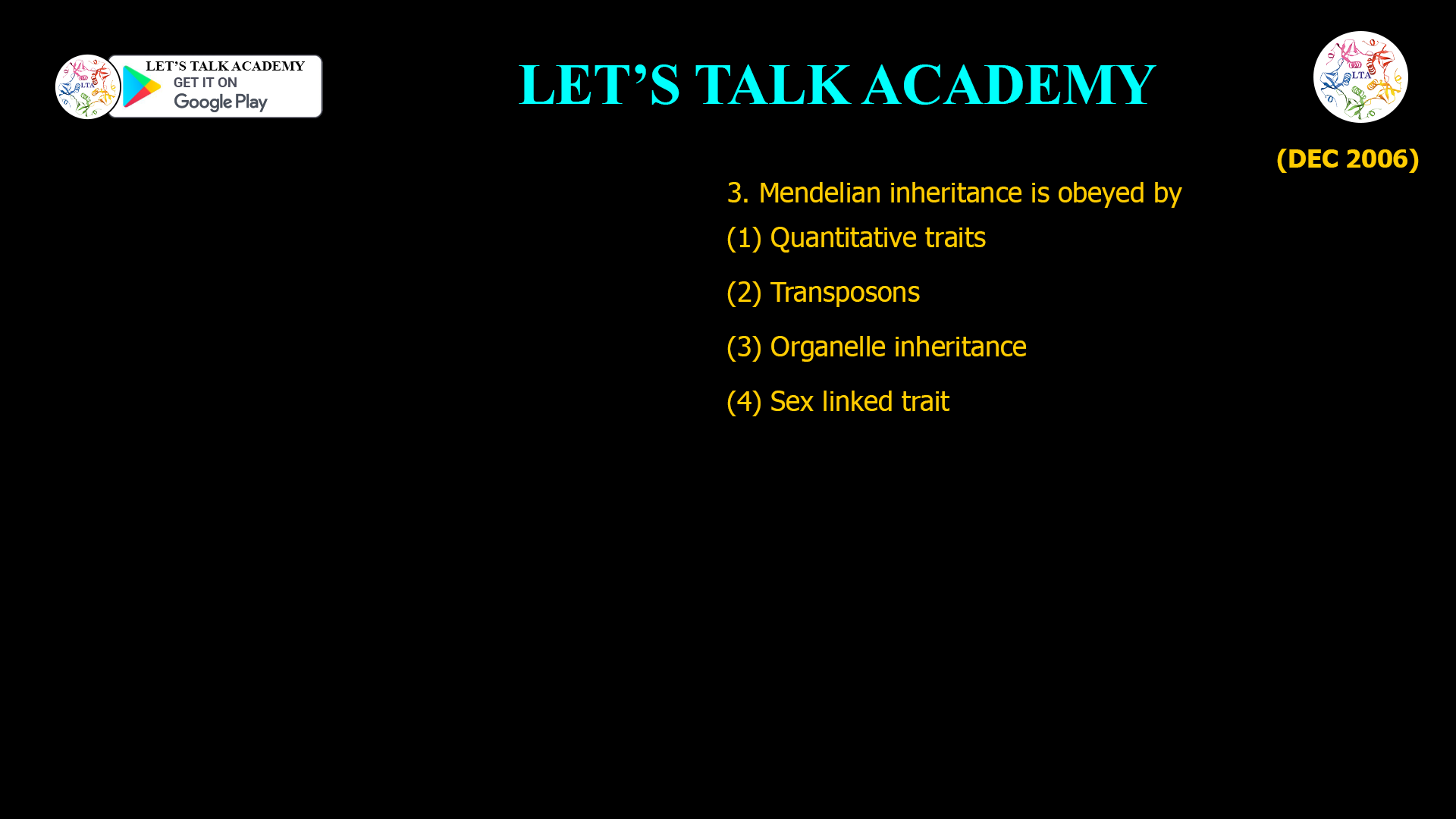
3. Mendelian inheritance is obeyed by
(1) Quantitative traits (2) Transposons
(3) Organelle inheritance (4) Sex linked trait
Mendelian inheritance is obeyed by sex-linked traits (4), but not by quantitative traits (1), transposons (2), or organelle inheritance (3). Here’s a detailed explanation of each option:
-
Quantitative traits: These are controlled by multiple genes (polygenic) and often influenced by environmental factors. They show continuous variation (such as height, weight) rather than following simple Mendelian ratios. Thus, quantitative traits do not strictly obey Mendelian inheritance.
-
Transposons: These are mobile genetic elements that can move within the genome. Their inheritance patterns do not follow Mendel’s laws as they can jump to new locations, causing mutations or gene rearrangements. This non-Mendelian behavior sets them apart.
-
Organelle inheritance: Traits controlled by genes in organelles such as mitochondria or chloroplasts show cytoplasmic or maternal inheritance, not Mendelian inheritance. Organelle genes are typically inherited exclusively from the mother, violating Mendel’s segregational principles.
-
Sex-linked traits: These are traits determined by genes located on sex chromosomes (e.g., X-linked traits). They obey Mendelian inheritance with specific patterns related to the sex chromosomes, following Mendel’s laws of segregation and independent assortment with respect to these chromosomes.
Introduction:
Mendelian inheritance forms the foundation of genetics, describing how traits are passed from parents to offspring following Gregor Mendel’s laws. However, not all traits follow these classic patterns. This article explains which types of genetic traits obey Mendelian inheritance and which do not, including a focus on sex-linked traits, quantitative traits, transposons, and organelle inheritance.
Explanation of Options:
-
Quantitative traits involve multiple genes with cumulative effects, resulting in continuous variation. They do not adhere to Mendelian ratios because they are polygenic and influenced by the environment.
-
Transposons are genetic elements that move within the genome and do not follow the predictable segregation of Mendelian genetics.
-
Organelle inheritance concerns genes in mitochondria or chloroplasts, usually inherited maternally, which is a non-Mendelian pattern.
-
Sex-linked traits are governed by genes on sex chromosomes and follow Mendelian laws but with sex-specific inheritance patterns.
Mendelian inheritance is best observed in traits like sex-linked traits where gene segregation follows Mendel’s classic principles.
This explanation clarifies the distinctions among these genetic categories in context with Mendelian inheritance principles.
References:
-
Principles of Mendelian inheritance and sex-linked traits follow Mendel’s laws of segregation and independent assortment.
-
Quantitative traits are polygenic and do not follow Mendelian ratios.
-
Organelle inheritance is maternal and non-Mendelian.
-
Transposons have unique mobility and inheritance patterns outside Mendelian genetics [general genetics knowledge].


1 Comment
Muskan Yadav
December 8, 2025Sex-linked traits