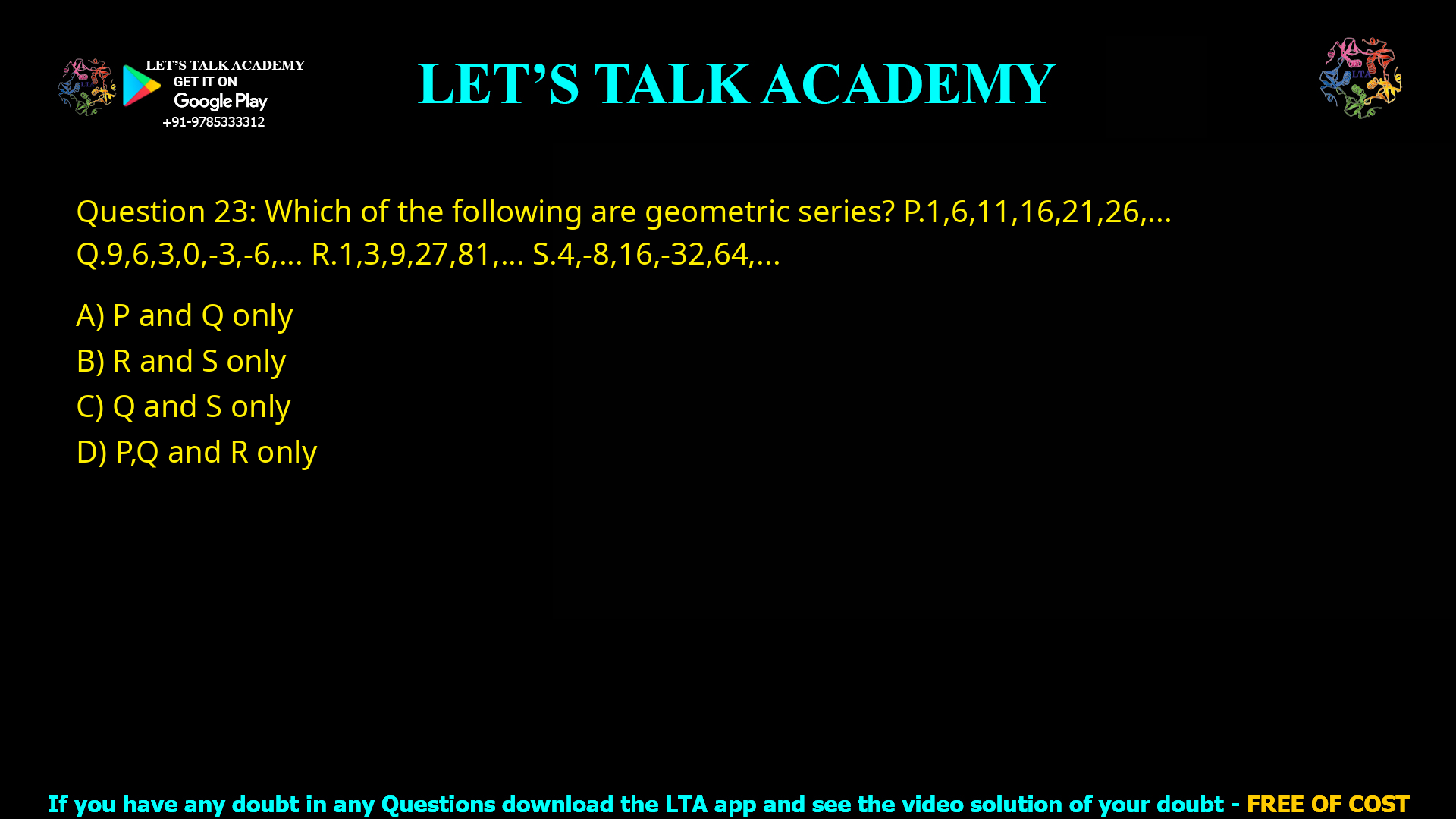
Q.23 Which of the following are geometric series?
P. 1, 6, 11, 16, 21, 26, …
Q. 9, 6, 3, 0, –3, –6, …
R. 1, 3, 9, 27, 81, …
S. 4, –8, 16, –32, 64, …
(A) P and Q only (B) R and S only (C) Q and S only (D) P, Q and R only
A geometric series features terms where each subsequent term results from multiplying the previous by a constant ratio, unlike arithmetic sequences that add a constant difference. This MCQ tests distinguishing them among given options for exam preparation.
Option Analysis
P: 1, 6, 11, 16, 21, 26
Forms an arithmetic sequence with common difference 5 (6-1=5, 11-6=5), but ratios vary (6/1=6, 11/6≈1.8).
Q: 9, 6, 3, 0, -3, -6
Is arithmetic with common difference -3 (6-9=-3, 3-6=-3), ratios inconsistent (6/9≈0.7, 3/6=0.5).
R: 1, 3, 9, 27, 81
Qualifies as geometric with constant ratio 3 (3/1=3, 9/3=3).
S: 4, -8, 16, -32, 64
Is geometric with ratio -2 (-8/4=-2, 16/-8=-2).
Correct Answer
Key Properties
- Geometric sequences follow a_n = ar^(n-1), where r is constant and nonzero.
- Verify by checking if a_(n+1)/a_n = r for all adjacent terms.
- Common errors include mistaking linear growth (arithmetic) for exponential (geometric).


