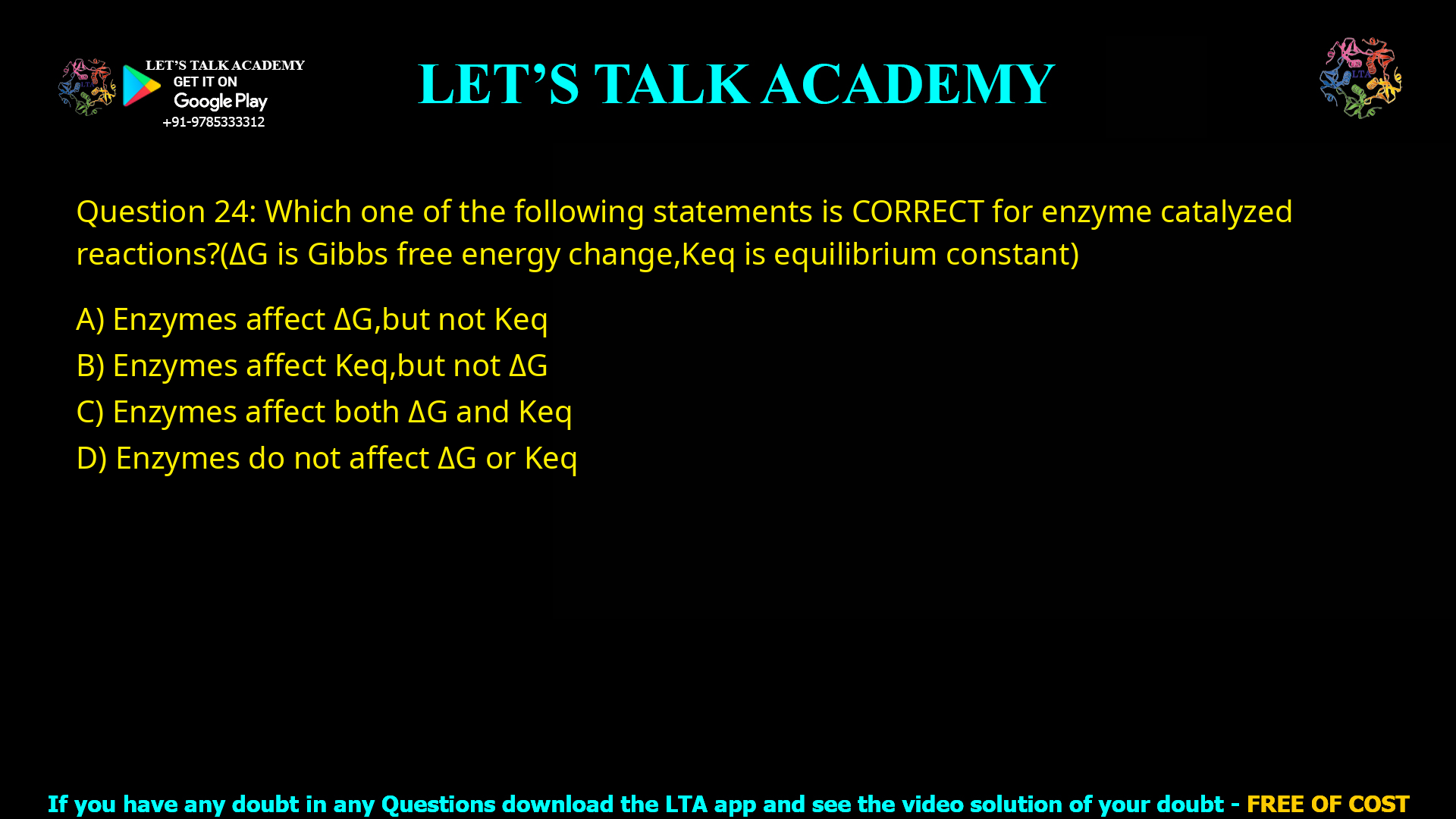
Q.24 Which one of the following statements is CORRECT for enzyme catalyzed reactions? (𝛥𝐺
is Gibbs free energy change, 𝐾𝑒𝑞 is equilibrium constant)
(A) Enzymes affect 𝛥𝐺, but not 𝐾𝑒𝑞
(B) Enzymes affect 𝐾𝑒𝑞, but not 𝛥𝐺
(C) Enzymes affect both 𝛥𝐺 and 𝐾𝑒𝑞
(D) Enzymes do not affect 𝛥𝐺 or 𝐾𝑒𝑞
Correct Answer: (D) Enzymes do not affect ΔG or Keq
Enzymes accelerate reactions by lowering activation energy without altering the thermodynamics of the system. The Gibbs free energy change (ΔG) and equilibrium constant (Keq) remain unchanged because enzymes do not shift the energy difference between reactants and products.
Option Analysis
-
(A) Enzymes affect ΔG, but not Keq: Incorrect. Enzymes leave ΔG unchanged as it reflects the inherent energy difference between reactants and products.
-
(B) Enzymes affect Keq, but not ΔG: Incorrect. Keq depends on ΔG via the relation ΔG∘=−RTlnKeq; since enzymes do not change ΔG, Keq stays the same.
-
(C) Enzymes affect both ΔG and Keq: Incorrect. Affecting both would violate thermodynamic principles, as enzymes only speed the path to equilibrium.
-
(D) Enzymes do not affect ΔG or Keq: Correct. They reduce activation energy (Ea), allowing faster equilibrium attainment without thermodynamic shifts.
Introduction to Enzymes in Catalyzed Reactions
In enzyme-catalyzed reactions, understanding how enzymes influence Gibbs free energy change (ΔG) and equilibrium constant (Keq) is crucial for exams like IIT JAM. Enzymes act as biological catalysts, speeding reactions without changing core thermodynamics. This guide solves Q.24 step-by-step for biotechnology and biochemistry students preparing for competitive tests.
Thermodynamic Role of Enzymes
Enzymes lower activation energy, enabling quicker transition state formation. However, ΔG—the net free energy shift from reactants to products—remains fixed, as do product/reactant concentrations at equilibrium defining Keq. Standard ΔG° ties directly to Keq, so neither shifts with enzymes.
Why Enzymes Ignore ΔG and Keq
-
Enzymes stabilize transition states, reducing Ea barrier height.
-
Equilibrium position stays identical; attainment just accelerates.
-
Coupling reactions (e.g., ATP synthesis) relies on overall negative ΔG, unchanged by enzymes.
This holds for all enzyme-catalyzed reactions in biochemistry.
Exam Tips for IIT JAM Biotech
Practice Gibbs free energy diagrams: enzyme curves show lowered Ea peaks but identical start/end energies. Review past papers—options testing ΔG vs. Keq frequently appear. Master Keq=e−ΔG∘/RT for quick elimination.


