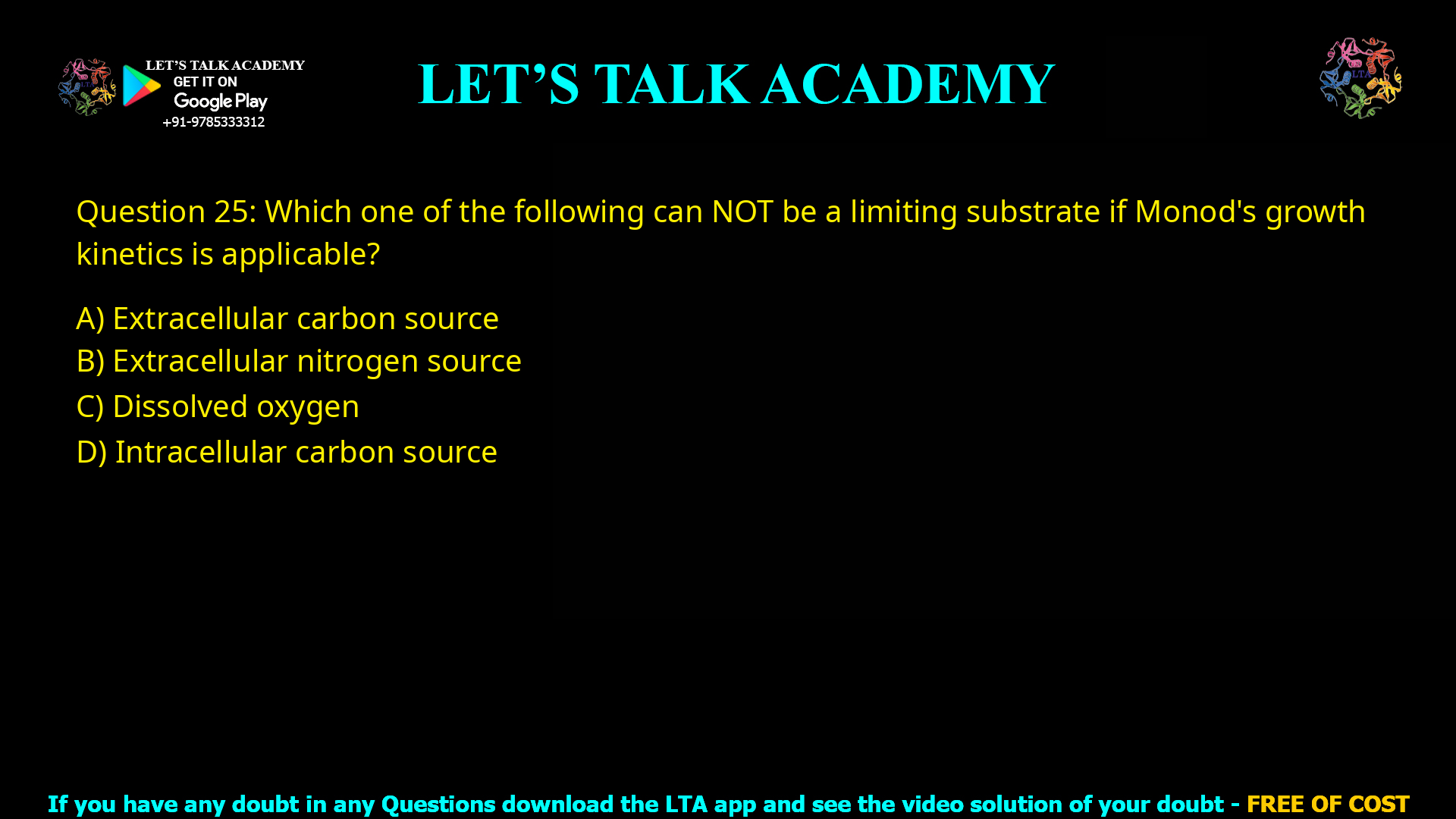
Q.25 Which one of the following can NOT be a limiting substrate if Monod’s growth kinetics is
applicable?
(A) Extracellular carbon source
(B) Extracellular nitrogen source
(C) Dissolved oxygen
(D) Intracellular carbon source
Monod’s Growth Kinetics: Identifying the Non-Limiting Substrate
Correct Answer: (D) Intracellular carbon source
Monod Equation Basics
Monod’s growth kinetics describes microbial growth rate as a function of a single limiting substrate’s extracellular concentration. The model equation is:
Where: μ = specific growth rate | μmax = maximum growth rate | S = substrate concentration | Ks = half-saturation constant
This empirical relation, analogous to Michaelis-Menten enzyme kinetics, applies to balanced growth phases where one external nutrient controls the rate. It assumes rapid intracellular distribution, focusing solely on extracellular S.
Option Analysis
Key Concept: Why Intracellular Carbon Fails
Monod growth kinetics limiting substrate refers specifically to external nutrients that microorganisms must transport across their cell membrane. Intracellular carbon sources (like stored glycogen or internal metabolites) are already inside the cell and don’t follow Monod kinetics because:
- Monod model measures external substrate concentration (S)
- Intracellular pools equilibrate rapidly through internal metabolism
- The model tracks transport-limited uptake, not internal storage usage
- Internal carbon doesn’t appear in the characteristic hyperbolic growth curve
Exam-Relevant Examples
- Extracellular glucose limits yeast growth in fermenters
- Dissolved oxygen caps rates in aerobic bioreactors
- Ammonium restricts bacterial biomass in media
IIT JAM Biotechnology Strategy
For IIT JAM biotech aspirants, master this distinction: Monod applies only to diffusible, external substrates. Practice questions testing intra- vs. extracellular factors provide competitive advantage in bioprocess engineering sections.
📝 Quick Revision Point
Monod Growth Kinetics Limiting Substrate = External Only
✅ Carbon source (external) | ✅ Nitrogen source (external) | ✅ Dissolved O₂
❌ Intracellular carbon (internal storage)


