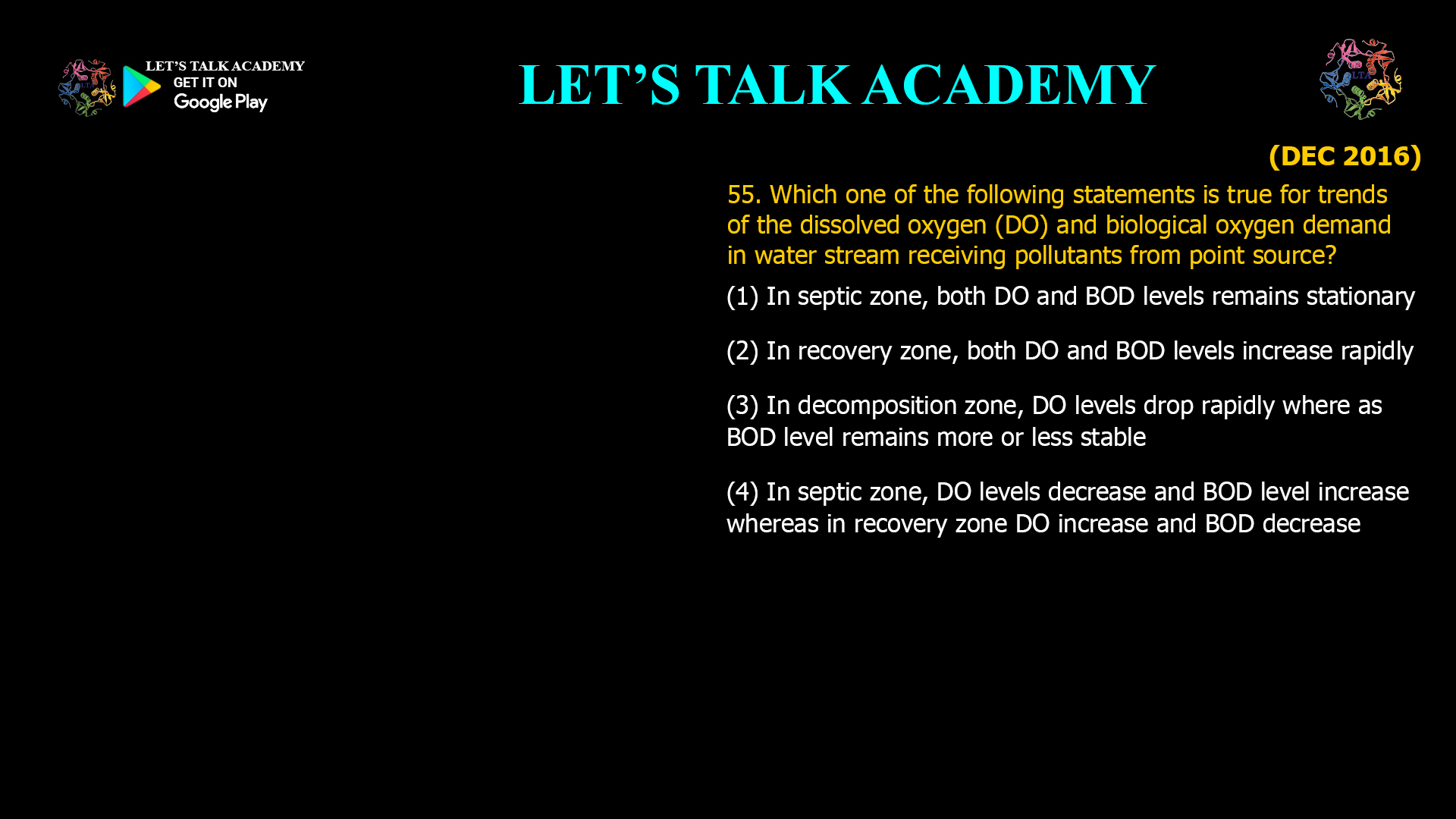
- Which one of the following statements is true for trends of the dissolved oxygen (DO) and biological oxygen demand in water stream receiving pollutants from point source?
(1) In septic zone, both DO and BOD levels remains stationary
(2) In recovery zone, both DO and BOD levels increase rapidly
(3) In decomposition zone, DO levels drop rapidly where as BOD level remains more or less stable
(4) In septic zone, DO levels decrease and BOD level increase whereas in recovery zone DO increase and BOD decrease
The Basics: Dissolved Oxygen and Biological Oxygen Demand
Dissolved Oxygen (DO)
Dissolved oxygen is the amount of oxygen present in water, essential for the survival of fish, invertebrates, and other aquatic organisms. DO levels are influenced by several factors, including temperature, water flow, photosynthesis by aquatic plants, and atmospheric exchange. When DO levels drop too low, aquatic life can be severely impacted, leading to fish kills and loss of biodiversity.
Biological Oxygen Demand (BOD)
BOD measures the amount of oxygen required by microorganisms to break down organic matter in water. High BOD indicates the presence of organic pollutants, such as sewage or agricultural runoff, which provide food for bacteria and other decomposers. As these microorganisms consume oxygen during decomposition, BOD directly affects DO levels—higher BOD leads to faster depletion of DO in the water.
How Pollutants Affect Stream Zones
When pollutants enter a stream from a point source, they create distinct zones downstream:
-
Septic Zone (or Initial Mixing Zone):
-
Characteristics: High pollutant concentration, rapid microbial activity.
-
DO and BOD Trends:
-
DO decreases as microorganisms consume oxygen to break down organic pollutants.
-
BOD increases because more organic material is available for decomposition.
-
-
-
Decomposition Zone:
-
Characteristics: Continued microbial activity, ongoing decomposition of organic matter.
-
DO and BOD Trends:
-
DO drops rapidly as oxygen is consumed by microbes.
-
BOD remains stable or slightly decreases as the initial surge of organic material is gradually broken down.
-
-
-
Recovery Zone:
-
Characteristics: Pollutants are diluted, organic matter is mostly decomposed, and the ecosystem begins to recover.
-
DO and BOD Trends:
-
DO increases as oxygen is replenished from the atmosphere and photosynthesis.
-
BOD decreases as the remaining organic matter is broken down and the demand for oxygen diminishes.
-
-
Evaluating the Statements
Let’s review each statement in the context of the above explanation:
-
(1) In septic zone, both DO and BOD levels remain stationary
-
Incorrect. In the septic zone, DO decreases and BOD increases due to the influx of pollutants and rapid microbial activity.
-
-
(2) In recovery zone, both DO and BOD levels increase rapidly
-
Incorrect. In the recovery zone, DO increases as the stream recovers, but BOD decreases as organic matter is broken down.
-
-
(3) In decomposition zone, DO levels drop rapidly whereas BOD level remains more or less stable
-
Partially correct, but not the best answer. In the decomposition zone, DO does drop rapidly, but BOD may remain stable or start to decrease as decomposition proceeds. However, the most accurate and comprehensive trend is described in option (4).
-
-
(4) In septic zone, DO levels decrease and BOD level increase whereas in recovery zone DO increase and BOD decrease
-
Correct. This statement accurately describes the trends in both the septic and recovery zones.
-
Note:
While option (3) is partially correct for the decomposition zone, option (4) is the most accurate overall because it covers both the septic and recovery zones, which are the most clearly defined and widely recognized in water quality studies.
Why These Trends Matter
Understanding the relationship between DO and BOD is crucial for:
-
Pollution Control: Identifying the most polluted zones helps target cleanup and mitigation efforts.
-
Aquatic Health: Monitoring DO and BOD helps protect fish and other aquatic organisms from oxygen depletion.
-
Regulatory Compliance: Many environmental regulations set limits on BOD and DO to ensure water quality standards are met.
The Role of Point Source Pollution
Point source pollution, such as an industrial discharge or wastewater treatment plant outfall, introduces a concentrated load of organic material into a stream. This creates a clear gradient of water quality downstream:
-
Near the Outfall (Septic Zone):
-
DO drops and BOD rises as microbes consume oxygen to break down the sudden influx of organic matter.
-
-
Further Downstream (Decomposition Zone):
-
DO continues to drop as decomposition proceeds.
-
BOD may remain stable or start to decrease as the initial organic load is broken down.
-
-
Even Further Downstream (Recovery Zone):
-
DO increases as the stream recovers and oxygen is replenished.
-
BOD decreases as the remaining organic matter is decomposed and the demand for oxygen drops.
-
Key Takeaways
-
Dissolved oxygen (DO) and biological oxygen demand (BOD) are critical indicators of stream health.
-
When pollutants enter a stream from a point source, DO decreases and BOD increases in the septic zone.
-
In the recovery zone, DO increases and BOD decreases as the stream recovers.
-
The most accurate statement is:
(4) In septic zone, DO levels decrease and BOD level increase whereas in recovery zone DO increase and BOD decrease
Summary Table
| Zone | DO Trend | BOD Trend |
|---|---|---|
| Septic | Decreases | Increases |
| Decomposition | Drops rapidly | Stable or decreases |
| Recovery | Increases | Decreases |
Conclusion
When a stream receives pollutants from a point source, the trends of dissolved oxygen (DO) and biological oxygen demand (BOD) follow predictable patterns. In the septic zone, DO decreases and BOD increases as microbes consume oxygen to break down organic matter. In the recovery zone, DO increases and BOD decreases as the stream returns to a healthier state. The most accurate statement describing these trends is:
(4) In septic zone, DO levels decrease and BOD level increase whereas in recovery zone DO increase and BOD decrease


4 Comments
Kirti Agarwal
November 7, 2025In septic zone DO level decrease and BOD level is increase while in recovery zone DO level increases and BOD level is decrease
Kajal
November 15, 2025Option 4 is whole correct while 3is partially correct
Sakshi Kanwar
November 28, 2025In septic zone, DO levels decrease and BOD level increase whereas in recovery zone DO increase and BOD decrease
Sakshi yadav
November 29, 2025In septic zone, DO levels decrease and BOD level increase whereas in recovery zone DO increase and BOD decrease