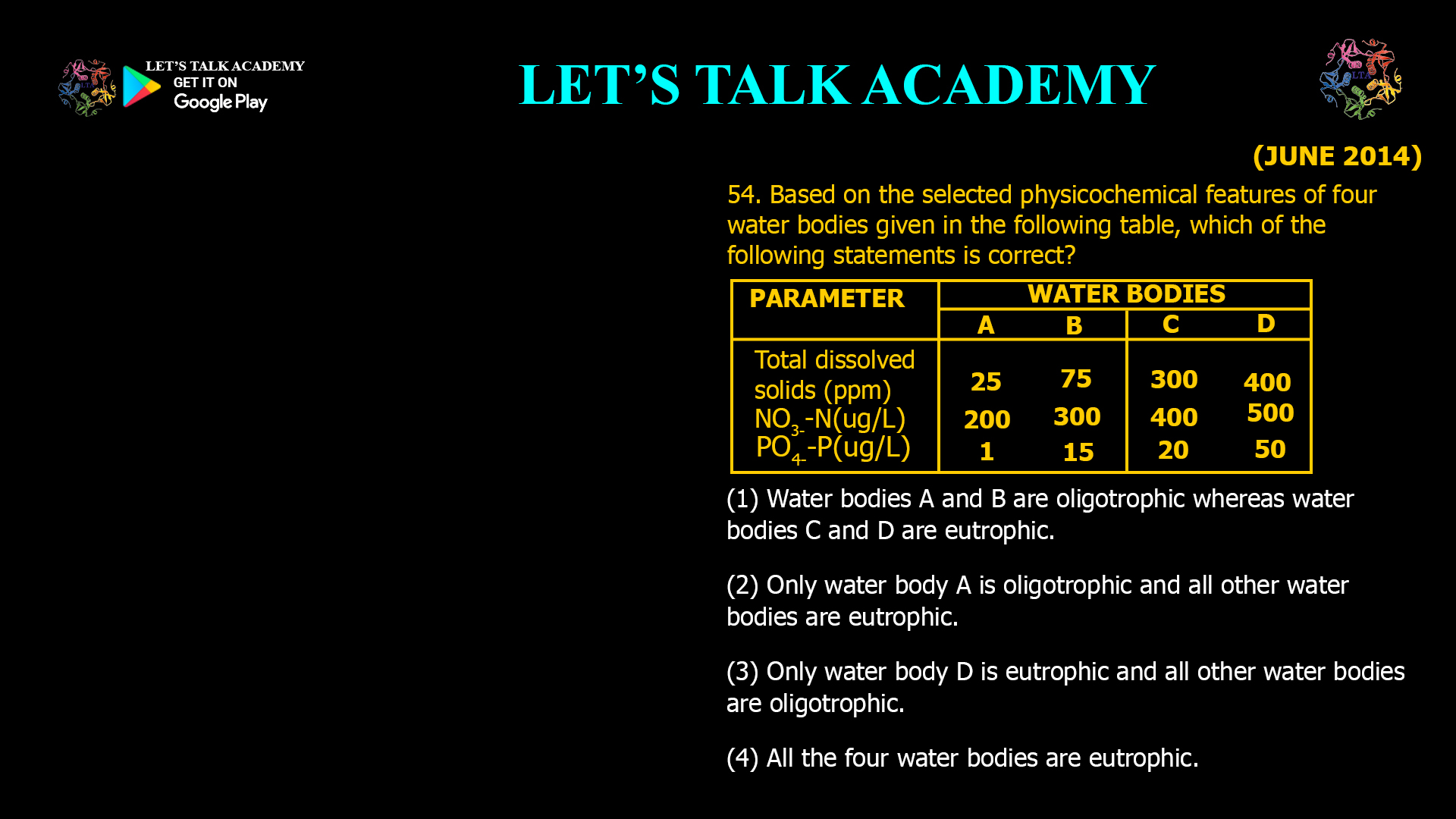
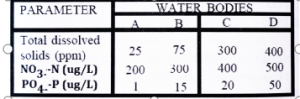
54.Based on the selected physicochemical features of four water bodies given in the following table, which of the following statements is correct?
(1) Water bodies A and B are oligotrophic whereas water bodies C and D are eutrophic.
(2) Only water body A is oligotrophic and all other water bodies are eutrophic.
(3) Only water body D is eutrophic and all other water bodies are oligotrophic.
(4) All the four water bodies are eutrophic.
What Are Oligotrophic and Eutrophic Water Bodies?
Oligotrophic water bodies are characterized by low nutrient concentrations, high water clarity, and low biological productivity. They typically have deep, clear waters and support a limited number of aquatic organisms. In contrast, eutrophic water bodies are rich in nutrients, have lower water clarity, and support abundant plant and algal growth, which can lead to oxygen depletion and ecological imbalances.
Key Physicochemical Features for Classification
To classify a water body as oligotrophic or eutrophic, scientists rely on several physicochemical parameters:
-
Nutrient Levels (Nitrogen and Phosphorus):
-
Oligotrophic: Low concentrations of nitrogen and phosphorus.
-
Eutrophic: High concentrations of nitrogen and phosphorus.
-
-
Chlorophyll-a:
-
Oligotrophic: Low chlorophyll-a (indicating low algal biomass).
-
Eutrophic: High chlorophyll-a (indicating high algal biomass).
-
-
Dissolved Oxygen:
-
Oligotrophic: High dissolved oxygen, especially in deeper waters.
-
Eutrophic: Lower dissolved oxygen, particularly near the bottom due to decomposition of organic matter.
-
-
Water Clarity (Transparency):
-
Oligotrophic: High transparency (clear water).
-
Eutrophic: Low transparency (murky or green water).
-
-
Primary Productivity:
-
Oligotrophic: Low primary productivity.
-
Eutrophic: High primary productivity.
-
These parameters are commonly measured and compared to standard ranges to determine the trophic status of a water body.
How to Interpret a Table of Physicochemical Features
When presented with a table of physicochemical features for several water bodies, follow these steps to classify them:
-
Identify Key Parameters:
-
Look for columns such as phosphorus, nitrogen, chlorophyll-a, dissolved oxygen, and transparency.
-
-
Compare Values to Standard Ranges:
-
Oligotrophic:
-
Phosphorus: <0.01 mg/L
-
Nitrogen: <0.2 mg/L
-
Chlorophyll-a: <2 µg/L
-
Dissolved Oxygen: High (near surface and bottom)
-
Transparency: >4 meters
-
-
Eutrophic:
-
Phosphorus: >0.03 mg/L
-
Nitrogen: >0.3 mg/L
-
Chlorophyll-a: >10 µg/L
-
Dissolved Oxygen: Low (especially near bottom)
-
Transparency: <2 meters
-
-
-
Classify Each Water Body:
-
If most parameters for a water body fall within the oligotrophic range, classify it as oligotrophic.
-
If most parameters fall within the eutrophic range, classify it as eutrophic.
-
Example: Hypothetical Table
Suppose the table for four water bodies (A, B, C, D) looks like this:
| Water Body | Phosphorus (mg/L) | Nitrogen (mg/L) | Chlorophyll-a (µg/L) | Dissolved Oxygen (mg/L) | Transparency (m) |
|---|---|---|---|---|---|
| A | 0.005 | 0.1 | 1 | 8 | 6 |
| B | 0.008 | 0.15 | 1.5 | 7.5 | 5 |
| C | 0.06 | 0.5 | 15 | 5 | 1 |
| D | 0.07 | 0.6 | 18 | 4 | 0.8 |
-
A and B: Low nutrients, high oxygen, high transparency → Oligotrophic
-
C and D: High nutrients, low oxygen, low transparency → Eutrophic
Evaluating the Options
Given the above example, let’s review the options:
-
(1) Water bodies A and B are oligotrophic whereas water bodies C and D are eutrophic.
-
Correct. This matches the classification based on the example table.
-
-
(2) Only water body A is oligotrophic and all other water bodies are eutrophic.
-
Incorrect. Both A and B are oligotrophic in the example.
-
-
(3) Only water body D is eutrophic and all other water bodies are oligotrophic.
-
Incorrect. C is also eutrophic in the example.
-
-
(4) All the four water bodies are eutrophic.
-
Incorrect. A and B are oligotrophic in the example.
-
If your table matches the pattern above, the correct answer is option (1).
Why Accurate Classification Matters
Accurately classifying water bodies as oligotrophic or eutrophic is crucial for:
-
Environmental Monitoring: Helps track changes in water quality over time.
-
Resource Management: Guides decisions on water use, conservation, and restoration.
-
Ecological Health: Informs efforts to protect aquatic ecosystems and biodiversity.
-
Public Health: Ensures safe water for drinking, recreation, and agriculture.
Broader Implications for Water Quality Management
Water quality management relies on regular monitoring of physicochemical parameters. By understanding the trophic status of water bodies, authorities can implement targeted interventions to prevent eutrophication, such as reducing nutrient runoff, promoting sustainable agriculture, and restoring wetlands.
Key Takeaways
-
Oligotrophic water bodies have low nutrients, high clarity, and high oxygen.
-
Eutrophic water bodies have high nutrients, low clarity, and low oxygen.
-
Physicochemical features such as phosphorus, nitrogen, chlorophyll-a, dissolved oxygen, and transparency are used to classify water bodies.
-
To answer questions about trophic status, compare the values in the table to standard ranges for oligotrophic and eutrophic conditions.
-
If the table shows A and B as oligotrophic and C and D as eutrophic, the correct answer is option (1).
Summary Table
| Parameter | Oligotrophic | Eutrophic |
|---|---|---|
| Phosphorus (mg/L) | <0.01 | >0.03 |
| Nitrogen (mg/L) | <0.2 | >0.3 |
| Chlorophyll-a (µg/L) | <2 | >10 |
| Dissolved Oxygen | High | Low (especially bottom) |
| Transparency (m) | >4 | <2 |
Conclusion
By analyzing the physicochemical features of water bodies, you can accurately classify them as oligotrophic or eutrophic. If the data show that water bodies A and B are oligotrophic and C and D are eutrophic, the correct statement is:
(1) Water bodies A and B are oligotrophic whereas water bodies C and D are eutrophic.


4 Comments
Kirti Agarwal
November 7, 2025Water bodies A and B is oligotrophic and C and D eutrophic
Kajal
November 15, 2025A and B are oligotrophic and C and D are Eutrophic
Sakshi Kanwar
November 28, 2025Water bodies A and B are oligotrophic whereas water bodies C and D are eutrophic.
Sakshi yadav
November 29, 2025A and B – oligotrophic and C D eutrophic