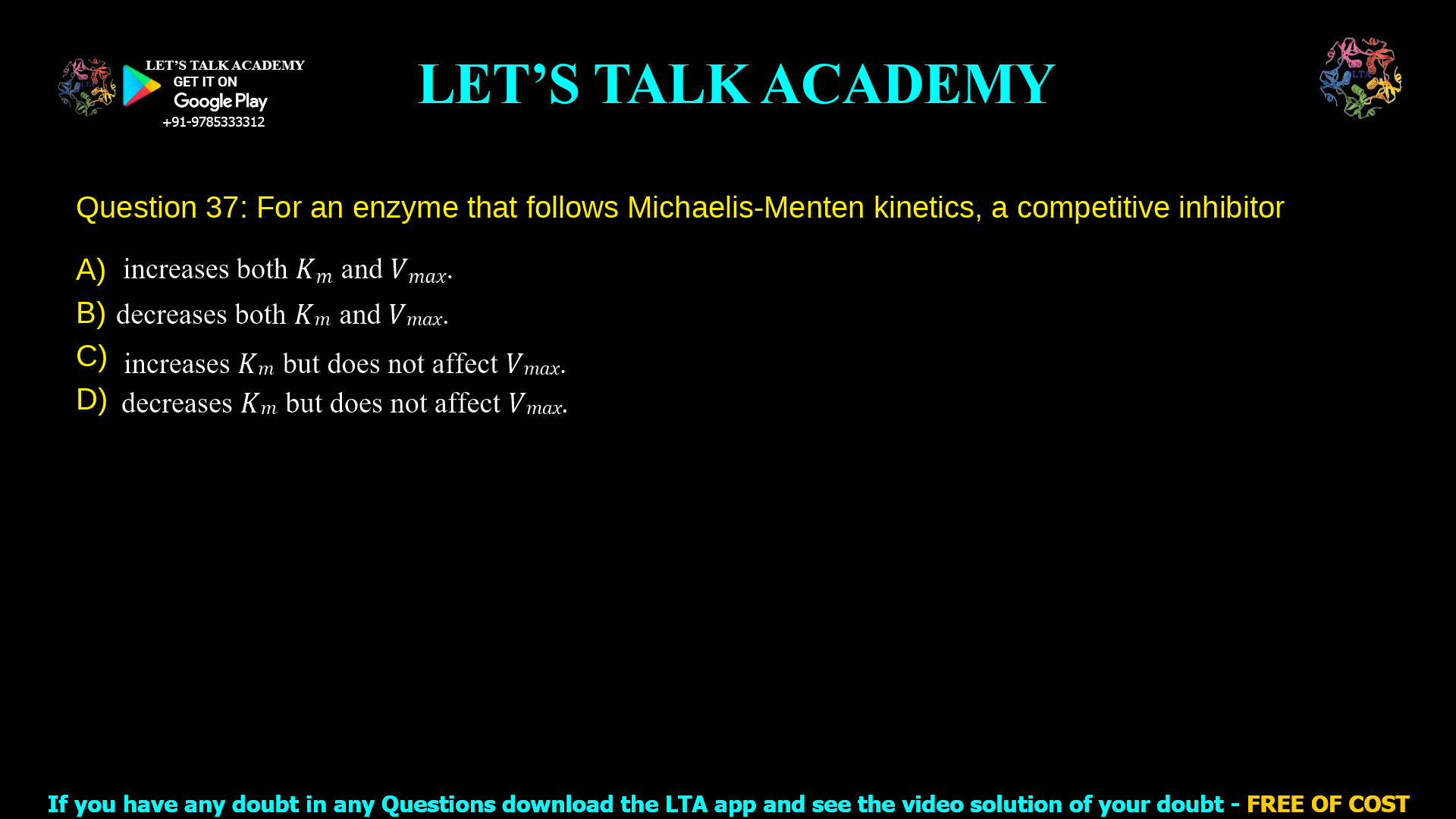
Q.37 For an enzyme that follows Michaelis–Menten kinetics, a competitive inhibitor
(A) increases both 𝐾𝑚 and 𝑉𝑚𝑎𝑥.
(B) decreases both 𝐾𝑚 and 𝑉𝑚𝑎𝑥.
(C) increases 𝐾𝑚 but does not affect 𝑉𝑚𝑎𝑥.
(D) decreases 𝐾𝑚 but does not affect 𝑉𝑚𝑎𝑥.
Correct Answer: (C) increases 𝐾𝑚 but does not affect 𝑉𝑚𝑎𝑥.
Competitive inhibitors bind reversibly to the enzyme’s active site, competing directly with the substrate and reducing the enzyme’s apparent affinity for substrate. This shifts the Michaelis-Menten curve rightward, requiring higher substrate concentrations to reach half-maximal velocity, while sufficient substrate overcomes inhibition to achieve the original maximum rate.
Option Analysis
(A) Increases both 𝐾𝑚 and 𝑉𝑚𝑎𝑥.
Incorrect. Competitive inhibition spares 𝑉𝑚𝑎𝑥 because high substrate displaces the inhibitor from the active site, saturating all enzyme molecules. No source supports 𝑉𝑚𝑎𝑥 increase here.
(B) Decreases both 𝐾𝑚 and 𝑉𝑚𝑎𝑥.
Incorrect. 𝐾𝑚 rises due to competition, not falls; decreased 𝐾𝑚 signals higher affinity, opposite to competitive effects. 𝑉𝑚𝑎𝑥 also stays constant.
(C) Increases 𝐾𝑚 but does not affect 𝑉𝑚𝑎𝑥.
Correct. Inhibitor occupancy raises apparent 𝐾𝑚 (substrate concentration at ½ 𝑉𝑚𝑎𝑥), but 𝑉𝑚𝑎𝑥 remains unchanged as substrate outcompetes at saturation.
(D) Decreases 𝐾𝑚 but does not affect 𝑉𝑚𝑎𝑥.
Incorrect. Decreased 𝐾𝑚 typifies uncompetitive inhibition (binds ES complex), not competitive, which always elevates 𝐾𝑚.
In Michaelis-Menten kinetics, competitive inhibitors play a key role by binding the enzyme active site, mimicking substrate structure to block access. This competition elevates the apparent Km—the substrate concentration yielding half Vmax—while Vmax holds steady, as excess substrate displaces the reversible inhibitor. Understanding this distinction proves vital for CSIR NET exams in biochemistry and enzymology.
Mechanism Breakdown
Competitive inhibition follows the modified Michaelis-Menten equation:
v=Vmax[S]/Km(1+[I]/ki)+[S]
Here, inhibitor concentration [I] and dissociation constant Ki inflate Km without altering Vmax. Lineweaver-Burk plots confirm this: parallel y-intercepts (same Vmax), steeper slopes (higher Km).
Comparison Table
| Inhibition Type | Km Effect | Vmax Effect | Reversibility by Substrate |
|---|---|---|---|
| Competitive | Increases | Unchanged | Yes |
| Non-competitive | Unchanged | Decreases | No |
| Uncompetitive | Decreases | Decreases | No |
This pattern equips students tackling competitive inhibitor Michaelis-Menten kinetics questions in exams like CSIR NET.


2 Comments
Sonal Nagar
January 6, 2026increases 𝐾𝑚 but does not affect 𝑉𝑚𝑎𝑥
Bhanwar
January 24, 2026Increases 𝐾𝑚 but does not affect 𝑉𝑚𝑎𝑥☑️👍