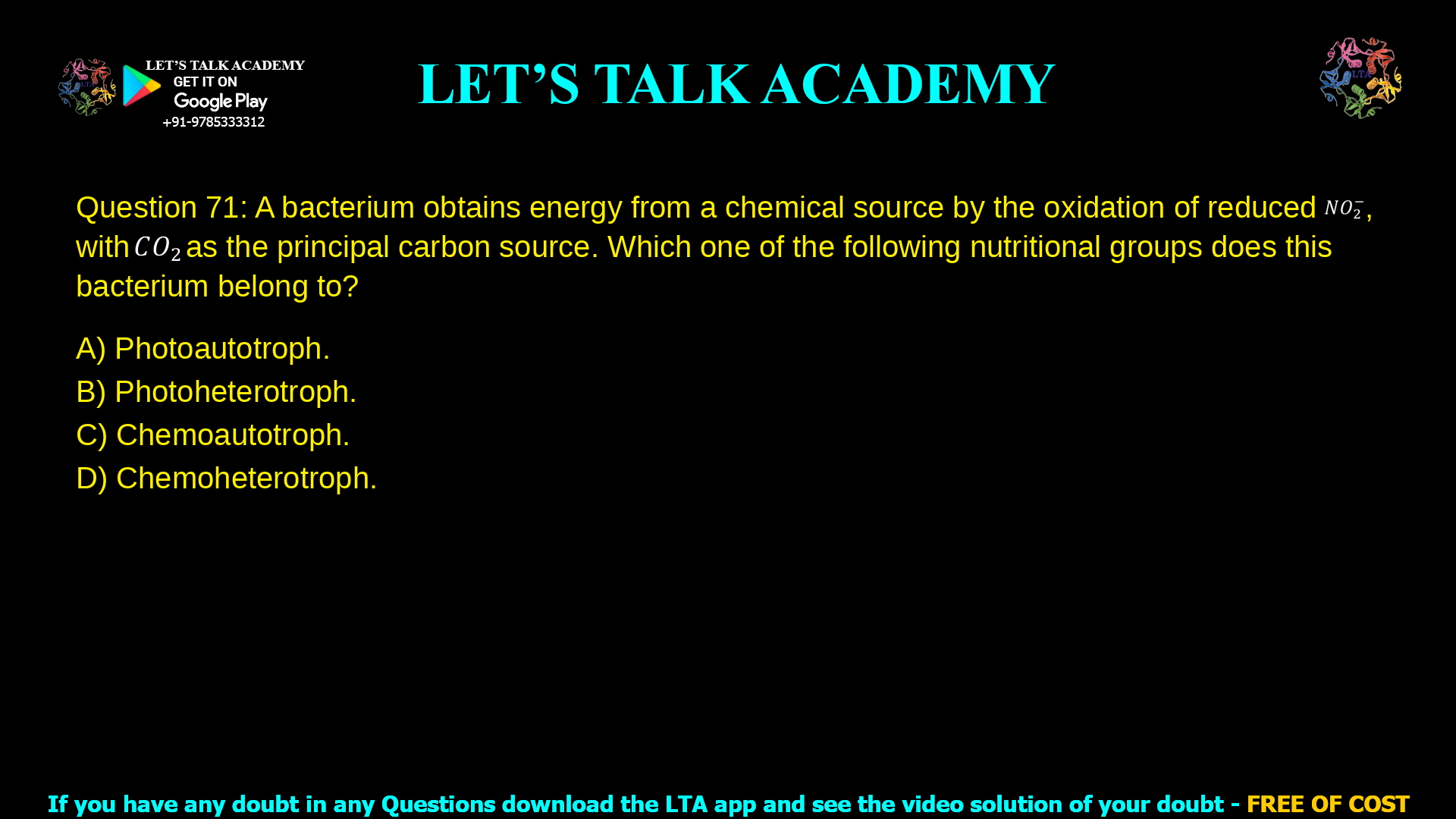
Q.71 A bacterium obtains energy from a chemical source by the oxidation of reduced
𝑁𝑂2–, with 𝐶𝑂2 as the principal carbon source. Which one of the following
nutritional groups does this bacterium belong to?
(A) Photoautotroph.
(B) Photoheterotroph.
(C) Chemoautotroph.
(D) Chemoheterotroph.
The bacterium belongs to the chemoautotroph nutritional group. It derives energy from oxidizing reduced NO₂⁻ (nitrite) chemically and fixes CO₂ as its carbon source, matching the definition of nitrite-oxidizing bacteria like Nitrobacter.
Option Analysis
Photoautotroph (A): These organisms use light energy for photosynthesis and CO₂ as carbon source, such as cyanobacteria. No light involvement here rules this out.
Photoheterotroph (B): These use light for energy but require organic carbon sources, not CO₂. Chemical oxidation and CO₂ use eliminate this.
Chemoautotroph (C): Correct. Energy comes from inorganic chemical oxidation (reduced NO₂⁻ to NO₃⁻), with CO₂ fixed via Calvin cycle, as in Nitrobacter and Nitrospira.
Chemoheterotroph (D): These oxidize chemicals for energy but need organic carbon. CO₂ as principal carbon source excludes this.
Introduction
In microbiology, classifying bacteria by nutritional groups—such as those oxidizing reduced NO₂⁻ (nitrite) with CO₂ as the principal carbon source—is key for CSIR NET Life Sciences. This bacterium exemplifies chemoautotrophs, harnessing chemical energy from inorganic oxidation while fixing CO₂ autotrophically.
Nutritional Groups Defined
Bacterial nutrition hinges on energy and carbon sources: phototrophs (light-based) vs. chemotrophs (chemical-based), autotrophs (CO₂) vs. heterotrophs (organic).
-
Photoautotrophs: Light energy powers CO₂ fixation (e.g., purple sulfur bacteria).
-
Photoheterotrophs: Light energy, organic carbon (e.g., Rhodospirillum).
-
Chemoautotrophs: Chemical oxidation of inorganics (e.g., NO₂⁻ → NO₃⁻) yields energy; CO₂ fixed (e.g., Nitrobacter).
-
Chemoheterotrophs: Chemical energy from organics; organic carbon (e.g., E. coli).
Nitrite-Oxidizing Chemoautotrophs
Nitrite-oxidizing bacteria (NOB) like Nitrobacter, Nitrospira oxidize NO₂⁻ to NO₃⁻, generating energy (ΔG∘′=−74kJ/mol NO₂⁻) and using CO₂ via reductive TCA or Calvin cycle. This nitrification step sustains soil fertility and ecosystems.
| Group | Energy Source | Carbon Source | Example |
|---|---|---|---|
| Photoautotroph | Light | CO₂ | Cyanobacteria |
| Photoheterotroph | Light | Organic | Rhodopseudomonas |
| Chemoautotroph | Inorganic chemicals (e.g., NO₂⁻) | CO₂ | Nitrobacter |
| Chemoheterotroph | Organic chemicals | Organic | Bacillus |


1 Comment
Sonal Nagar
January 8, 2026Chemoautotroph