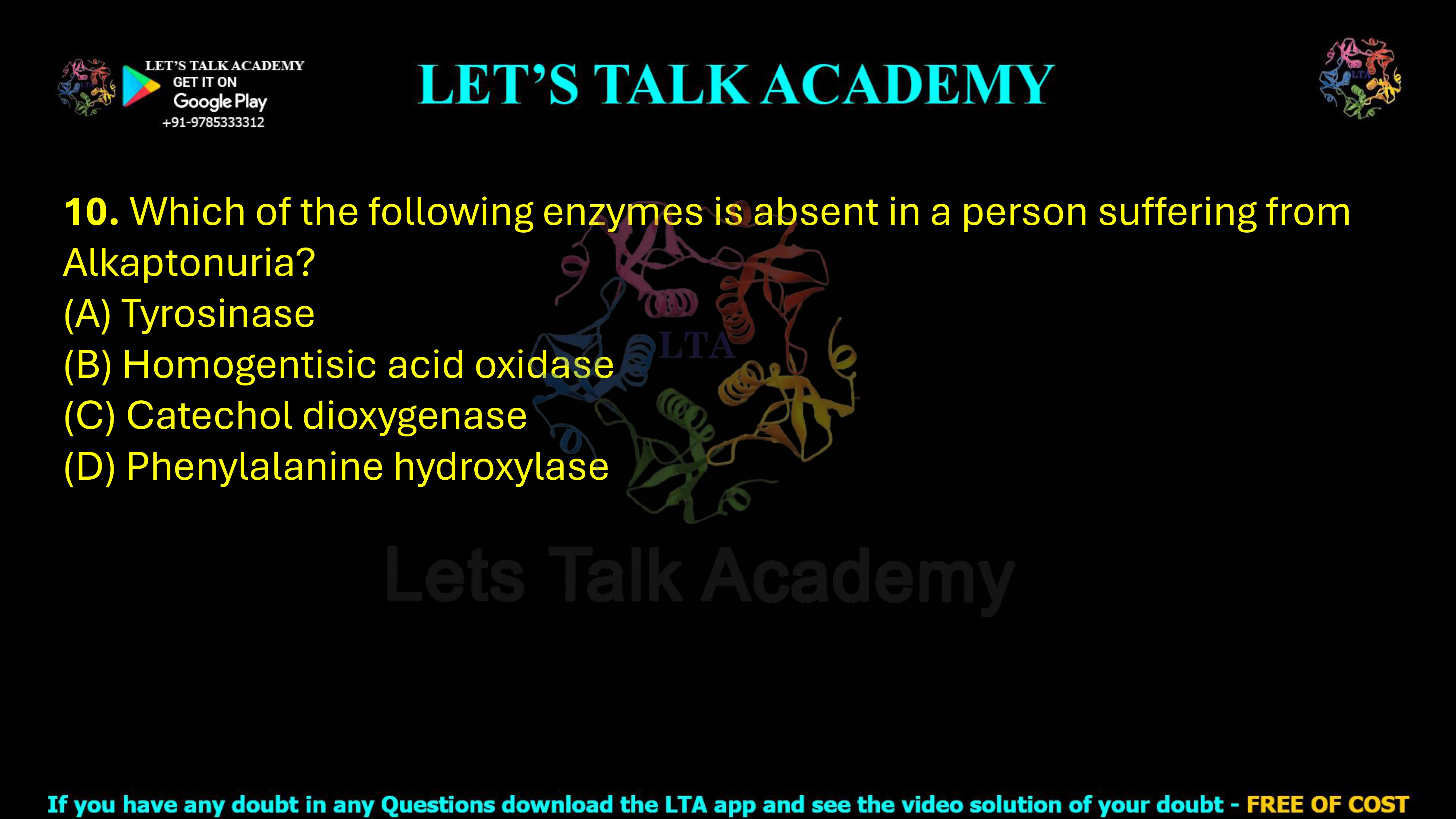
10. Which of the following enzymes is absent in a person suffering from Alkaptonuria?
(A) Tyrosinase
(B) Homogentisic acid oxidase
(C) Catechol dioxygenase
(D) Phenylalanine hydroxylase
Alkaptonuria Explained: Homogentisic Acid Oxidase Deficiency and Tyrosine Metabolism
Introduction
Alkaptonuria is one of the earliest discovered inborn errors of metabolism and was first described by Sir Archibald Garrod while developing the concept of biochemical individuality. It is a rare autosomal recessive genetic disorder caused by a defect in the degradation pathway of the amino acids phenylalanine and tyrosine. Due to the absence or deficiency of a specific metabolic enzyme, an intermediate metabolite called homogentisic acid accumulates in the body.
The accumulated homogentisic acid is excreted in urine, which turns dark brown or black upon standing because of oxidation. Over time, homogentisic acid also deposits in connective tissues, cartilage, and joints, producing a condition known as ochronosis. Patients often develop arthritis, pigmentation of cartilage, heart valve abnormalities, and kidney stones later in life. Understanding the enzyme deficiency responsible for Alkaptonuria is an important concept in human genetics, medical biochemistry, and metabolic diseases.
Correct Answer
Correct Option: (B) Homogentisic acid oxidase
Detailed Explanation
Alkaptonuria results from a deficiency of the enzyme homogentisic acid oxidase, also known as homogentisate 1,2-dioxygenase (HGD). This enzyme normally catalyzes the conversion of homogentisic acid into maleylacetoacetate during the degradation of phenylalanine and tyrosine.
When this enzyme is absent or nonfunctional, homogentisic acid cannot be metabolized and therefore accumulates in body fluids and connective tissues. Excess homogentisic acid is excreted in urine, where exposure to air causes oxidation and polymerization, producing the characteristic black-colored urine observed in patients with Alkaptonuria.
Long-term accumulation of homogentisic acid also leads to ochronosis, in which connective tissues become darkly pigmented. This eventually causes progressive arthritis, especially in large joints and the spine, making Alkaptonuria a multisystem metabolic disorder.
Tyrosine Degradation Pathway
The simplified metabolic pathway is:
Phenylalanine → Tyrosine → p-Hydroxyphenylpyruvate → Homogentisic Acid → Maleylacetoacetate → Fumarylacetoacetate → Fumarate + Acetoacetate
The blocked step in Alkaptonuria is:
Homogentisic Acid ──X──► Maleylacetoacetate
The missing enzyme is Homogentisic Acid Oxidase (Homogentisate Dioxygenase).
Explanation of Each Option
Option (A): Tyrosinase
This option is incorrect. Tyrosinase is involved in melanin synthesis. Deficiency of tyrosinase causes albinism, not Alkaptonuria.
Option (B): Homogentisic Acid Oxidase
This option is correct. Deficiency of homogentisic acid oxidase blocks tyrosine degradation, causing accumulation of homogentisic acid and resulting in Alkaptonuria.
Option (C): Catechol Dioxygenase
This option is incorrect. Catechol dioxygenase participates mainly in microbial aromatic compound degradation and is not responsible for human Alkaptonuria.
Option (D): Phenylalanine Hydroxylase
This option is incorrect. Deficiency of phenylalanine hydroxylase causes Phenylketonuria (PKU), another inherited metabolic disorder, but not Alkaptonuria.
Why Option (B) is Correct
The enzyme homogentisic acid oxidase is essential for converting homogentisic acid into maleylacetoacetate during tyrosine metabolism. Its deficiency causes homogentisic acid accumulation, black urine, ochronosis, and degenerative arthritis, all of which are classical features of Alkaptonuria.
Comparison of All Options
| Option | Enzyme | Associated Disorder | Status |
|---|---|---|---|
| A | Tyrosinase | Albinism | Incorrect |
| B | Homogentisic Acid Oxidase | Alkaptonuria | Correct |
| C | Catechol Dioxygenase | Not associated with Alkaptonuria | Incorrect |
| D | Phenylalanine Hydroxylase | Phenylketonuria (PKU) | Incorrect |
Important Inborn Errors of Amino Acid Metabolism
| Disease | Deficient Enzyme | Characteristic Feature |
|---|---|---|
| Alkaptonuria | Homogentisic Acid Oxidase | Black urine, ochronosis |
| Phenylketonuria (PKU) | Phenylalanine Hydroxylase | Intellectual disability if untreated |
| Albinism | Tyrosinase | Reduced melanin synthesis |
| Maple Syrup Urine Disease | Branched-chain α-keto acid dehydrogenase | Sweet-smelling urine |
Clinical Features of Alkaptonuria
| Feature | Cause |
|---|---|
| Black urine on standing | Oxidation of homogentisic acid |
| Ochronosis | Pigment deposition in connective tissues |
| Degenerative arthritis | Cartilage damage due to pigment accumulation |
| Autosomal recessive inheritance | Mutation in the HGD gene |
Biological Significance
Alkaptonuria highlights the importance of enzymes in metabolic pathways. A defect in a single enzyme can block an entire biochemical pathway, leading to accumulation of toxic intermediates and the development of disease. The disorder also provided one of the earliest examples linking genes to enzyme function, laying the foundation for modern biochemical genetics and molecular medicine.
Final Answer
Alkaptonuria is caused by deficiency of homogentisic acid oxidase (homogentisate 1,2-dioxygenase), leading to accumulation of homogentisic acid, black urine, and ochronosis.
Correct Option: (B) Homogentisic acid oxidase


