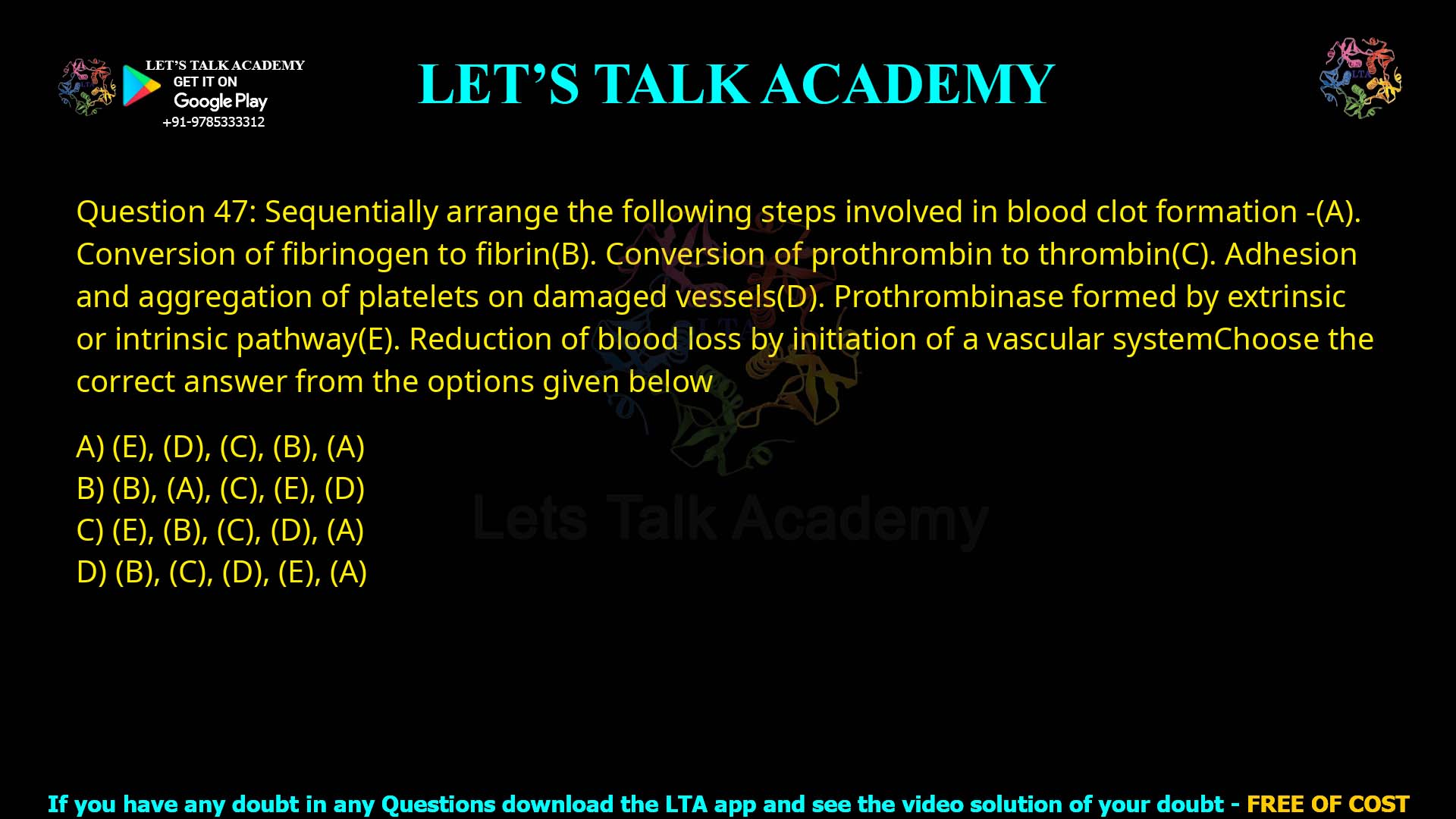
Q.47 Sequentially arrange the following steps involved in blood clot formation –
(A). Conversion of fibrinogen to fibrin
(B). Conversion of prothrombin to thrombin
(C). Adhesion and aggregation of platelets on damaged vessels
(D). Prothrombinase formed by extrinsic or intrinsic pathway
(E). Reduction of blood loss by initiation of a vascular system
Choose the correct answer from the options given below:
1. (E), (D), (C), (B), (A).
2. (B), (A), (C), (E), (D).
3. (E), (B), (C), (D), (A).
4. (B), (C), (D), (E), (A).
The correct sequence for blood clot formation is option 1: (E), (D), (C), (B), (A). This follows the physiological hemostasis process starting from vascular response to fibrin mesh formation.
Hemostasis Overview
Blood clot formation, or hemostasis, prevents excessive bleeding through four main phases: vascular constriction, platelet plug formation, coagulation cascade, and fibrinolysis.
It begins immediately after vessel injury to minimize blood loss.
The process involves both cellular (platelets) and plasma components (clotting factors).
Correct Sequence Breakdown
The right order is (E) → (D) → (C) → (B) → (A), matching option 1.
| Step | Description | Biological Role |
|---|---|---|
| (E) Reduction of blood loss by initiation of a vascular system | Vascular spasm or constriction occurs first upon vessel damage. | Smooth muscle contracts to narrow the vessel, reducing blood flow instantly . |
| (D) Prothrombinase formed by extrinsic or intrinsic pathway | Prothrombinase (Factor Xa) forms via tissue factor (extrinsic) or contact activation (intrinsic). | Activates the common pathway of coagulation . |
| (C) Adhesion and aggregation of platelets on damaged vessels | Platelets adhere to exposed collagen via von Willebrand factor, then aggregate. | Forms primary platelet plug for temporary seal . |
| (B) Conversion of prothrombin to thrombin | Prothrombinase converts prothrombin (Factor II) to thrombin (Factor IIa). | Thrombin amplifies clotting and activates fibrinogen . |
| (A) Conversion of fibrinogen to fibrin | Thrombin cleaves fibrinogen to fibrin monomers, which polymerize. | Creates stable fibrin mesh trapping cells for final clot . |
Why Other Options Are Incorrect
-
Option 2: (B), (A), (C), (E), (D) starts with thrombin formation, skipping initial vascular and platelet responses—logically impossible without prior injury signals.
-
Option 3: (E), (B), (C), (D), (A) places thrombin (B) before platelet plug (C) and prothrombinase (D), but prothrombinase must precede thrombin.
-
Option 4: (B), (C), (D), (E), (A) begins with thrombin (B) and misplaces vascular initiation (E) late; primary hemostasis (E, C) precedes coagulation.
This sequence aligns with standard physiology for exams like NEET, emphasizing primary (vascular/platelet) then secondary (coagulation) hemostasis.


