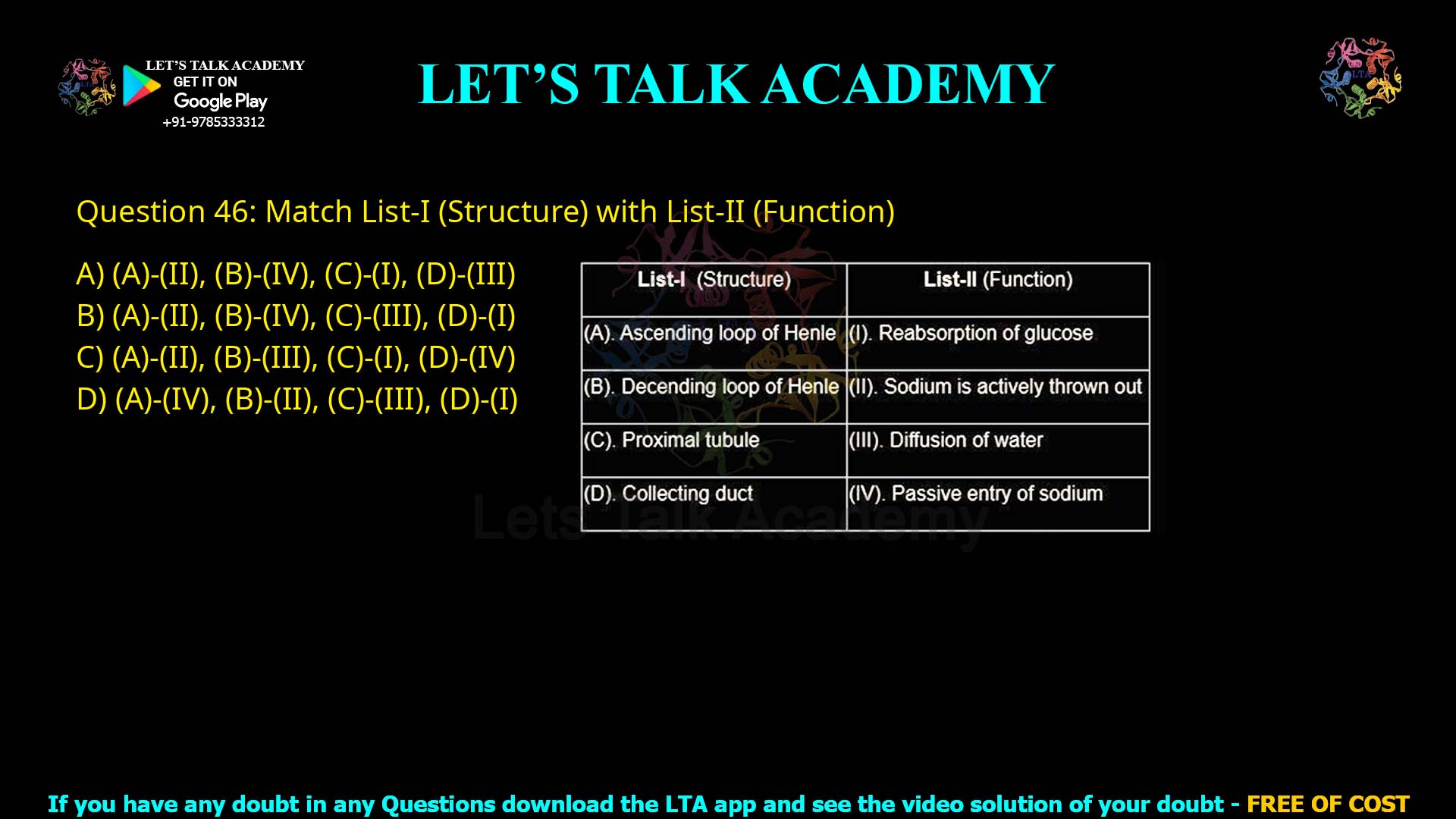
Q.46 Match List-I with List-II
| List-I (Structure) |
List-II (Function) |
| (A) Ascending loop of Henle |
(I) Reabsorption of glucose |
| (B) Descending loop of Henle |
(II) Sodium is actively thrown out |
| (C) Proximal tubule |
(III) Diffusion of water |
| (D) Collecting duct |
(IV) Passive entry of sodium |
Choose the correct answer from the options given below:
- (A) – (II), (B) – (IV), (C) – (I), (D) – (III)
- (A) – (II), (B) – (IV), (C) – (III), (D) – (I)
- (A) – (II), (B) – (III), (C) – (I), (D) – (IV)
- (A) – (IV), (B) – (II), (C) – (III), (D) – (I)
Nephron Structures Matched to Functions: Correct Answer for Q.46 Revealed
The nephron’s loop of Henle and tubules handle selective reabsorption and water balance in kidney function. Correct matching ensures exam success in physiology questions like this one.
Correct Answer
Option (C) (A) – (II), (B) – (III), (C) – (I), (D) – (IV) pairs each structure correctly.
Technique Matches Explained
-
(A) Ascending loop of Henle – (II) Sodium is actively thrown out: Thick ascending limb pumps Na+ out actively via Na-K-2Cl cotransporters, diluting filtrate without water.
-
(B) Descending loop of Henle – (III) Diffusion of water: Thin descending limb is permeable to water, allowing passive diffusion out into hypertonic medulla.
-
(C) Proximal tubule – (I) Reabsorption of glucose: Proximal convoluted tubule reabsorbs nearly all glucose via SGLT transporters alongside Na+.
-
(D) Collecting duct – (IV) Passive entry of sodium: Principal cells allow paracellular Na+ entry driven by medullary gradient, regulated by aldosterone.
Why Other Options Fail
Option (A) wrongly assigns water diffusion to collecting duct instead of descending limb.
Option (B) mismatches ascending loop’s active transport with proximal tubule’s glucose role.
Option (D) swaps ascending loop to passive Na+ entry, which fits descending limb poorly.
Exam Tips
Recall countercurrent multiplier: descending loses water, ascending pumps salt. Practice with nephron diagrams labeling transport mechanisms.