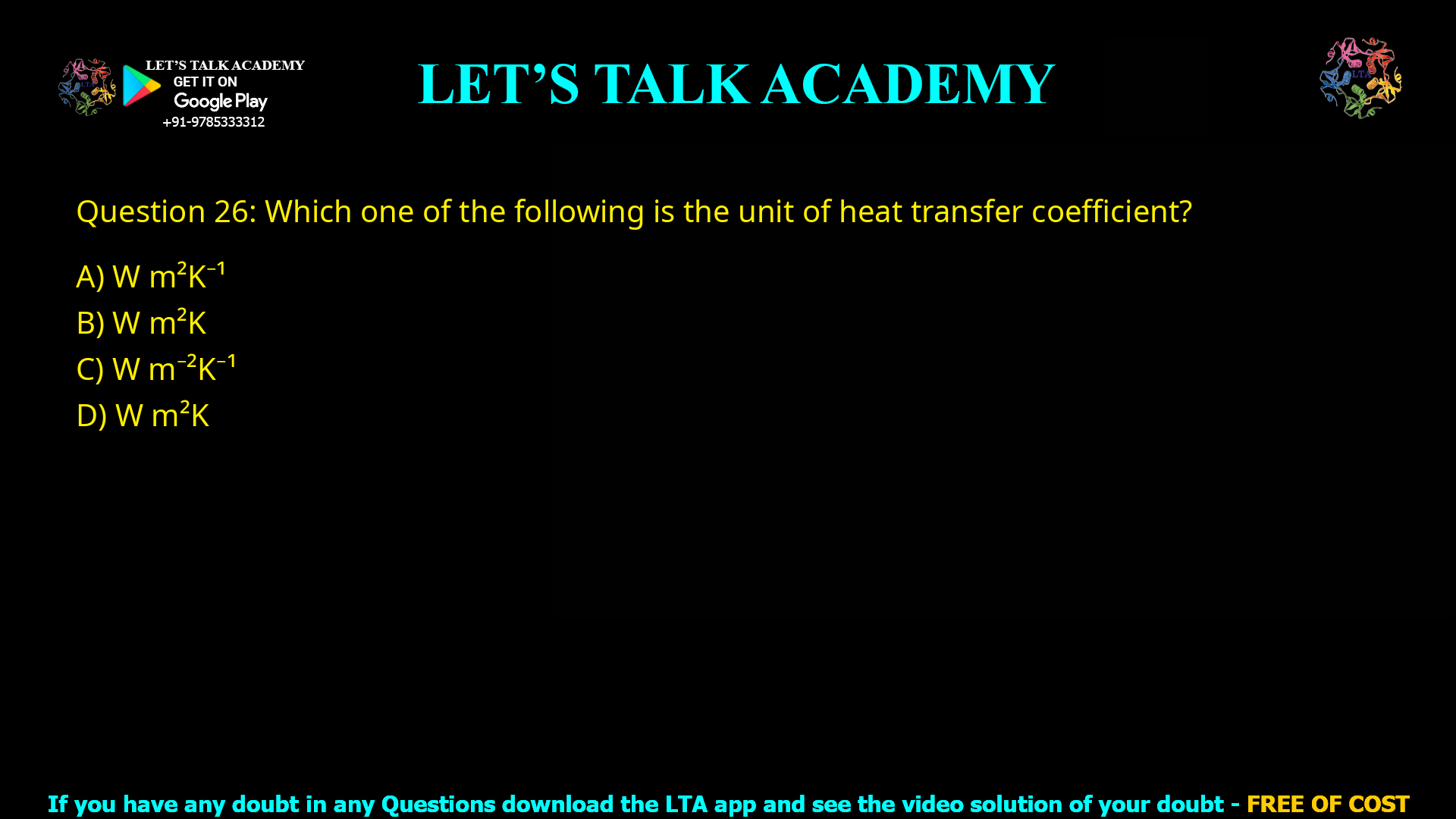
Q.26 Which one of the following is the unit of heat transfer coefficient?
(A) W m2 K-1
(B) W m-2 K
(C) W m-2 K-1
(D) W m2 K
The unit of heat transfer coefficient is W m-2 K-1 (option C). This follows from Newton’s law of cooling, where heat flux q = h ΔT, with q in W/m² and ΔT in K, yielding h in W m-2 K-1.
Option Analysis
Heat transfer coefficient h (or overall U) quantifies convective heat transfer rate per unit area per unit temperature difference.
- (A) W m2 K-1: Incorrect; resembles thermal resistance (m² K/W), inverse of
h. - (B) W m-2 K: Incorrect; lacks inverse temperature dependence, as
hdivides byΔT(K). - (C) W m-2 K-1: Correct; matches
q = h ΔT, standard SI unit across convection, boiling, and overall transfer. - (D) W m2 K: Incorrect; implies heat rate times area times temperature, not a coefficient.
The unit of heat transfer coefficient is a fundamental concept in heat and mass transfer, crucial for competitive exams like IIT JAM and GATE. Defined as the heat flux per unit temperature difference, it ensures accurate calculations in convection and heat exchanger design. Understanding why W m-2 K-1 is the correct unit of heat transfer coefficient helps differentiate it from thermal conductivity (W m-1 K-1).
Derivation of Heat Transfer Coefficient Unit
From q = h ΔT:
q: W m-2 (heat flux)ΔT: K- Thus,
h = q / ΔT: W m-2 K-1
This applies to convective h, film coefficient, and overall U in Q = U A ΔT.
Common Confusions in MCQs
Exams test dimensional analysis:
| Option | Formula Match | Why Wrong/Correct |
|---|---|---|
| (A) W m2 K-1 | No | Inverse units (resistance) |
| (B) W m-2 K | No | Missing K-1 |
| (C) W m-2 K-1 | Yes | Exact SI unit |
| (D) W m2 K | No | Multiplies by K |
Practical Applications
In heat exchangers, U values range 10–5000 W m-2 K-1 depending on fluids. For air cooling, typical h ≈ 10–100 W m-2 K-1.


