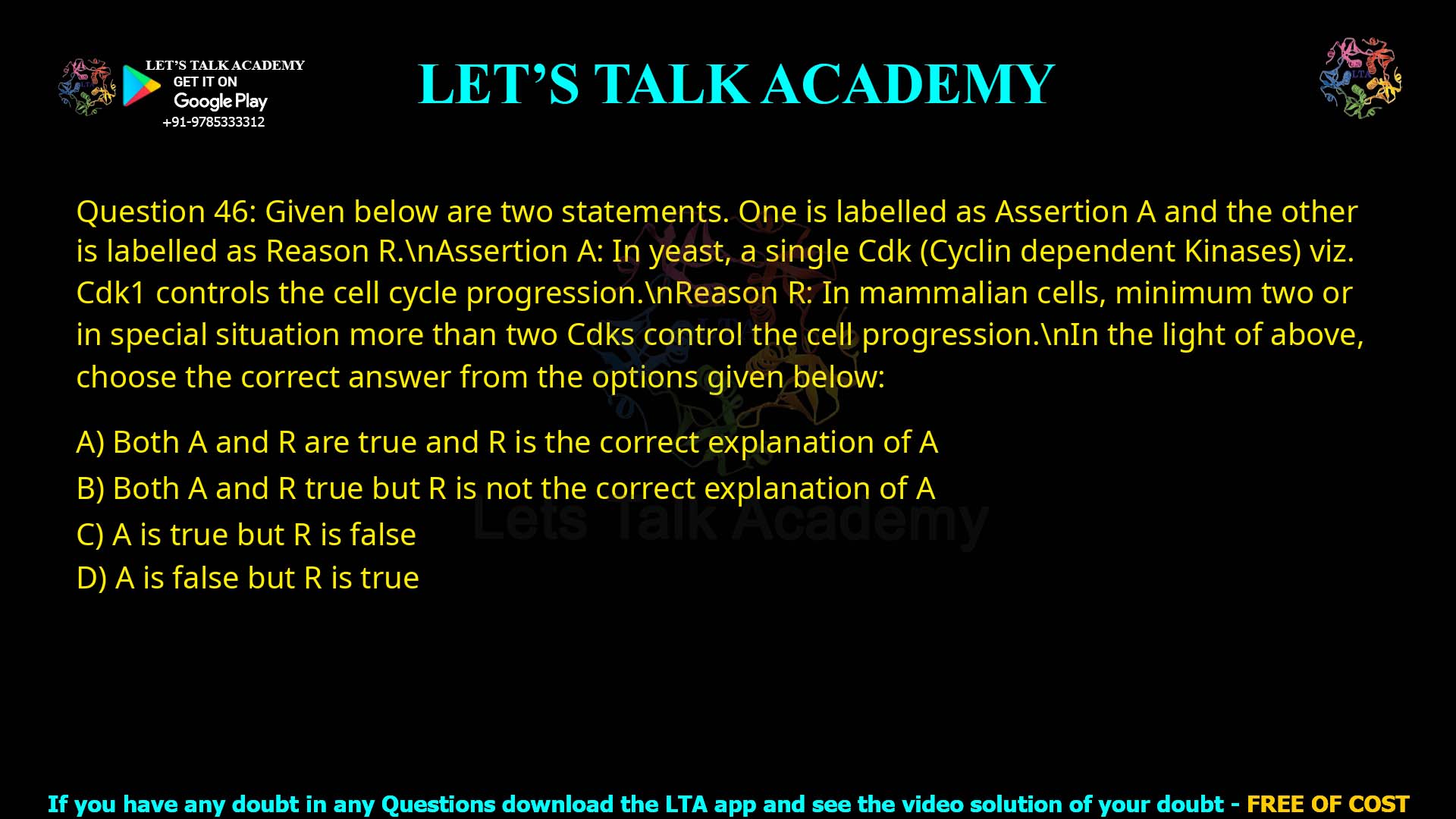
Q.46 Given below are two statements. One is labelled as Assertion A and the other is labelled as Reason R.
Assertion A: In yeast, a single Cdk (Cyclin dependent Kinases) viz. Cdk1 controls the cell cycle progression.
Reason R: In mammalian cells, minimum two or in special situation more than two Cdks control the cell
progression.
In the light of above, choose the correct answer from the options given below:
1. Both A and R are true and R is the correct explanation of A
2. Both A and R true but R is not the correct explanation of A
3. A is true but R is false
4. A is false but R is true
Yeast Cdk1 Controls Cell Cycle: Assertion-Reason Analysis
In yeast, a single cyclin-dependent kinase (Cdk1, or Cdc28) orchestrates all cell cycle phases by pairing with different cyclins, unlike mammalian cells requiring multiple Cdks for progression. This assertion-reason question highlights evolutionary differences in cell cycle regulation, key for biology exams.
Correct Answer
Option 2: Both A and R are true but R is not the correct explanation of A.
Assertion A is true: Yeast relies solely on Cdk1 (Cdc28 in S. cerevisiae) to drive G1/S, S, G2/M transitions via cyclin binding. Reason R is true for mammalian cells, where Cdks like CDK1, CDK2, CDK4/6 handle phases, sometimes exceeding two in specialized cases. However, R contrasts yeast with mammals without explaining why yeast uses one Cdk.
Option Breakdown
-
Option 1: Incorrect; R describes mammalian complexity but doesn’t causally explain yeast’s single-Cdk strategy, which stems from simpler genome and cyclin diversity.
-
Option 2 (Correct): Both statements factually hold, yet R serves as contrast, not explanation—yeast Cdk1 sufficiency arises from evolutionary streamlining, independent of mammalian multi-Cdk needs.
-
Option 3: Invalid; R accurately reflects mammalian regulation (e.g., CDK4/6 for G1, CDK1 for mitosis, extras like CDK7 in stress).
-
Option 4: False; A is established in yeast models like S. cerevisiae and S. pombe, where Cdk1 alone governs mitosis/meiosis via cyclin oscillations.
Cell Cycle Regulation Differences
Yeast Cdk1 pairs with cyclins (Cln for G1, Clb for S/G2/M) for phased activity, ensuring ordered progression without extra Cdks. Mammals evolved multiple Cdks for tissue-specific control and checkpoint fidelity, reflecting complexity. This single-Cdk efficiency in yeast simplifies research on core mechanisms.


