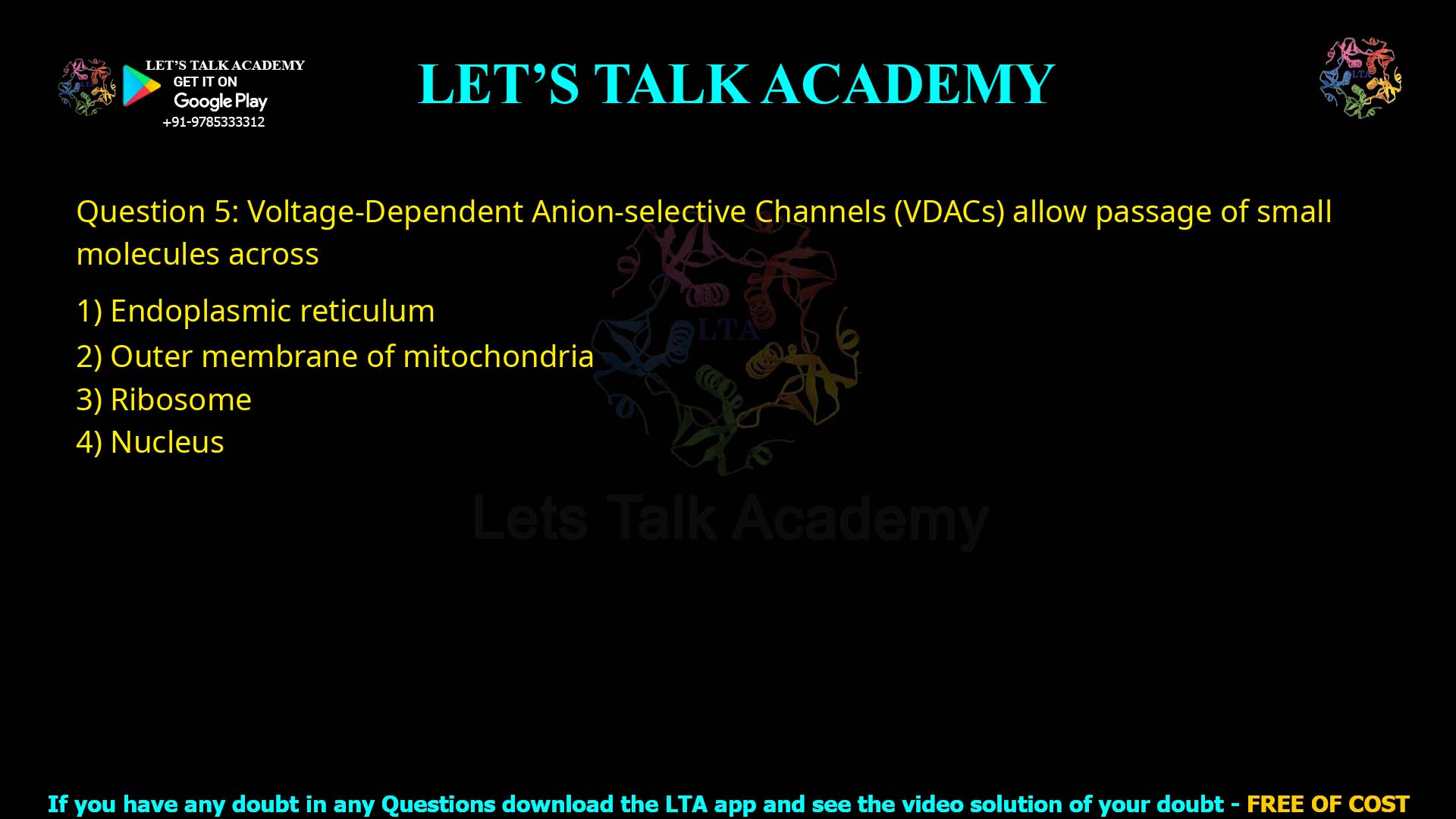
Q.5 Voltage-Dependent Anion-selective Channels (VDACs) allow passage of small molecules across
(1) Endoplasmic reticulum
(2) Outer membrane of mitochondria
(3) Ribosome
(4) Nucleus
Here’s a well-structured, SEO-friendly article on Voltage-Dependent Anion-selective Channels (VDACs), optimized for search engines with the key phrase “VDACs allow passage across,” a concise title, meta description, and a clean slug.
What Are VDACs and Where Do They Allow Passage Across?
Voltage-Dependent Anion-selective Channels (VDACs) are porin proteins that form channels in cellular membranes, enabling the transport of small molecules like ions, ATP, and metabolites (up to ~5 kDa). In the MCQ: “VDACs allow passage of small molecules across,” the correct answer is (2) Outer membrane of mitochondria.
VDACs reside primarily in the outer mitochondrial membrane, regulating metabolite flux between the cytosol and mitochondrial intermembrane space. This supports key processes like oxidative phosphorylation and apoptosis. Let’s break down all options with evidence-based reasoning.
Correct Answer: Option (2) – Outer Membrane of Mitochondria
VDACs are the most abundant proteins in the mitochondrial outer membrane, forming β-barrel pores that selectively allow anions and small hydrophilic molecules to pass. Their voltage-gated nature closes channels at high membrane potentials, fine-tuning mitochondrial function.
-
Key Evidence: Discovered in the 1970s, VDACs (isoforms VDAC1-3 in mammals) control ~80-90% of outer membrane permeability. Studies (e.g., in Nature Reviews Molecular Cell Biology) confirm their role in ATP/ADP exchange via the adenine nucleotide translocase.
This matches the question precisely—VDACs enable small molecule passage here.
Why Not the Other Options? Full Explanations
-
Option (1) Endoplasmic Reticulum: Incorrect. The ER membrane uses different channels like Sec61 for protein translocation or IP3 receptors for calcium. No VDACs are found here; ER porins differ structurally and functionally.
-
Option (3) Ribosome: Incorrect. Ribosomes are ribonucleoprotein complexes for protein synthesis, lacking membranes or channels. They have no role in small molecule transport across barriers—VDACs aren’t associated with translation machinery.
-
Option (4) Nucleus: Incorrect. The nuclear envelope’s outer membrane has some shared proteins, but VDACs localize to mitochondria, not nuclear pores. Nuclear pore complexes (NPCs) handle larger macromolecules via FG-nucleoporins, not VDAC-like anion channels.
Quick Comparison Table: VDAC Locations vs. Options
| Option | Structure | Small Molecule Channels? | VDACs Present? |
|---|---|---|---|
| (1) ER | Single bilayer | Sec61, IP3R | No |
| (2) Mitochondrial outer membrane | Double membrane (outer) | VDACs (porins) | Yes |
| (3) Ribosome | Non-membranous complex | None | No |
| (4) Nucleus | Double membrane with pores | NPCs | No |
Why This Matters in Molecular Biology
Understanding VDAC location is crucial for mitochondrial dynamics, bioenergetics, and diseases like cancer (where VDAC dysregulation promotes Warburg effect) or neurodegeneration. For exams like NEET, CSIR NET, or grad-level molecular biology, this tests organelle-specific protein localization.


