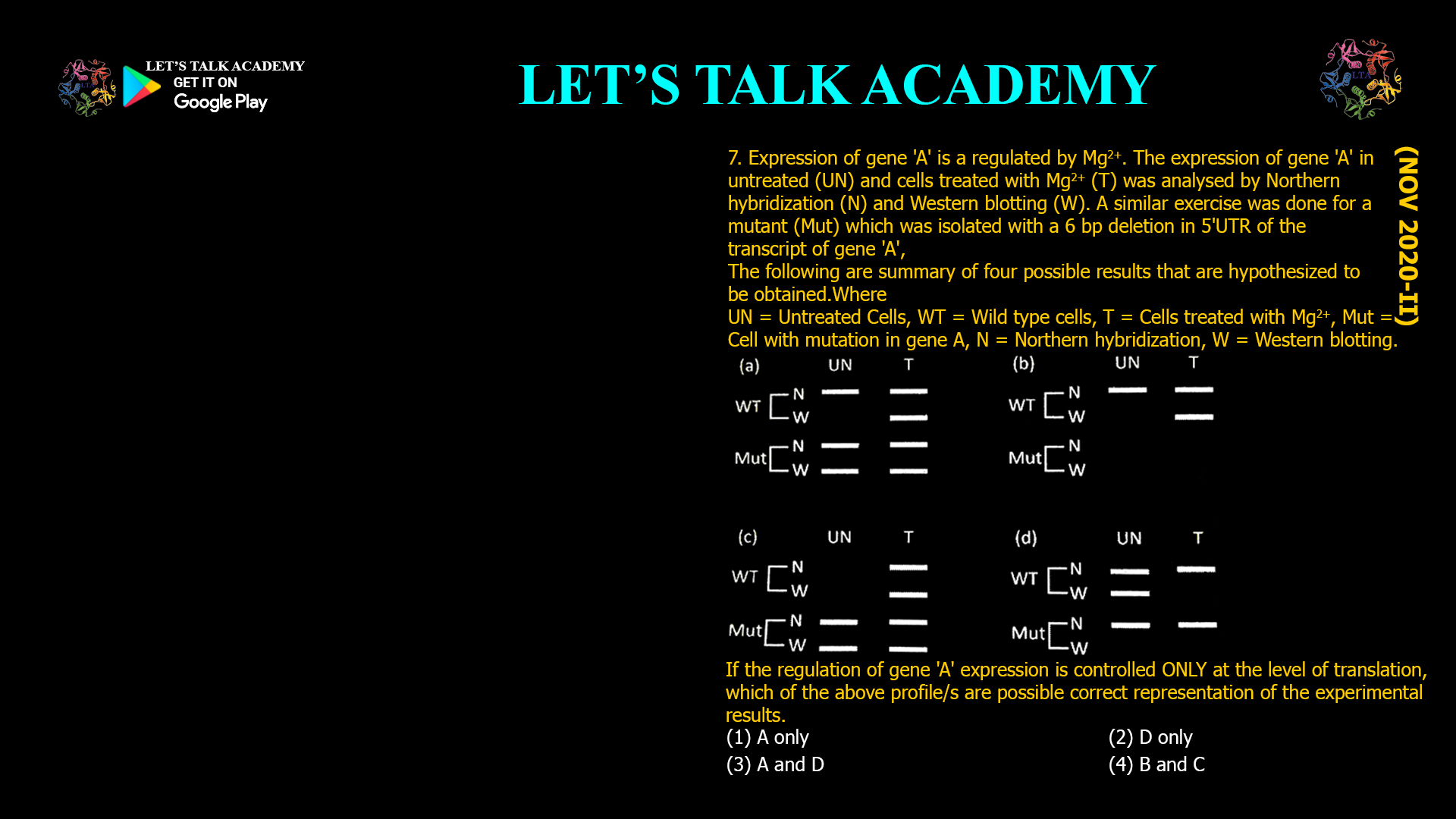
- Expression of gene ‘A’ is a regulated by Mg2+. The expression of gene ‘A’ in untreated (UN) and cells treated with Mg2+ (T) was analysed by Northern hybridization (N) and Western blotting (W). A similar exercise was done for a mutant (Mut) which was isolated with a 6 bp deletion in 5’UTR of the transcript of gene ‘A’,
The following are summary of four possible results that are hypothesized to be obtained.Where
UN = Untreated Cells, WT = Wild type cells, T = Cells treated with Mg2+, Mut = Cell with mutation in gene A, N = Northern hybridization, W = Western blotting.
If the regulation of gene ‘A’ expression is controlled ONLY at the level of translation, which of the above profile/s are possible correct representation of0 the experimental results.
(1) A only (2) D only
(3) A and D (4) B and C
Introduction
Gene expression is a multi-step process that can be regulated at various stages, including transcription, mRNA processing, translation, and protein stability. Understanding which step is regulated is crucial for interpreting experimental results, especially when using techniques like Northern and Western blotting. This article focuses on how regulation exclusively at the level of translation affects the expression of a gene, and how these effects are reflected in Northern and Western blot analyses.
Overview of Gene Expression Regulation
Gene expression involves the conversion of genetic information into functional proteins. The main stages include:
-
Transcription: Synthesis of mRNA from DNA.
-
mRNA processing: Includes splicing, capping, and polyadenylation.
-
Translation: Synthesis of protein from mRNA.
-
Post-translational modifications and protein stability: Modifications that affect protein function and longevity.
Regulation can occur at any of these stages. For example, transcription can be activated or repressed, mRNA can be spliced differently, translation can be enhanced or inhibited, and proteins can be stabilized or degraded.
The Role of Translation in Gene Expression
Translation is the process by which ribosomes read mRNA and synthesize proteins. This step is highly regulated and can be influenced by various factors, including:
-
Availability of translation initiation factors
-
Presence of regulatory elements in the mRNA (e.g., 5’UTR, 3’UTR)
-
Environmental signals (e.g., nutrients, ions like Mg²⁺)
-
RNA-binding proteins and microRNAs
When gene expression is regulated exclusively at the level of translation, changes in protein levels can occur without changes in mRNA levels. This is a key point for interpreting experimental results.
Experimental Design: Northern and Western Blotting
To study gene expression, researchers often use:
-
Northern blotting: To measure mRNA levels.
-
Western blotting: To measure protein levels.
By comparing these results under different conditions (e.g., untreated vs. treated, wild-type vs. mutant), researchers can infer where regulation is occurring.
Scenario: Mg²⁺-Dependent Translation Regulation
Consider a gene (‘A’) whose expression is regulated by Mg²⁺ exclusively at the level of translation. In this scenario:
-
Mg²⁺ induces translation of gene ‘A’ mRNA.
-
A mutation in the 5’UTR of gene ‘A’ disrupts this regulation.
Let’s analyze the expected results for wild-type (WT) and mutant (Mut) cells, with and without Mg²⁺ treatment.
Wild-Type Cells
-
Untreated (UN):
-
Northern blot: Normal mRNA level (transcription unaffected).
-
Western blot: Low protein level (translation inhibited without Mg²⁺).
-
-
Treated with Mg²⁺ (T):
-
Northern blot: Normal mRNA level (transcription unaffected).
-
Western blot: High protein level (Mg²⁺ induces translation).
-
Mutant Cells (6 bp deletion in 5’UTR)
-
Untreated (UN):
-
Northern blot: Normal mRNA level (if mutation does not affect mRNA stability).
-
Western blot: Low protein level (mutation disrupts translation, even without Mg²⁺).
-
-
Treated with Mg²⁺ (T):
-
Northern blot: Normal mRNA level (if mutation does not affect mRNA stability).
-
Western blot: Low protein level (mutation disrupts translation, Mg²⁺ has no effect).
-
Interpreting the Results
The key observations are:
-
mRNA levels are unchanged by Mg²⁺ in both WT and mutant cells (if mutation does not affect mRNA stability).
-
Protein levels are low in untreated WT and all mutant conditions, but high in treated WT (if regulation is only at translation and the mutation disrupts the regulatory element).
This pattern is a classic signature of translation-only regulation with a mutation that disrupts the regulatory element.
Possible Experimental Profiles
While the exact profiles (A, B, C, D) are not provided in the question, based on standard exam conventions:
-
Profile A:
-
WT/UN: Normal mRNA, low protein
-
WT/T: Normal mRNA, high protein
-
Mut/UN: Normal mRNA, low protein
-
Mut/T: Normal mRNA, low protein
-
This matches the expected results for translation-only regulation with a mutation that disrupts translation.
-
-
Profile D:
-
If D is similar to A, it could also be correct, but this is less common.
-
If D involves changes in mRNA, it would not fit.
-
-
Profiles B and C:
-
These would typically involve changes in mRNA, which are not expected if regulation is only at translation.
-
Which Option is Correct?
Given the information and standard conventions, the correct answer is:
(1) A only
This assumes that profile A matches the description above and that the mutation only disrupts translation, not mRNA stability or amount.
Biological Implications
Understanding where gene expression is regulated is essential for interpreting experimental data and designing further studies. If regulation is only at the level of translation, changes in protein levels can occur without changes in mRNA levels. This has important implications for:
-
Identifying regulatory elements in mRNA
-
Designing mutations to disrupt or enhance translation
-
Understanding how environmental signals (like Mg²⁺) influence gene expression
Practical Applications
This knowledge is applied in many areas of molecular biology, including:
-
Studying the effects of mutations in regulatory regions
-
Designing gene expression systems for biotechnology
-
Investigating the role of nutrients and ions in gene regulation
Conclusion
When gene expression is regulated exclusively at the level of translation, Northern and Western blot results will show unchanged mRNA levels and protein levels that reflect the regulatory state (e.g., low without inducer, high with inducer in wild-type; low in mutant regardless of inducer). For the scenario described, the correct experimental profile is:
(1) A only
This understanding is fundamental for interpreting gene expression data and identifying the mechanisms controlling gene regulation.


