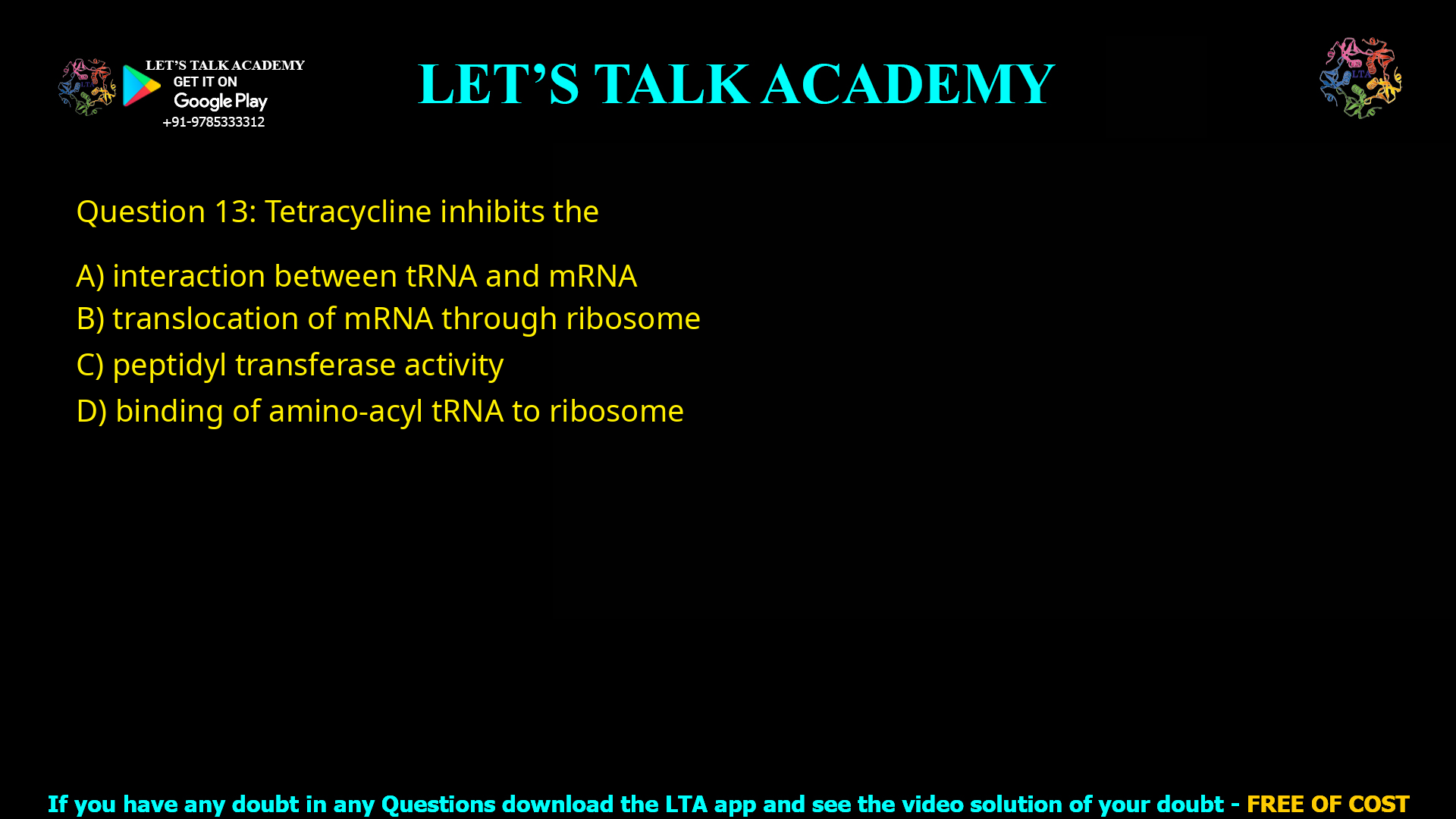
Q.13 Tetracycline inhibits the
(A) interaction between tRNA and mRNA
(B) translocation of mRNA through ribosome
(C) peptidyl transferase activity
(D) binding of amino–acyl tRNA to ribosome
Tetracycline inhibits the binding of aminoacyl-tRNA to the A site of the bacterial ribosome, preventing protein synthesis during translation elongation. This makes option (D) the correct answer for the multiple-choice question.
Option Analysis
Translation involves initiation, elongation (aminoacyl-tRNA binding, peptidyl transfer, translocation), and termination on the ribosome.
-
(A) Interaction between tRNA and mRNA: Incorrect. Tetracycline does not directly block anticodon-codon pairing; it prevents tRNA from accessing the A site to enable that interaction.
-
(B) Translocation of mRNA through ribosome: Incorrect. Translocation is handled by EF-G after peptide bond formation; tetracycline acts earlier by blocking A-site entry.
-
(C) Peptidyl transferase activity: Incorrect. Peptidyl transferase (on 50S subunit) forms peptide bonds; tetracycline targets the 30S subunit without affecting this enzyme.
-
(D) Binding of amino-acyl tRNA to ribosome: Correct. Tetracycline binds the 30S subunit at the A site, sterically blocking aminoacyl-tRNA accommodation and halting elongation.
Tetracycline inhibits binding of amino-acyl tRNA to ribosome, a key step in bacterial protein synthesis, making it essential knowledge for exams like IIT JAM Biotechnology. This broad-spectrum antibiotic targets the 30S ribosomal subunit to block translation elongation.
Protein Synthesis Stages
Bacterial translation proceeds as:
-
Initiation: Ribosome assembles on mRNA.
-
Elongation: Aminoacyl-tRNA binds A site, peptidyl transferase links peptides, EF-G translocates.
-
Termination: Release factors end chain growth.
Tetracycline disrupts elongation by occupying the A site.
Why Option D is Correct
By binding near the A site on 16S rRNA, tetracycline prevents codon-anticodon recognition and tRNA entry, starving the ribosome of amino acids without impacting eukaryotic ribosomes. Resistance often involves efflux pumps or protective proteins.
Exam Relevance
For competitive exams, recall: Tetracycline (30S, A-site block) vs. Chloramphenicol (50S, peptidyl transferase) vs. Erythromycin (50S, translocation). Practice similar MCQs to master antibiotic mechanisms.


