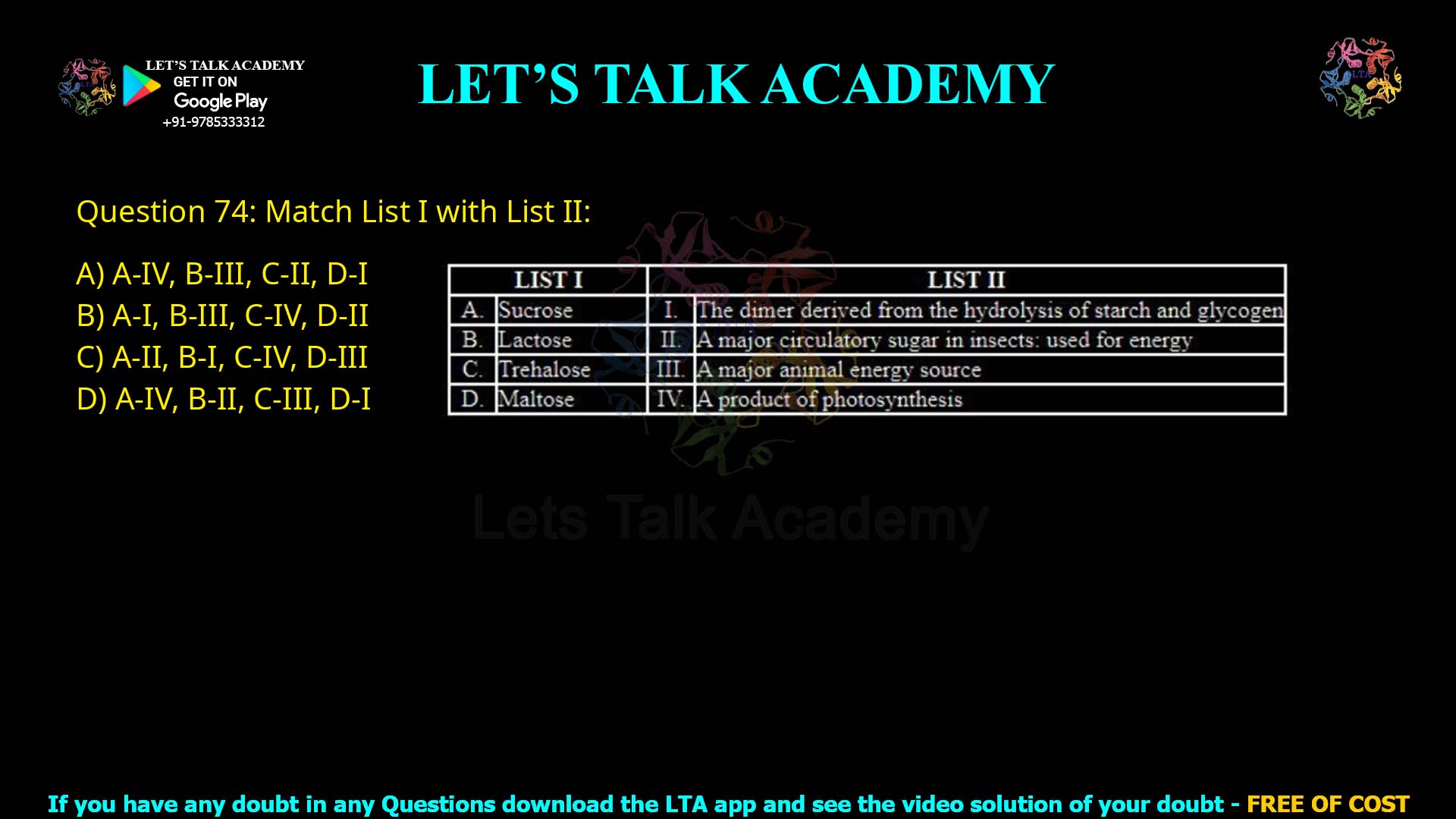
Q.74 Match List I with List II
| LIST I | LIST II |
|---|---|
| A. Sucrose B. Lactose C. Trehalose D. Maltose |
I. The dimer derived from the hydrolysis of starch and glycogen II. A major circulatory sugar in insects: used for energy III. A major animal energy source IV. A product of photosynthesis |
Choose the correct answer from the options given below:
- A-IV, B-III, C-II, D-I
- A-I, B-III, C-IV, D-II
- A-II, B-I, C-IV, D-III
- A-IV, B-II, C-III, D-I
The correct answer is A-IV, B-III, C-II, D-I.
Sucrose is the primary photosynthesis product transported in plants, lactose serves as the main energy source in milk for mammals, trehalose powers insect circulation, and maltose results from starch/glycogen enzymatic breakdown.
Statement Matching Analysis
A. Sucrose → IV. A product of photosynthesis
Correct. Sucrose (glucose-α1,2-fructose) forms in plant cytosol from UDP-glucose + fructose-6-P via sucrose phosphate synthase; major phloem transport sugar.B. Lactose → III. A major animal energy source
Correct. Lactose (galactose-β1,4-glucose) constitutes 4-7% of mammalian milk, hydrolyzed by lactase to glucose/galactose for neonatal energy.C. Trehalose → II. A major circulatory sugar in insects: used for energy
Correct. Trehalose (glucose-α1,1-glucose) is insect hemolymph sugar (1-2% concentration), more stable than glucose for flight muscle energy.D. Maltose → I. The dimer derived from the hydrolysis of starch and glycogen
Correct. Maltose (glucose-α1,4-glucose) produced by amylase action on starch/glycogen during digestion/germination.Option Evaluation Table
Option A B C D Correct? 1. A-IV, B-III, C-II, D-I Photo✅ Animal✅ Insect✅ Starch✅ Yes 2. A-I, B-III, C-IV, D-II Starch❌ Animal✅ Photo❌ Insect❌ No 3. A-II, B-I, C-IV, D-III Insect❌ Starch❌ Photo❌ Animal❌ No 4. A-IV, B-II, C-III, D-I Photo✅ Insect❌ Animal❌ Starch✅ No
Sucrose as photosynthesis product, lactose as animal milk energy source, trehalose as insect circulatory sugar, and maltose from starch/glycogen hydrolysis represent perfect disaccharide-function matching for biochemistry exams.
Disaccharide Biosynthesis & Roles
Sucrose (A-IV): Plants synthesize sucrose in photosynthesizing leaf cells from triose phosphates. Non-reducing (α1,2 linkage blocks anomeric carbons), ideal for long-distance phloem transport without reacting.
Lactose (B-III): Mammalian lactose synthase (galactosyltransferase + α-lactalbumin) produces β1,4-galactose-glucose in Golgi of mammary cells. Primary neonatal carbohydrate (~120 g/L human milk).
Trehalose (C-II): Insect trehalose-6-P synthase/phosphatase pathway generates α1,1-glucose dimer. Protects proteins during desiccation; hemolymph levels rise during flight. Absent in vertebrates.
Maltose (D-I): α-Amylase hydrolyzes internal α1,4-glucosidic bonds of amylose/amylopectin/glycogen, releasing maltose + limit dextrins. Maltase completes glucose liberation.
Exam-Focused Comparison
Disaccharide Source Linkage Key Feature Hydrolysis Products Sucrose Photosynthesis α1,2 Plant transport Glucose + Fructose Lactose Milk β1,4 Animal energy Galactose + Glucose Trehalose Insects α1,1 Circulatory sugar 2 Glucose Maltose Starch α1,4 Hydrolysis dimer 2 Glucose Why This Pattern Matters
NEET/GATE tests disaccharide specificity: sucrose (plants), lactose (mammals), trehalose (arthropods), maltose (digestion). Memorize A-IV, B-III, C-II, D-I for instant matching. Common traps swap trehalose (insect-only) with sucrose or confuse lactose (milk-only) with maltose (plant storage).


