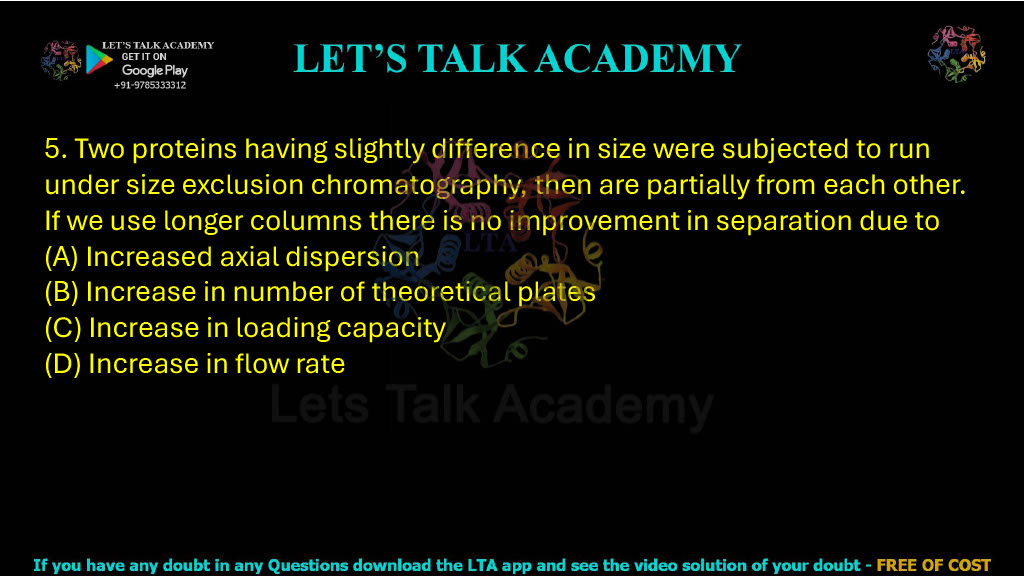
5. Two proteins having a slight difference in size are subjected to size-exclusion chromatography and partially flow from each other. If longer columns show no improvement in separation, it is due to:
A. Increased axial dispersion
B. Increase in number of theoretical plates
C. Increase in loading capacity
D. Increase in flow rate
Longer columns in size-exclusion chromatography should improve resolution for proteins with slight size differences, but fail when axial dispersion dominates band broadening. This limits separation gains despite increased length.
Question Analysis
Size-exclusion chromatography (SEC) separates by hydrodynamic volume. Longer columns increase theoretical plates (N), improving resolution (Rs ∝ √N). No improvement despite “partial flow” (some separation exists) indicates fundamental limitation.
Option Analysis
A. Increased axial dispersion
Correct. Longer columns amplify extra-column dispersion (system tubing, detector, injector) and diffusion effects. Peak broadening exceeds plate height gains, nullifying resolution. SEC’s narrow elution range makes it dispersion-sensitive.
B. Increase in number of theoretical plates
Incorrect. Longer columns increase N (N ∝ L), improving separation. This would enhance, not limit, resolution.
C. Increase in loading capacity
Wrong. Longer columns have proportionally higher capacity, but question specifies analytical separation of slight size differences—loading irrelevant.
D. Increase in flow rate
False. Flow rate typically held constant when testing column length. Higher flow decreases efficiency (higher HETP).
Correct Answer
A. Increased axial dispersion—SEC resolution plateaus when extra-column/system dispersion exceeds column-generated efficiency.
SEC Resolution Fundamentals
Resolution Rs = (√N/4) × (α-1) × (k/(1+k)), where N ∝ column length L. But total peak variance σ²_total = σ²_column + σ²_system. Long columns magnify σ²_system dominance.
| Factor | Longer Column Effect | Resolution Impact |
|---|---|---|
| Theoretical plates | Increases (N ∝ L) | Should improve |
| Axial dispersion | Dominates | Kills gains |
| Loading capacity | Increases | Irrelevant here |
| Flow rate | Usually constant | Not the issue |
GATE Prep Key Concept
SEC paradox: Optimal length ~30cm (not infinite). Beyond this, system dispersion limits returns. Use low-dw/dV UHPLC systems (V_extra-column <10% peak volume). For slight size differences, switch to narrower ID columns or orthogonal methods (RP-HPLC, IEX).
Pro Tip: “Partial flow from each other” confirms SEC works but resolution-limited. Axial dispersion explains why “longer = no better” in practice. Classic chromatography efficiency question pattern.


2 Comments
Vanshika Sharma
January 29, 2026Increased axial dispersion
Kanica Sunwalka
June 25, 2026Dispersion more – > resolution less
NO improvement in seperation