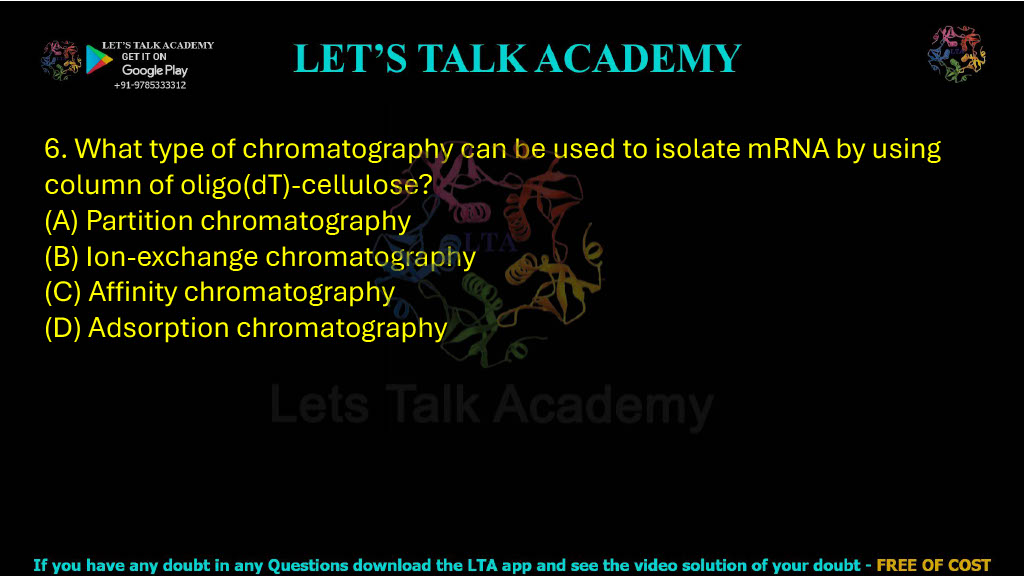
6. What type of chromatography can be used to isolate mRNA using a column of oligo (dT)-cellulose?
A. Partition chromatography
B. Ion-exchange chromatography
C. Affinity chromatography
D. Adsorption chromatography
Oligo(dT)-cellulose columns specifically bind poly(A) tails of mRNA through base-pairing with thymidine residues, making this a classic affinity chromatography application.
Question Analysis
mRNA isolation exploits the universal poly(A) tail (50-250 adenines) added post-transcriptionally to eukaryotic mRNAs. Oligo(dT) = stretch of ~12-25 thymidines covalently linked to cellulose, creating ligand-specific binding matrix.
Option Analysis
A. Partition chromatography
Incorrect. Partition separates by solubility between mobile and stationary liquid phases (e.g., paper chromatography). No specific biorecognition here—just physical partitioning.
B. Ion-exchange chromatography
Wrong. Ion-exchange separates by charge. Poly(A)-oligo(dT) binding is hydrogen bonding/base pairing, not electrostatic. High salt (0.5M NaCl) promotes binding by shielding charges.
C. Affinity chromatography
Correct. Affinity uses biological specificity: ligand (oligo dT) captures target (polyA mRNA) via reversible non-covalent interactions. Elution by low salt/heat disrupts A-T bonds.
D. Adsorption chromatography
No. Adsorption relies on surface attraction (polarity, charge). Here, binding is sequence-specific hybridization, not general surface adsorption.
Correct Answer
C. Affinity chromatography—oligo(dT)-cellulose exemplifies affinity purification: ligand specifically recognizes poly(A) tail.
Protocol Summary
-
Load: Total RNA in high-salt buffer → mRNA poly(A) hybridizes to oligo(dT)
-
Wash: Remove rRNA/tRNA (no polyA)
-
Elute: Low salt + 65°C → disrupt A-T base pairs, recover pure mRNA
| Chromatography Type | Binding Mechanism | mRNA Isolation? |
|---|---|---|
| Partition | Solubility | No |
| Ion-exchange | Charge | No |
| Affinity | Specific biorecognition | Yes |
| Adsorption | Surface polarity | No |
GATE Prep Essential
Affinity chromatography definition: Stationary phase contains ligand with high, specific affinity for target molecule. Classic examples: Ni-NTA (His-tag), Protein A (antibodies), streptavidin-biotin, oligo(dT)-polyA.
Pro Tip: Remembers as “biological fishing”—bait (ligoand) catches specific prey (target). Regeneration: 0.1M NaOH strips column for reuse. Yields 1-5% of total RNA as mRNA.


2 Comments
Vanshika Sharma
January 29, 2026Affinity chromatography
Kanica Sunwalka
June 25, 2026Affinity chr.