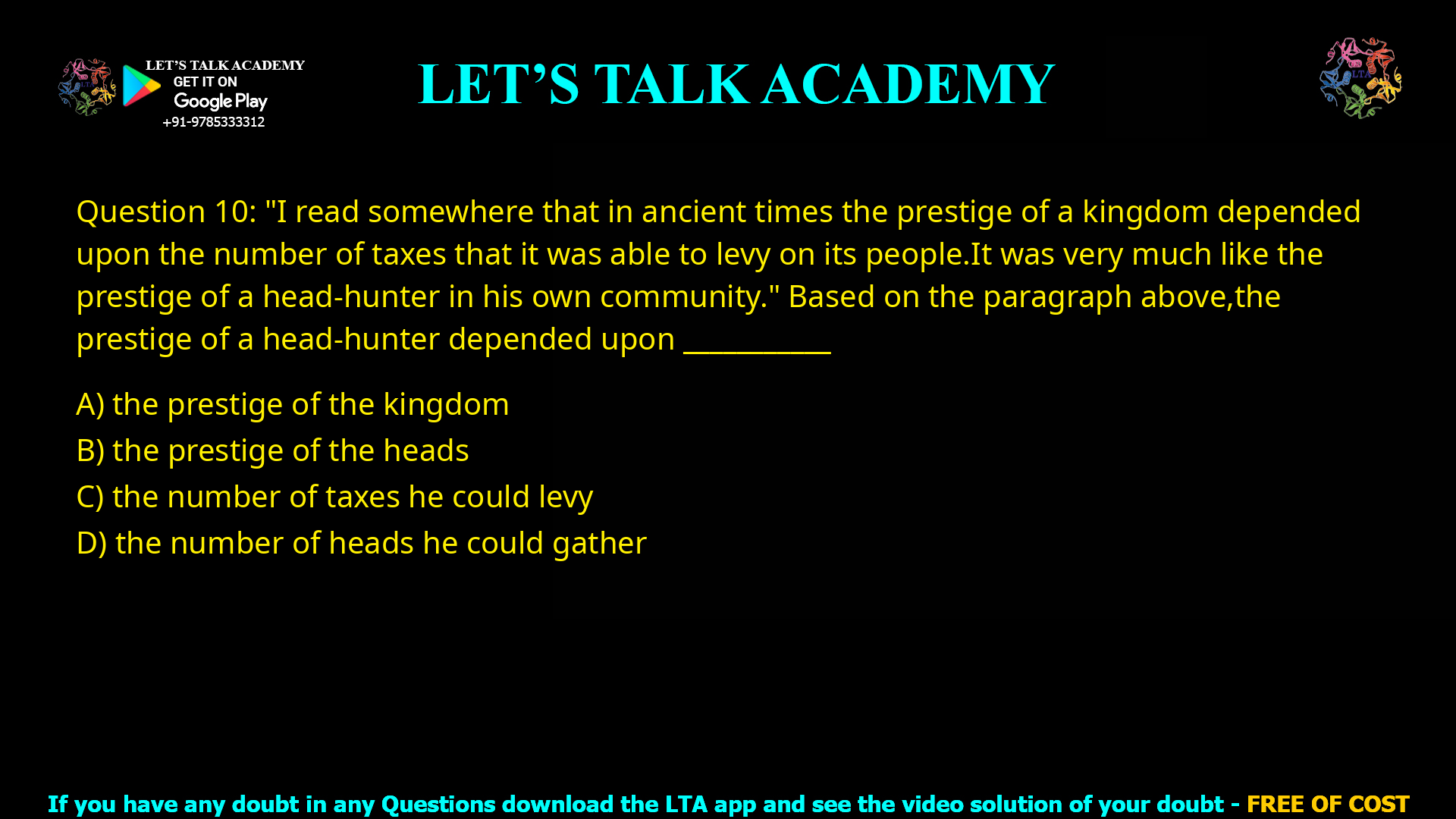
Q.10 “I read somewhere that in ancient times the prestige of a kingdom depended upon the
number of taxes that it was able to levy on its people. It was very much like the prestige of
a head-hunter in his own community.”
Based on the paragraph above, the prestige of a head-hunter depended upon ___________
(A) the prestige of the kingdom
(B) the prestige of the heads
(C) the number of taxes he could levy
(D) the number of heads he could gather
The correct answer is (D) the number of heads he could gather.
Passage Analysis
The paragraph draws an analogy between a kingdom’s prestige, derived from levying numerous taxes on its people, and a head-hunter’s prestige in his community. The phrase “very much like” signals a direct parallel: just as taxes quantified a kingdom’s power, the head-hunter’s status hinged on a countable achievement tied to his role.
Option Breakdown
-
(A) the prestige of the kingdom: Incorrect, as the passage compares the head-hunter’s prestige to the kingdom’s independently, not as a derivative. No link suggests kingdom status determines the head-hunter’s own standing.
-
(B) the prestige of the heads: Incorrect, since “heads” refers literally to collected enemy heads (a gruesome tally in headhunting cultures), not heads possessing inherent prestige. The analogy emphasizes quantity, not quality of the heads.
-
(C) the number of taxes he could levy: Incorrect, as this mirrors the kingdom’s metric, but the head-hunter is not a tax collector; the comparison assigns him a parallel brutal “collection” activity.
-
(D) the number of heads he could gather: Correct, as the passage implies the head-hunter’s prestige stems from accumulating heads, akin to taxes—both quantify dominance and status in their contexts.
In competitive exams like GATE Biotechnology, questions testing reading comprehension often use historical analogies to evaluate inference skills. One such query revolves around the prestige of a head-hunter in ancient times, paralleling kingdom prestige from taxes to headhunter status from gathered heads. This passage-based MCQ sharpens analytical abilities for exams like IIT JAM or GATE.
Historical Context of Headhunting
Headhunting thrived in tribal societies, where warriors gained status by collecting enemy heads, symbolizing power and community protection. More heads elevated prestige, much like taxes signaled kingdom wealth.
Why Option D Fits Perfectly
The analogy hinges on quantifiable acts: taxes for kingdoms, heads for head-hunters. This highlights the passage’s critique of exploitative prestige systems.
-
Prepares aspirants for similar verbal ability questions.
-
Reinforces inference over literal reading.
-
Links to anthropology for interdisciplinary insight.


