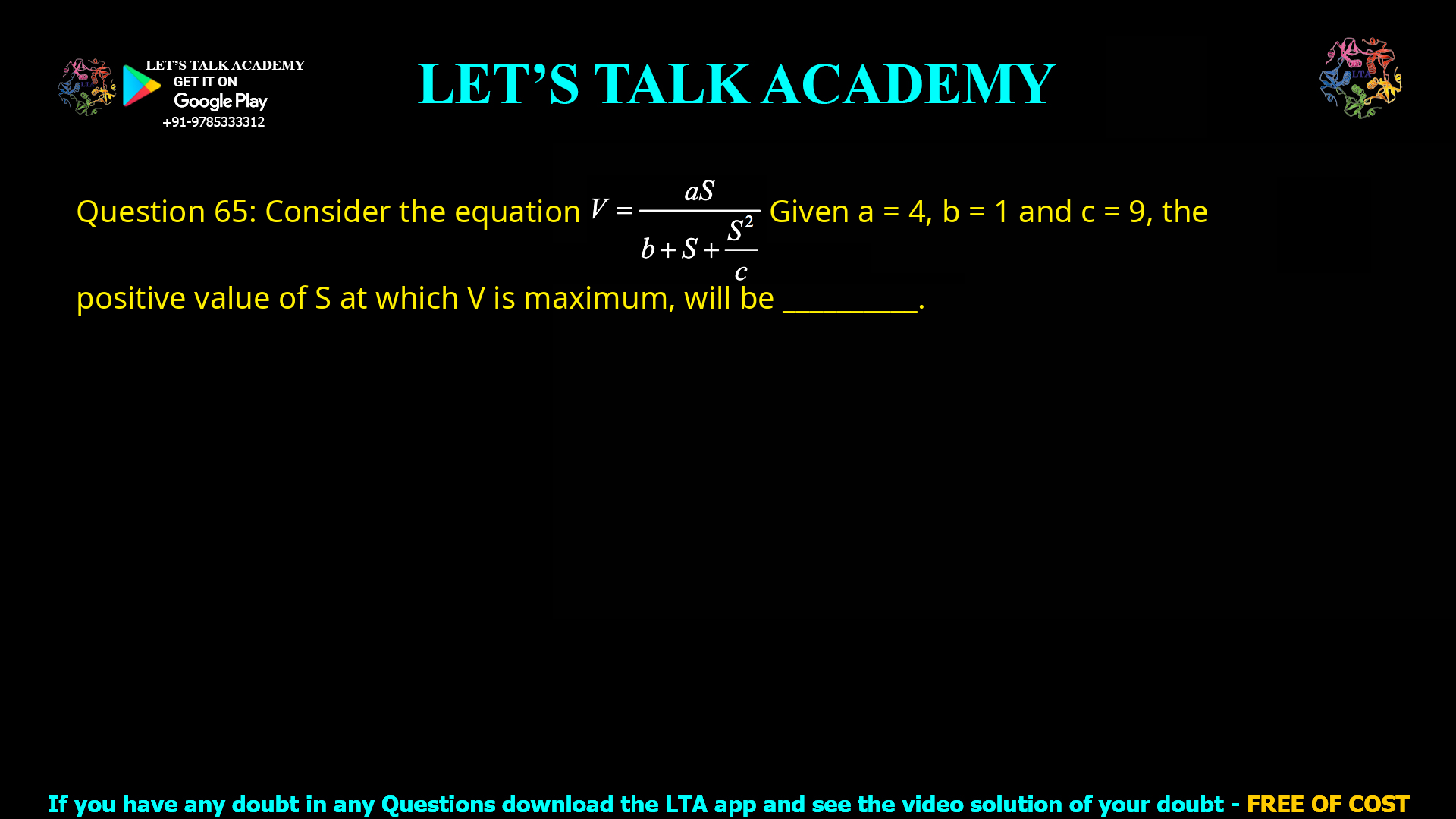
Q.65 Consider the equation
V = aS /
b + S + S2/c
Given a = 4, b = 1 and c = 9,
the positive value of S at which V is maximum
will be __________.
Given: a = 4, b = 1, c = 9
Final Answer: S = 3
Problem Statement
To find the positive value of S that maximizes
V, consider the equation:
V = 4S /1 + S + S2/9
Conceptual Background
The equation resembles a substrate inhibition model in enzyme kinetics.
The reaction velocity V increases with substrate concentration
S up to a maximum value, after which inhibition dominates.
Mathematical Form
Rewrite the equation as:
V(S) = 4S /1 + S + S2/9
To find the maximum value of V, compute the derivative
dV/dS and set it equal to zero.
Step-by-Step Differentiation
Let:
- u = 4S ⇒ u′ = 4
- v = 1 + S + S2/9 ⇒ v′ = 1 + 2S/9
Using the quotient rule:
dV/dS =
u′v − uv′ /v2
dV/dS = 4(1 + S + S2/9) − 4S(1 + 2S/9)/(1 + S + S2/9)2
Simplification
Simplifying the numerator:
4 + 4S + 4S2/9 − 4S − 8S2/9
= 4 − 4S2/9
Therefore:
dV/dS = 4 − 4S2/9 /(1 + S + S2/9)2
Finding the Maximum
Set the numerator equal to zero:
4 − 4S2/9 = 0
S2 = 9
S = ±3
Since S must be positive:
S = 3
Verification
The second derivative test confirms a maximum at S = 3:
- V″(3) < 0
- V → 0 as S → 0 or S → ∞
Numerical check:
- S = 2 → V ≈ 1.60
- S = 3 → V ≈ 1.78 (maximum)
- S = 4 → V ≈ 1.60
Applications in Biotechnology
Determining the substrate concentration at which reaction velocity is maximum
is crucial in enzyme kinetics, fermentation optimization, and bioreactor design.
This analysis helps balance activation and inhibition effects.
Conclusion
The equation
V = 4S / (1 + S + S2/9)
reaches its maximum value at the positive substrate concentration:
S = 3
This structured calculus-based approach ensures accuracy and is highly
relevant for competitive exams such as GATE Biotechnology and CSIR NET.


