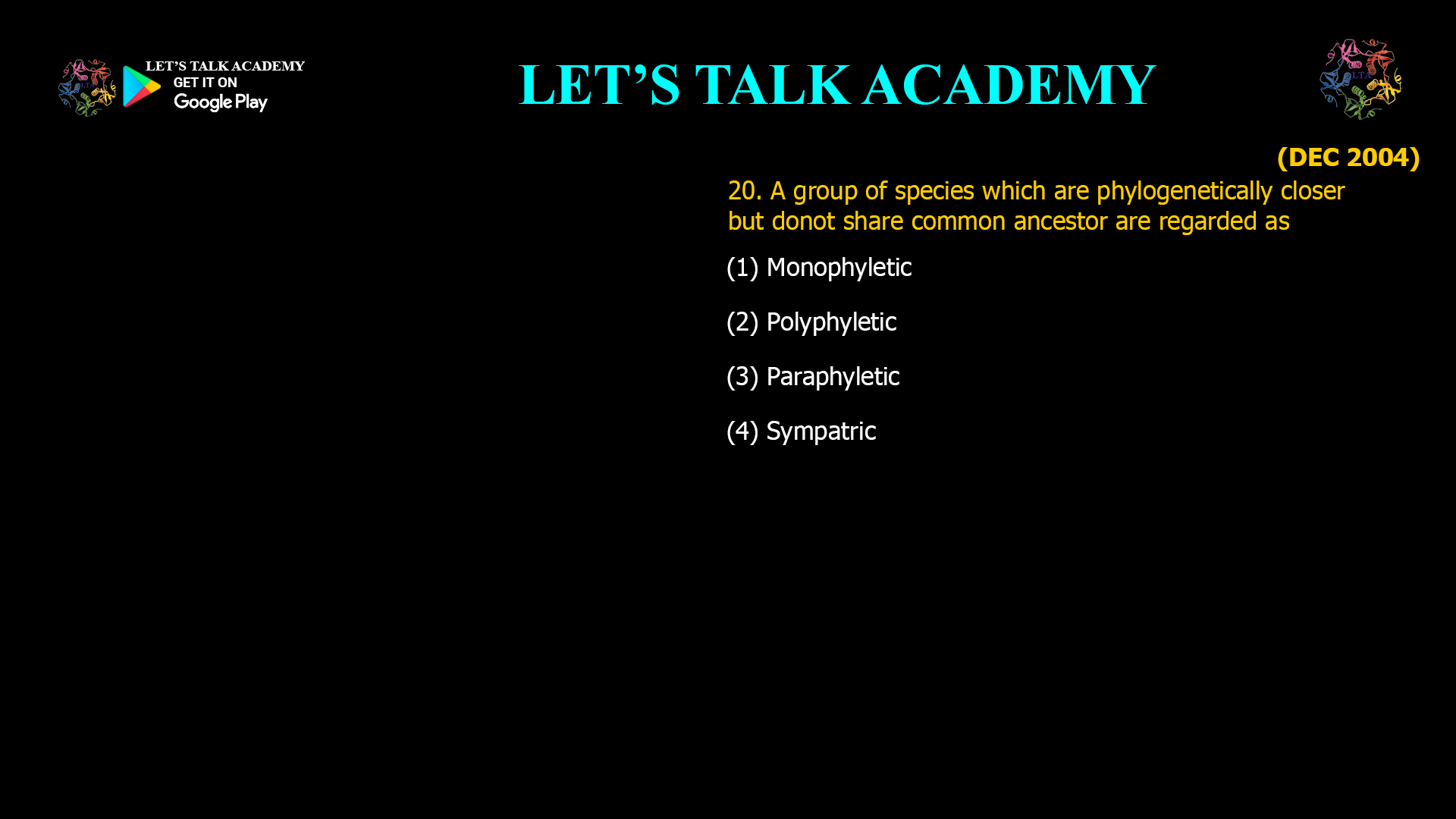
- A group of species which are phylogenetically closer but donot share common ancestor are regarded as
(1) Monophyletic (2) Polyphyletic
(3) Paraphyletic (4) SympatricPolyphyletic Groups: When Phylogenetically Close Species Lack a Common Ancestor
In evolutionary biology, understanding how species are grouped based on their ancestry is crucial for reconstructing the tree of life. Phylogenetic relationships help scientists determine how species are related through evolutionary history. Sometimes, however, groups of species that appear similar or share certain traits do not actually share a recent common ancestor. These groups are known as polyphyletic.
What Is a Polyphyletic Group?
A polyphyletic group is defined as a collection of organisms that are grouped together based on similarities, but do not share a unique common ancestor. Instead, their most recent common ancestor is not included in the group, or the group is derived from multiple ancestral sources. This is in contrast to:
-
Monophyletic groups, which include a common ancestor and all of its descendants.
-
Paraphyletic groups, which include a common ancestor and some, but not all, of its descendants356.
Why Are Polyphyletic Groups Important?
Polyphyletic groupings often arise when organisms are classified based on superficial similarities or convergent traits rather than true evolutionary relationships. For example, grouping bats and birds together because they both have wings would be polyphyletic, as their wings evolved independently and their most recent common ancestor did not possess wings.
Key Differences: Monophyletic, Paraphyletic, and Polyphyletic
Group Type Common Ancestor Included? All Descendants Included? Example Monophyletic Yes Yes Mammals Paraphyletic Yes No Reptiles (excluding birds) Polyphyletic No No Winged animals (bats, birds, insects) Why Polyphyletic Groups Do Not Share a Common Ancestor
The defining feature of a polyphyletic group is the absence of a unique common ancestor for all group members. The similarities that unite these species are the result of convergent evolution or parallel evolution, not shared descent.
Conclusion
A group of species that are phylogenetically closer but do not share a common ancestor is regarded as polyphyletic. Proper classification in evolutionary biology aims to avoid polyphyletic groupings to ensure that taxonomic groups accurately reflect evolutionary histories.
Correct answer:
(2) Polyphyletic -