- The figure below shows a gene duplication event followed by a divergence event in species 1 and 2.
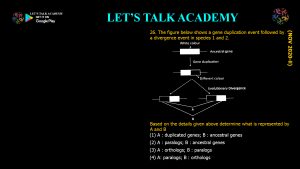
Based on the details given above determine what is represented by A and B
(1) A : duplicated genes; B : ancestral genes
(2) A : paralogs; B : ancestral genes
(3) A : orthologs; B : paralogs
(4) A: paralogs; B : orthologsParalogs and Orthologs: Decoding Gene Duplication and Divergence in Evolution
In evolutionary genetics, the way genes evolve and diversify across species is central to understanding both the unity and diversity of life. Two key terms—paralogs and orthologs—describe the relationships between genes that arise from different evolutionary events. When examining a gene duplication event followed by divergence in two species, identifying which genes are paralogs and which are orthologs is crucial for interpreting gene function and evolutionary history.
Gene Duplication and Speciation: The Basics
-
Gene duplication is an event where a single gene is copied within the genome, resulting in two or more gene copies in the same organism.
-
Speciation is the process by which populations diverge to form new species.
After a gene duplication event, the organism has two gene copies (paralogs). If speciation occurs later, each new species inherits both gene copies. The relationships between these genes across the two species are then defined by whether their divergence was caused by duplication or speciation.
What Are Paralogs and Orthologs?
Paralogs
-
Genes that arise from a gene duplication event within the same genome.
-
Paralogs may evolve new functions or specialize over time.
-
Example: If a gene duplicates in an ancestral species, both copies in the same species are paralogs.
Orthologs
-
Genes that diverge due to a speciation event.
-
Orthologs are found in different species and usually retain the same function.
-
Example: After speciation, the same gene in two different species are orthologs.
Interpreting the Figure: What Do A and B Represent?
In a typical gene tree showing a duplication event followed by speciation:
-
A: Genes that are the result of the duplication event within the same species (before speciation). These are paralogs.
-
B: Genes that are related by speciation, i.e., the same gene in two different species after the divergence. These are orthologs.
So, if you are asked to identify what A and B represent:
Label Represents A Paralogs B Orthologs Why This Distinction Matters
Understanding the difference between paralogs and orthologs is essential for:
-
Functional Genomics: Orthologs typically maintain similar functions across species, making them valuable for predicting gene function in newly sequenced genomes.
-
Evolutionary Biology: Paralogs can acquire new functions, contributing to genetic innovation and complexity.
-
Comparative Genomics: Distinguishing these relationships helps clarify evolutionary histories and gene family expansions.
Conclusion
In the context of a gene duplication event followed by divergence in two species, A represents paralogs (genes related by duplication), and B represents orthologs (genes related by speciation). This distinction is foundational in evolutionary genetics and comparative genomics, guiding research into gene function, evolution, and the relationships among all living organisms.
Correct answer:
(4) A: paralogs; B: orthologs -


