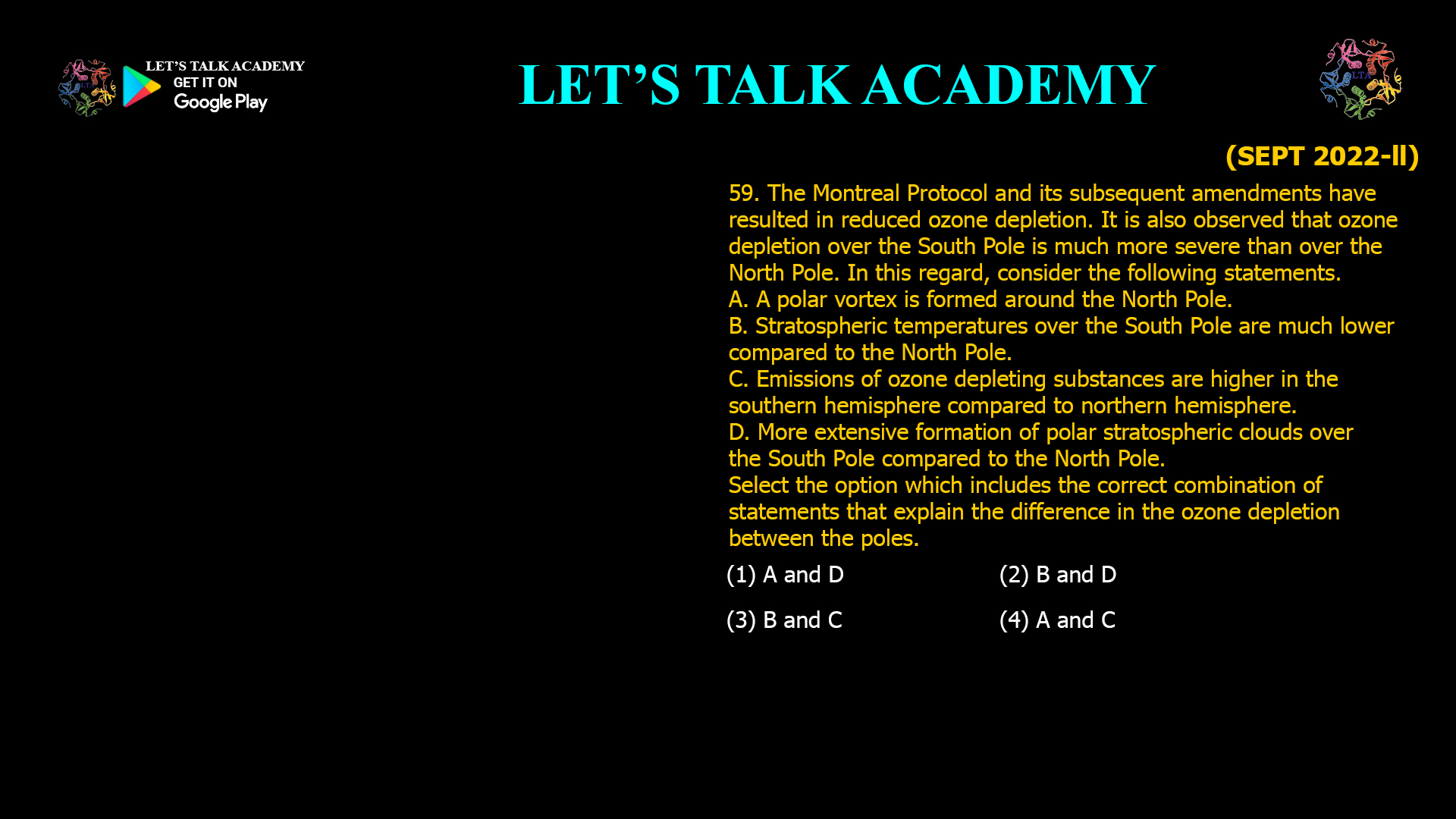
- The Montreal Protocol and its subsequent amendments have resulted in reduced ozone depletion. It is also observed that ozone depletion over the South Pole is much more severe than over the North Pole. In this regard, consider the following statements.
A. A polar vortex is formed around the North Pole.
B. Stratospheric temperatures over the South Pole are much lower compared to the North Pole.
C. Emissions of ozone depleting substances are higher in the southern hemisphere compared to northern hemisphere.
D. More extensive formation of polar stratospheric clouds over the South Pole compared to the North Pole.
Select the option which includes the correct combination of statements that explain the difference in the ozone depletion between the poles.
(1) A and D (2) B and D
(3) B and C (4) A and C
The Montreal Protocol and Ozone Depletion
The Montreal Protocol, adopted in 1987, is an international treaty designed to protect the ozone layer by phasing out the production and use of ODS. Thanks to this agreement, the release of CFCs and other harmful chemicals has significantly declined, leading to a gradual recovery of the ozone layer. However, the legacy of past emissions means that ODS remain in the atmosphere for decades, continuing to affect ozone levels, especially in polar regions.
Why Is Ozone Depletion More Severe Over the South Pole?
Several factors contribute to the greater severity of ozone depletion over the South Pole compared to the North Pole. These include atmospheric dynamics, temperature differences, and the formation of polar stratospheric clouds.
A. A Polar Vortex Is Formed Around the North Pole
-
Fact: A polar vortex is a large area of low pressure and cold air that surrounds both the North and South Poles.
-
Implication: While it is true that a polar vortex forms around the North Pole, this is not unique to the Arctic—Antarctica also has a polar vortex. The presence of a polar vortex alone does not explain the difference in ozone depletion between the poles.
B. Stratospheric Temperatures Over the South Pole Are Much Lower Compared to the North Pole
-
Fact: The stratosphere over the South Pole becomes much colder than that over the North Pole, especially during winter.
-
Implication: Extremely low temperatures are required for the formation of polar stratospheric clouds (PSCs), which play a crucial role in ozone depletion. The consistently colder temperatures over Antarctica allow for more extensive and persistent PSC formation, accelerating ozone destruction.
C. Emissions of Ozone Depleting Substances Are Higher in the Southern Hemisphere Compared to Northern Hemisphere
-
Fact: Ozone-depleting substances are well-mixed globally due to atmospheric circulation.
-
Implication: There is no significant difference in ODS concentrations between the hemispheres. Therefore, this statement is incorrect.
D. More Extensive Formation of Polar Stratospheric Clouds Over the South Pole Compared to the North Pole
-
Fact: PSCs are clouds that form at extremely low temperatures in the polar stratosphere. They provide surfaces for chemical reactions that convert chlorine from ODS into forms that rapidly destroy ozone.
-
Implication: The colder and more stable conditions over the South Pole lead to more extensive and persistent PSC formation, resulting in more severe ozone depletion compared to the North Pole.
Evaluating the Statements
Let’s review each statement in the context of the above explanations:
-
A. A polar vortex is formed around the North Pole.
-
Incomplete: A polar vortex forms around both poles, so this does not explain the difference.
-
-
B. Stratospheric temperatures over the South Pole are much lower compared to the North Pole.
-
Correct: Lower temperatures over the South Pole allow for more extensive PSC formation and more severe ozone depletion.
-
-
C. Emissions of ozone depleting substances are higher in the southern hemisphere compared to northern hemisphere.
-
Incorrect: ODS are well-mixed globally; there is no significant hemispheric difference.
-
-
D. More extensive formation of polar stratospheric clouds over the South Pole compared to the North Pole.
-
Correct: More extensive PSC formation over the South Pole leads to more severe ozone depletion.
-
Correct Combination of Statements
The correct combination of statements that explain the difference in ozone depletion between the poles is:
B and D
These statements highlight the key factors: lower stratospheric temperatures and more extensive PSC formation over the South Pole, which together drive more severe ozone depletion.
Why These Factors Matter
Understanding the interplay between the polar vortex, stratospheric temperatures, and PSCs is essential for predicting future ozone depletion and assessing the effectiveness of international agreements like the Montreal Protocol. The unique atmospheric conditions over Antarctica create a perfect environment for ozone destruction, while the Arctic, with its warmer and less stable stratosphere, experiences less severe depletion.
Key Takeaways
-
The Montreal Protocol has reduced ozone depletion, but legacy ODS continue to affect polar regions.
-
Ozone depletion is much more severe over the South Pole than the North Pole.
-
Lower stratospheric temperatures and more extensive PSC formation over the South Pole are the primary reasons for this difference.
-
The correct combination of statements is:
-
B. Stratospheric temperatures over the South Pole are much lower compared to the North Pole.
-
D. More extensive formation of polar stratospheric clouds over the South Pole compared to the North Pole.
-
Summary Table
| Statement | Correctness | Explanation |
|---|---|---|
| A | Incomplete | Polar vortex forms around both poles |
| B | Correct | South Pole is much colder, enabling more PSCs |
| C | Incorrect | ODS are well-mixed globally |
| D | Correct | More PSCs form over the South Pole |
Conclusion
The greater severity of ozone depletion over the South Pole compared to the North Pole is due to the much lower stratospheric temperatures and more extensive formation of polar stratospheric clouds over Antarctica. These conditions accelerate the chemical reactions that destroy ozone, making the Antarctic ozone hole much more pronounced than any depletion observed over the Arctic.
In summary, the correct option is:
(2) B and D


4 Comments
Kajal
November 15, 2025B and D
Akshita
November 26, 2025B/D
Sakshi Kanwar
November 28, 2025B and D
Sakshi yadav
November 29, 2025B and D