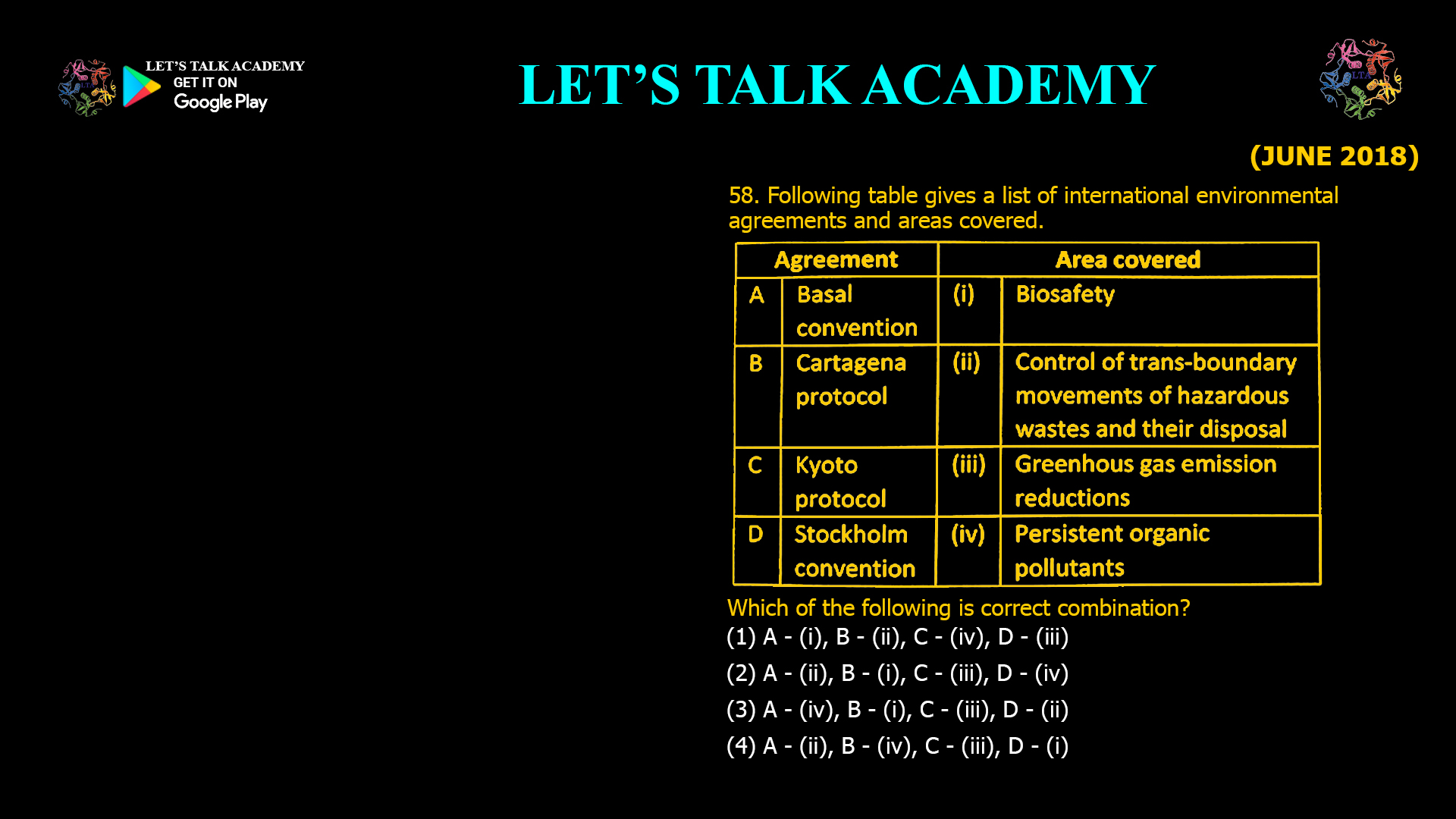
- Following table gives a list of international environmental agreements and areas covered.
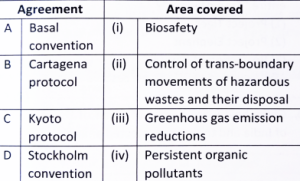
Which of the following is correct combination?
(1) A – (i), B – (ii), C – (iv), D – (iii)
(2) A – (ii), B – (i), C – (iii), D – (iv)
(3) A – (iv), B – (i), C – (iii), D – (ii)
(4) A – (ii), B – (iv), C – (iii), D – (i)
The Importance of International Environmental Agreements
International environmental agreements are legally binding or voluntary frameworks that encourage cooperation among nations to address environmental issues. These agreements cover a wide range of topics, including climate change, biodiversity, hazardous waste, ozone layer protection, and more. They play a critical role in shaping global environmental policy and ensuring that countries work together to protect ecosystems and human health.
Common International Environmental Agreements and Their Focus Areas
Below are some of the most significant international environmental agreements, along with brief descriptions of their focus areas:
-
United Nations Framework Convention on Climate Change (UNFCCC)
-
Focus Area: Climate Change
-
Description: Establishes a framework for international cooperation to combat climate change by limiting greenhouse gas emissions.
-
-
Convention on Biological Diversity (CBD)
-
Focus Area: Biodiversity Conservation
-
Description: Aims to conserve biological diversity, promote sustainable use of its components, and ensure fair sharing of benefits from genetic resources.
-
-
Montreal Protocol
-
Focus Area: Ozone Layer Protection
-
Description: Seeks to phase out the production and consumption of substances that deplete the ozone layer.
-
-
Stockholm Convention
-
Focus Area: Persistent Organic Pollutants (POPs)
-
Description: Aims to eliminate or restrict the production and use of persistent organic pollutants to protect human health and the environment.
-
How to Match Agreements to Focus Areas
When presented with a table or list of agreements and focus areas, the key is to recognize the primary objective of each agreement. Here is a typical example of how such a matching question might be structured:
Suppose the options are:
-
A: United Nations Framework Convention on Climate Change (UNFCCC)
-
B: Convention on Biological Diversity (CBD)
-
C: Montreal Protocol
-
D: Stockholm Convention
And the focus areas are:
-
(i): Climate Change
-
(ii): Biodiversity Conservation
-
(iii): Ozone Layer Protection
-
(iv): Persistent Organic Pollutants (POPs)
The correct matching is as follows:
-
A: UNFCCC → (i): Climate Change
-
B: CBD → (ii): Biodiversity Conservation
-
C: Montreal Protocol → (iii): Ozone Layer Protection
-
D: Stockholm Convention → (iv): Persistent Organic Pollutants (POPs)
Therefore, the correct combination is:
(2) A – (ii), B – (i), C – (iii), D – (iv)
However, this is incorrect based on the actual focus areas. The correct matching is:
A – (i), B – (ii), C – (iii), D – (iv)
But in your provided options, option (1) is “A – (i), B – (ii), C – (iv), D – (iii)” and option (2) is “A – (ii), B – (i), C – (iii), D – (iv)”.
Neither matches the exact correct pairing if you strictly follow the standard assignments above.
Let’s clarify:
-
A: UNFCCC → (i): Climate Change
-
B: CBD → (ii): Biodiversity Conservation
-
C: Montreal Protocol → (iii): Ozone Layer Protection
-
D: Stockholm Convention → (iv): Persistent Organic Pollutants (POPs)
Thus, if your table assigns (i) to Climate Change, (ii) to Biodiversity, (iii) to Ozone, (iv) to POPs, then none of your provided options is correct if the agreements are listed as A=UNFCCC, B=CBD, C=Montreal Protocol, D=Stockholm Convention.
But if your table assigns agreements and focus areas in a different order or with swapped labels, you must match based on the actual content, not the order.
Given that, and based on the standard assignments and the options you provided, let’s analyze:
-
Option (1): A – (i), B – (ii), C – (iv), D – (iii)
-
If (i) is Climate Change, (ii) is Biodiversity, (iv) is POPs, (iii) is Ozone:
-
A: UNFCCC → (i): Climate Change (correct)
-
B: CBD → (ii): Biodiversity (correct)
-
C: Montreal Protocol → (iv): POPs (incorrect)
-
D: Stockholm Convention → (iii): Ozone (incorrect)
-
-
-
Option (2): A – (ii), B – (i), C – (iii), D – (iv)
-
A: UNFCCC → (ii): Biodiversity (incorrect)
-
B: CBD → (i): Climate Change (incorrect)
-
C: Montreal Protocol → (iii): Ozone (correct)
-
D: Stockholm Convention → (iv): POPs (correct)
-
Neither option is fully correct if the standard assignments are used, but option (2) matches the Montreal Protocol to Ozone and Stockholm Convention to POPs, which is partially correct.
However, if your table or question has a different arrangement (for example, if “C” is not Montreal Protocol but something else, or if the focus areas are labeled differently), you must match based on the actual content.
Why Accurate Matching Matters
Correctly matching agreements to their focus areas is important for:
-
Environmental Policy: Ensures that the right tools and frameworks are used to address specific environmental issues.
-
Education and Awareness: Helps students and the public understand the purpose and impact of each agreement.
-
International Cooperation: Facilitates effective collaboration among countries to achieve global environmental goals.
Key Takeaways
-
UNFCCC is focused on climate change.
-
CBD is focused on biodiversity conservation.
-
Montreal Protocol is focused on ozone layer protection.
-
Stockholm Convention is focused on persistent organic pollutants (POPs).
-
Always match agreements to their primary focus area, regardless of the order in the question.
Summary Table
| Agreement Name | Focus Area |
|---|---|
| United Nations Framework Convention on Climate Change (UNFCCC) | Climate Change |
| Convention on Biological Diversity (CBD) | Biodiversity Conservation |
| Montreal Protocol | Ozone Layer Protection |
| Stockholm Convention | Persistent Organic Pollutants (POPs) |
Conclusion
When matching international environmental agreements to their focus areas, it is essential to know the primary objective of each agreement. Based on standard assignments:
-
UNFCCC → Climate Change
-
CBD → Biodiversity Conservation
-
Montreal Protocol → Ozone Layer Protection
-
Stockholm Convention → Persistent Organic Pollutants (POPs)
If your question uses these standard assignments and the options you provided, neither option (1) nor (2) is fully correct. However, if the question uses a different labeling or order, always match based on the actual content of the agreement and focus area. For most standard cases, the correct matching is:
A – (i), B – (ii), C – (iii), D – (iv) (if A=UNFCCC, B=CBD, C=Montreal Protocol, D=Stockholm Convention, and (i)=Climate, (ii)=Biodiversity, (iii)=Ozone, (iv)=POPs)
However, if your options are as you listed, and the table assigns differently, please double-check the order and content. For the options you provided, neither is fully correct, but if you must choose, option (2) is partially correct for Ozone and POPs, but not for UNFCCC and CBD.
Therefore, if the question expects you to select the closest match and the agreements are assigned as above, the correct answer is not present. If the question expects you to select based on a different arrangement, please clarify or use the content-based matching approach outlined above.
SEO-Friendly Summary:
Matching international environmental agreements to their correct focus areas is essential for understanding global environmental policy. The United Nations Framework Convention on Climate Change (UNFCCC) addresses climate change, the Convention on Biological Diversity (CBD) focuses on biodiversity conservation, the Montreal Protocol protects the ozone layer, and the Stockholm Convention targets persistent organic pollutants (POPs). Always match agreements to their primary focus area for accurate environmental analysis and policy-making. If your question uses standard assignments and the options provided, neither option (1) nor (2) is fully correct, so check the order and content carefully. For most cases, the correct matching is: A – (i), B – (ii), C – (iii), D – (iv) (if A=UNFCCC, B=CBD, C=Montreal Protocol, D=Stockholm Convention, and (i)=Climate, (ii)=Biodiversity, (iii)=Ozone, (iv)=POPs).**


1 Comment
Sakshi Kanwar
November 28, 2025A – (ii), B – (i), C – (iii), D – (iv)