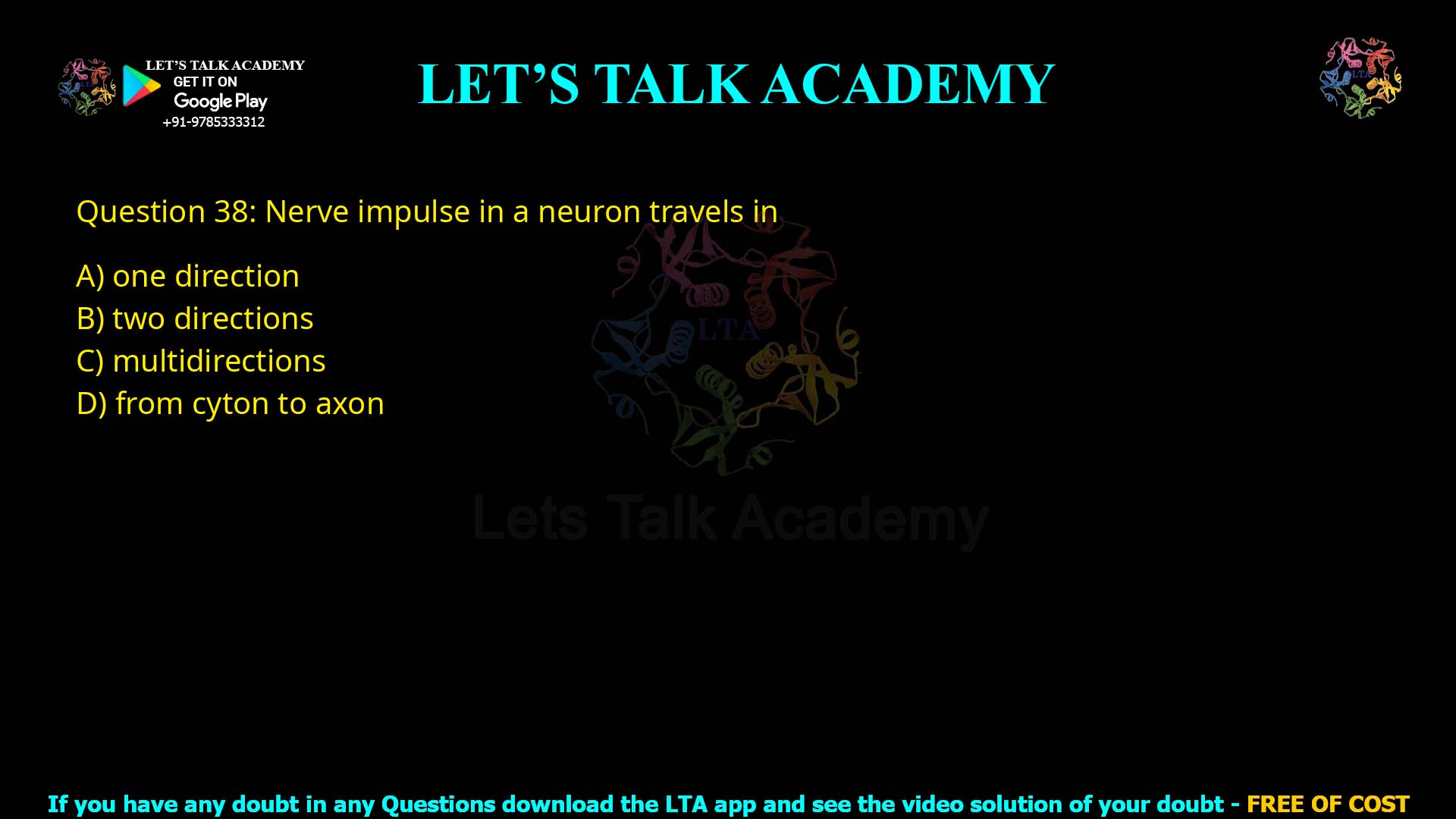
Q.38 Nerve impulse in a neuron travels in
Nerve impulses in a neuron travel in one direction, from dendrites/cell body toward axon terminals, making option (1) correct.
Question Breakdown
Neuron impulse conduction involves action potentials propagating unidirectionally due to refractory periods and synaptic orientation, essential for orderly signal transmission in nervous systems.
Option Analysis
-
(1) One direction: Correct; action potentials move from axon hillock to terminals via refractory period preventing backward propagation.
-
(2) Two directions: Incorrect; bidirectional possible artificially but physiological conduction is unidirectional due to sodium channel inactivation.
-
(3) Multidirections: Incorrect; impulses follow axon path linearly, not radiating in multiple directions within single neuron.
-
(4) From cyton to axon: Partially accurate directionally but incomplete—impulse starts at dendrites/receptive regions, enters axon from cyton (cell body).
Nerve impulse neuron travels direction follows one-way propagation from dendrite to axon terminal, fundamental for GATE Life Sciences neurophysiology MCQs. Action potentials regenerate via Na⁺/K⁺ fluxes with absolute refractory period ensuring forward-only movement.
Action Potential Mechanism
-
Depolarization: Na⁺ influx at trigger zone.
-
Propagation: Local currents open adjacent channels.
-
Refractory: Na⁺ inactivation blocks backward firing.
Key Features Table
| Aspect | Description | Purpose |
|---|---|---|
| Direction | One way (soma → axon) | Ordered signaling |
| Speed | 1-120 m/s (myelinated faster) | Efficient transmission |
| Saltatory | Jumps at Nodes of Ranvier | Increases velocity |
Exam Strategy
GATE tests refractory mechanism. Avoid “cyton to axon” (incomplete path); “two directions” (antidromic rare). Visualize: Impulse = self-propagating wave, forward only.


