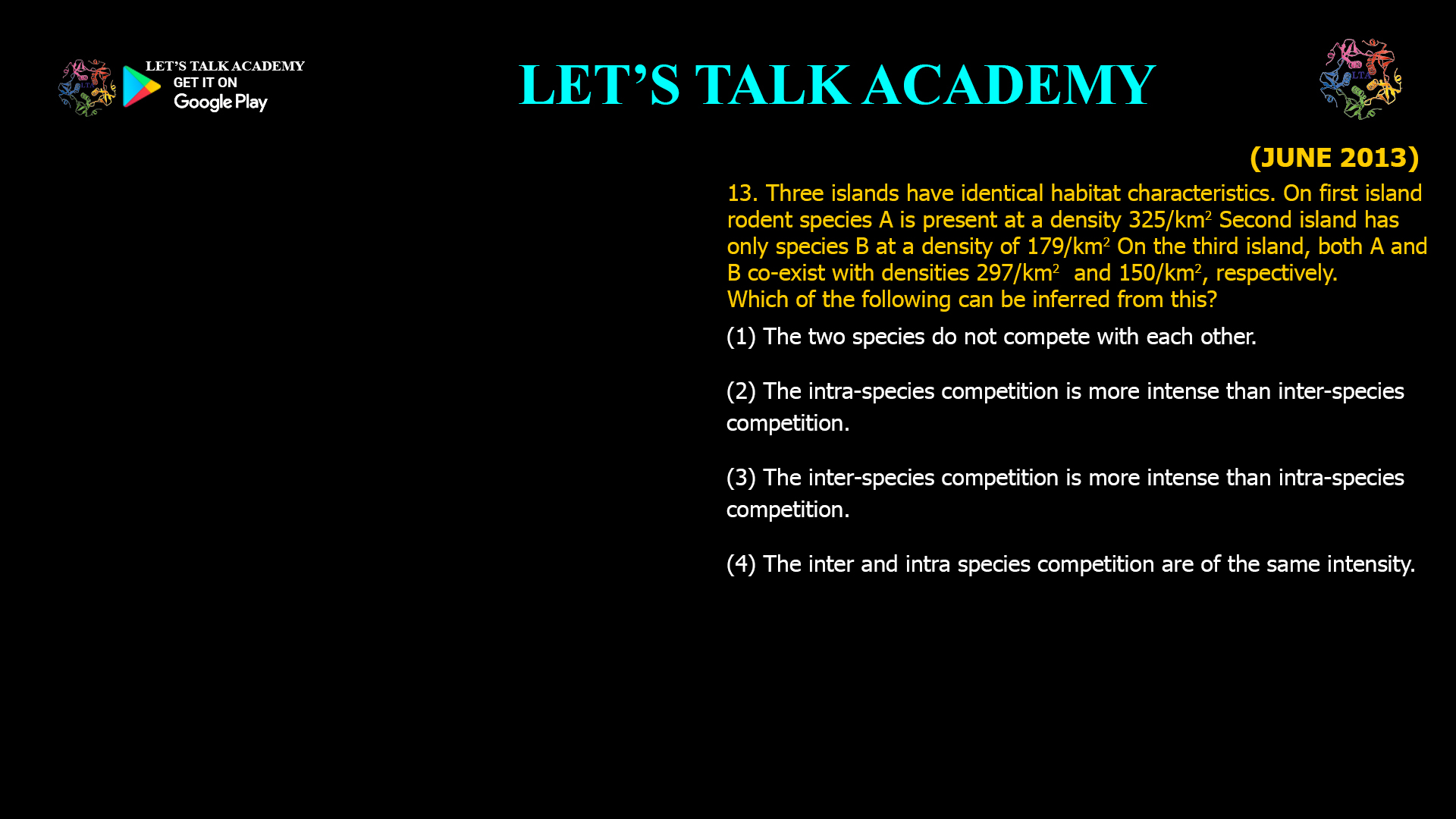
- Three islands have identical habitat characteristics. On first island rodent species A is present at a density 325/km2 Second island has only species B at a density of 179/km2 On the third island, both A and B co-exist with densities 297/km2 and 150/km2, respectively.
Which of the following can be inferred from this?
(1) The two species do not compete with each other.
(2) The intra-species competition is more intense than inter-species competition.
(3) The inter-species competition is more intense than intra-species competition.
(4) The inter and intra species competition are of the same intensity.Understanding how different types of competition shape species populations is central to ecology. Competition can occur within a species (intraspecific) or between different species (interspecific), and the intensity of these interactions influences population sizes, community structure, and species coexistence.
The Island Rodent Scenario
Consider three islands with identical habitats:
-
Island 1: Only rodent species A is present at 325/km².
-
Island 2: Only rodent species B is present at 179/km².
-
Island 3: Both A and B coexist, with densities of 297/km² (A) and 150/km² (B).
What Do These Numbers Tell Us?
When each species is alone, it achieves a higher population density. When both coexist, the population densities of each drop, but not as dramatically as one might expect if interspecific competition were extremely intense. Instead, both species maintain substantial populations, just at slightly reduced densities.
Key Inference
This pattern suggests that intraspecific competition (competition within the same species) is more intense than interspecific competition (competition between different species). Why? Because when alone, each species’ density is limited only by competition with its own kind. When together, both species experience some competition from the other, but the reduction in density is less than what would be expected if interspecific competition were stronger than intraspecific competition.
Scientific Support
Studies in ecology consistently show that intraspecific competition is often more severe than interspecific competition. This is because individuals of the same species have identical resource requirements, leading to more direct and intense competition for food, space, and other necessities57. In contrast, different species often have slightly different niches or resource preferences, reducing the direct overlap and intensity of competition26.
Matching to the Correct Option
Given the options:
-
The two species do not compete with each other.
-
The intra-species competition is more intense than inter-species competition.
-
The inter-species competition is more intense than intra-species competition.
-
The inter and intra species competition are of the same intensity.
The correct answer is:
(2) The intra-species competition is more intense than inter-species competition.
Why Not the Other Options?
-
Option 1: The decrease in densities when both species are present shows that competition does occur.
-
Option 3: If interspecific competition were more intense, the presence of the other species would reduce densities far more dramatically.
-
Option 4: The densities are not reduced equally, indicating different competition intensities.
Conclusion
The rodent population densities on these islands illustrate a key ecological principle: intraspecific competition is generally more intense than interspecific competition. This is because members of the same species have identical needs, leading to stronger competition for limited resources, while different species often have overlapping but not identical resource requirements, allowing for coexistence at slightly reduced densities57. This principle is fundamental for understanding population regulation, species coexistence, and the dynamics of natural communities.
-


3 Comments
Manisha choudhary
November 8, 2025Intra species competition jyada h interspecies competition s
Kyoki density drastically km nhi hui h doni species n apni density maintain ki hui h
Kajal
November 9, 2025Option 2
Sakshi Kanwar
November 27, 2025intraspecific competition is generally more intense than interspecific competition.