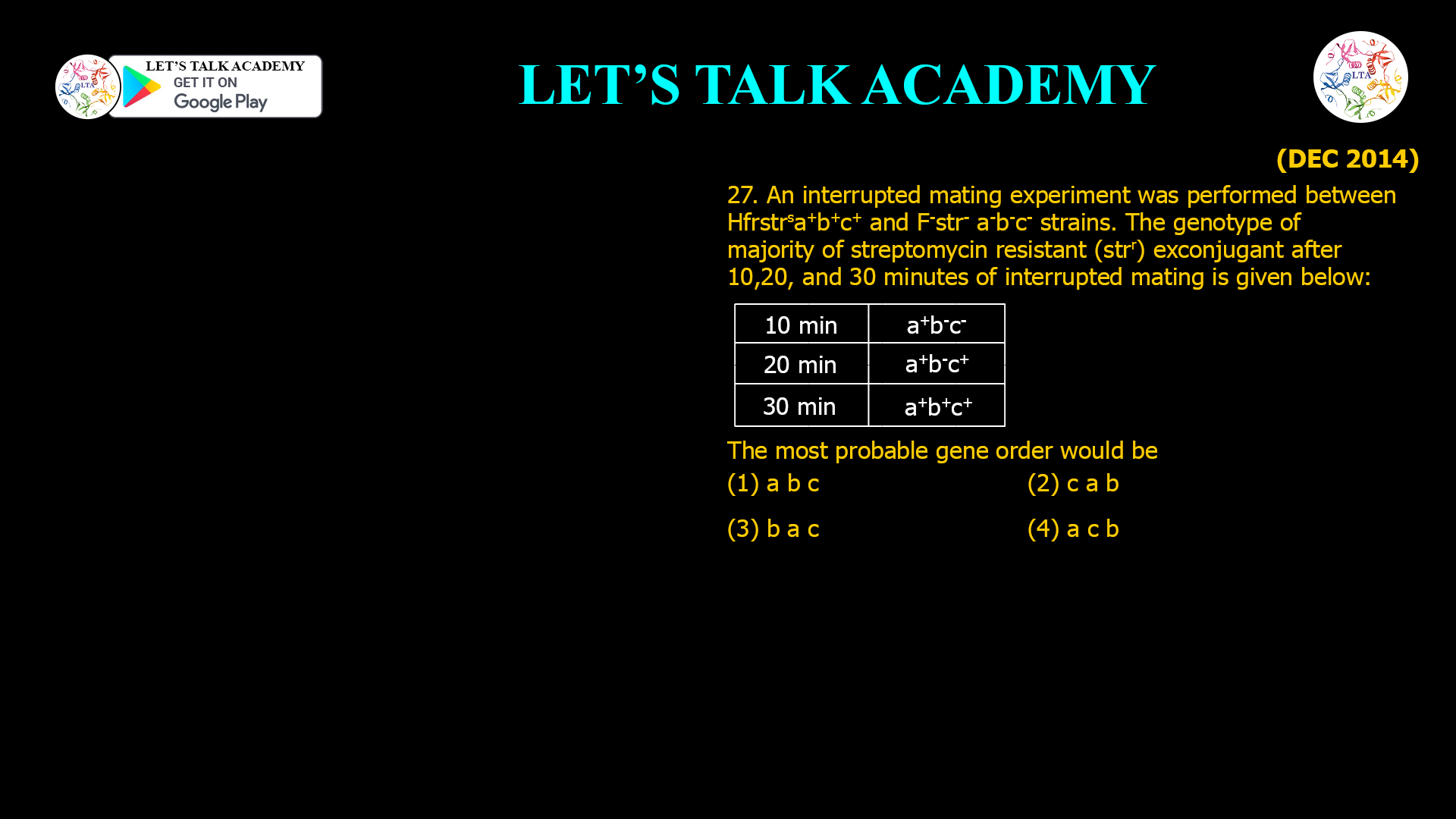
- An interrupted mating experiment was performed between Hfr strs a+b+c+ and F– strr a–b–c– strains. The genotype of majority of streptomycin resistant (strr) exconjugant after 10,20, and 30 minutes of interrupted mating is given below:
| 10 min | a+b–c– |
| 20 min | a+b–c+ |
| 30 min | a+b+c+ |
The most probable gene order would be
(1) a b c (2) c a b
(3) b a c (4) a c b
Question restatement
An interrupted mating experiment is performed between Hfr strˢ a⁺ b⁺ c⁺ and F⁻ strʳ a⁻ b⁻ c⁻ strains, and streptomycin-resistant exconjugants (i.e., recipients) are analyzed at 10, 20 and 30 minutes. The majority genotypes are: 10 min → a⁺ b⁻ c⁻, 20 min → a⁺ b⁺ c⁺, 30 min → a⁺ b⁺ c⁺. The most probable order of the three genes must be deduced.
Concept of interrupted mating
During conjugation with an Hfr donor, genes enter the F⁻ cell in a linear order, beginning from the origin of transfer on the donor chromosome. Earlier‐entering genes are closer to the origin; later genes are farther away in the same line.
Stepwise solution and gene order
At 10 min, only a⁺ has entered and recombined (b and c are still minus), so a is closest to the origin and must be the first gene. By 20 min, both b⁺ and c⁺ appear together, meaning that the segment containing b and c enters after a, but their relative order must be inferred from how quickly both are recovered together.
The fact that at the first time point after a⁺ appears, both b⁺ and c⁺ are already present in most recombinants indicates that b and c are close to each other, with one lying between a and the other gene. Under such data, the simplest arrangement is a – c – b, where a enters first, then c, and then b soon after; by 20 min both later genes are generally present.
So, the most probable gene order is: a c b (Option 4).
Analysis of each option
Option (1) a b c
If the order were a – b – c, then after a⁺ appears, b⁺ should appear earlier than c⁺, giving a time point where most recombinants are a⁺ b⁺ c⁻ before c⁺ starts to show. The table never shows a majority class of a⁺ b⁺ c⁻; instead, b⁺ and c⁺ appear together at 20 min, so this order is inconsistent.
Option (2) c a b
If the order were c – a – b, then c⁺ should appear before a⁺, so the earliest recombinants would carry c⁺ alone or c⁺ with a⁺. However, the earliest selected recombinants at 10 min are a⁺ b⁻ c⁻, showing that a⁺ is the first marker, not c⁺, so this option is ruled out.
Option (3) b a c
For b – a – c, the first entering gene would be b, so at the earliest time most exconjugants should be b⁺ with a⁻ c⁻, which is not observed. Instead, the earliest class is a⁺ only, meaning a is closer to the origin than b, so b – a – c cannot be correct.
Option (4) a c b
With a – c – b, the earliest recombinant class (10 min) is a⁺ only, agreeing with the data. As transfer continues, c⁺ and then b⁺ enter in quick succession, so by 20 min the majority of recombinants already show a⁺ b⁺ c⁺, matching the observed genotypes; thus this is the best-supported order.
Short SEO‑oriented introduction
Interrupted mating experiments are a classic tool for mapping gene order on the bacterial chromosome by tracking the time of entry of donor markers during Hfr × F⁻ conjugation. In this CSIR NET‑style problem, time‑dependent genotypes of streptomycin‑resistant exconjugants are used to deduce the correct linear arrangement of three genes, a, b and c, on the E. coli chromosome, leading to the gene order a c b.


2 Comments
Juber Khan
February 21, 2026Option 4 is right
Nisha Choudhary
February 22, 2026Option 4