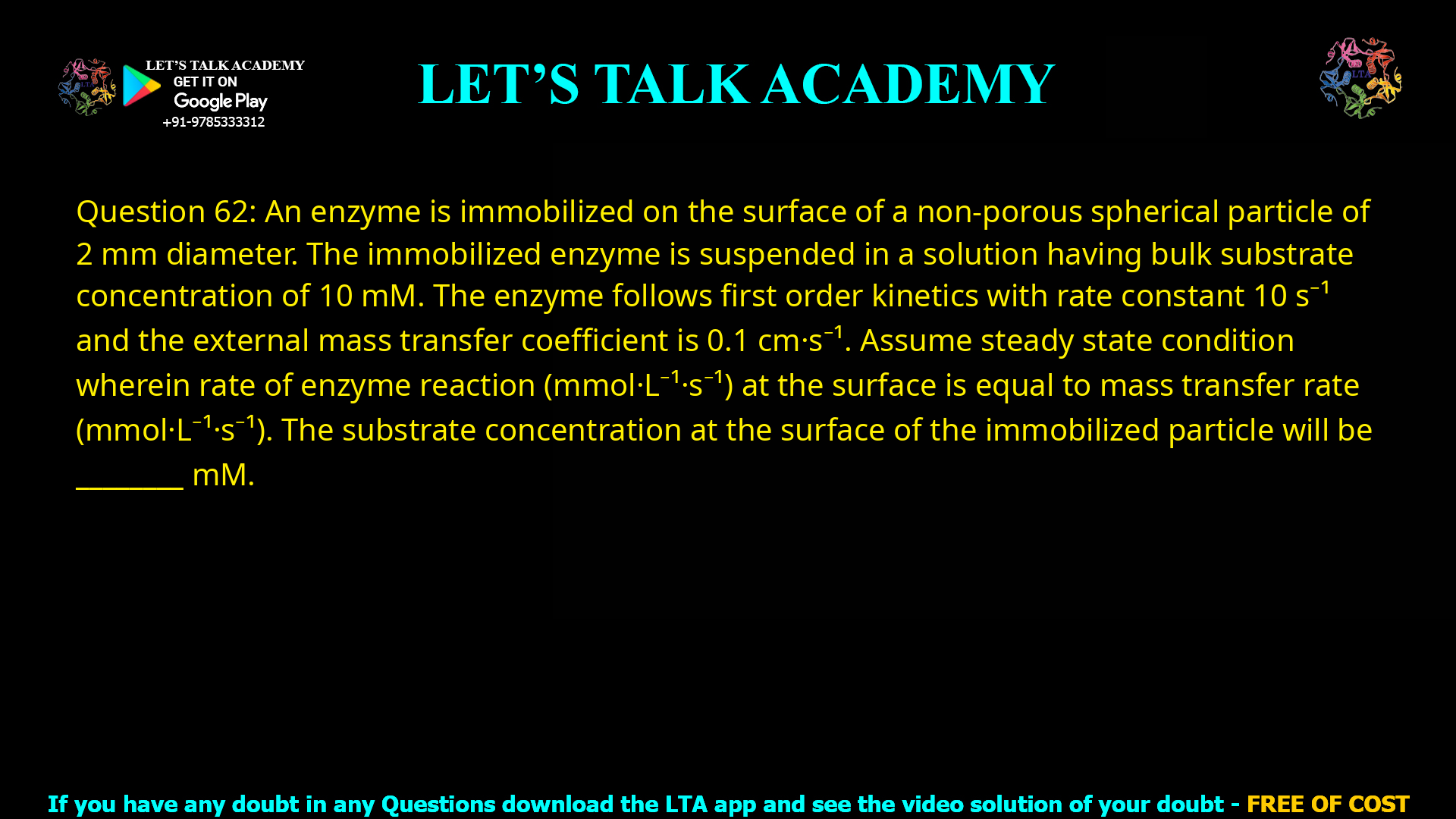
Q.62 An enzyme is immobilized on the surface of a non-porous spherical particle of
2 mm diameter. The immobilized enzyme is suspended in a solution having bulk substrate
concentration of 10 mM. The enzyme follows first order kinetics with rate constant
10 s−1 and the external mass transfer coefficient is 1 cm·s−1.
Assume steady state condition wherein rate of enzyme reaction (mmol·L−1·s−1) at the surface is equal to mass transfer rate (mmol·L−1·s−1).
The substrate concentration at the surface of the immobilized particle will be __________ mM.
Substrate Concentration at Surface of Immobilized Enzyme
System: Non-porous spherical particle |
Kinetics: First-order |
Result: Ss = 7.5 mM
Problem Setup
Immobilized enzymes on non-porous particles experience
external mass transfer limitations, where the substrate
concentration at the particle surface drops below the bulk concentration.
At steady state, the diffusive mass transfer rate equals the surface
reaction rate.
- Particle diameter = 2 mm → Radius, R = 0.1 cm
- Bulk substrate concentration, Sb = 10 mM
- First-order rate constant, k = 10 s-1
- External mass transfer coefficient, km = 1 cm·s-1
Key Equations
For a spherical particle, the specific surface area is:
a = 3 / R = 3 / 0.1 = 30 cm-1
Mass transfer rate per unit volume:
km a (Sb − Ss)
Surface reaction rate (first-order):
k Ss
At steady state:
km a (Sb − Ss) = k Ss
Step-by-Step Solution
Step 1: Substitute Known Values
1 × 30 (10 − Ss) = 10 Ss
Step 2: Simplify
300 − 30 Ss = 10 Ss
300 = 40 Ss
Step 3: Solve for Surface Concentration
Ss = 300 / 40 = 7.5 mM
Dimensionless Check (Damköhler Number)
Damköhler number:
Da = k / (km a) = 10 / 30 = 1/3
Relationship:
Ss / Sb = 1 / (1 + Da)
Ss = 10 × (1 / 1.333) = 7.5 mM
Final Answer
Substrate concentration at the particle surface,
Ss = 7.5 mM
Why External Mass Transfer Matters
In immobilized enzyme systems, external mass transfer resistance reduces
substrate availability at the surface, lowering the effective reaction rate.
This is especially important in non-porous particles where internal diffusion
is absent.
Common Mistakes Avoided
- Ignoring the specific surface area (a = 3/R)
- Unit mismatch between mM and mol·L-1
- Assuming zero-order kinetics instead of first-order
Applications in Biochemical Engineering
This analysis is crucial for optimizing immobilized enzyme reactors,
fermentation processes, and biocatalyst design.
For porous particles, internal diffusion effects must also be considered.


