Q.60 Consider a first order reaction 𝐴 → 𝐵. The initial concentration of 𝐴 is 100 mol L-1 and the value of first order rate constant is 0.01 min-1. The concentration of 𝐴 after 10 min of reaction is __________ mol L-1 (rounded off to one decimal place).

First Order Reaction Concentration After 10 Min

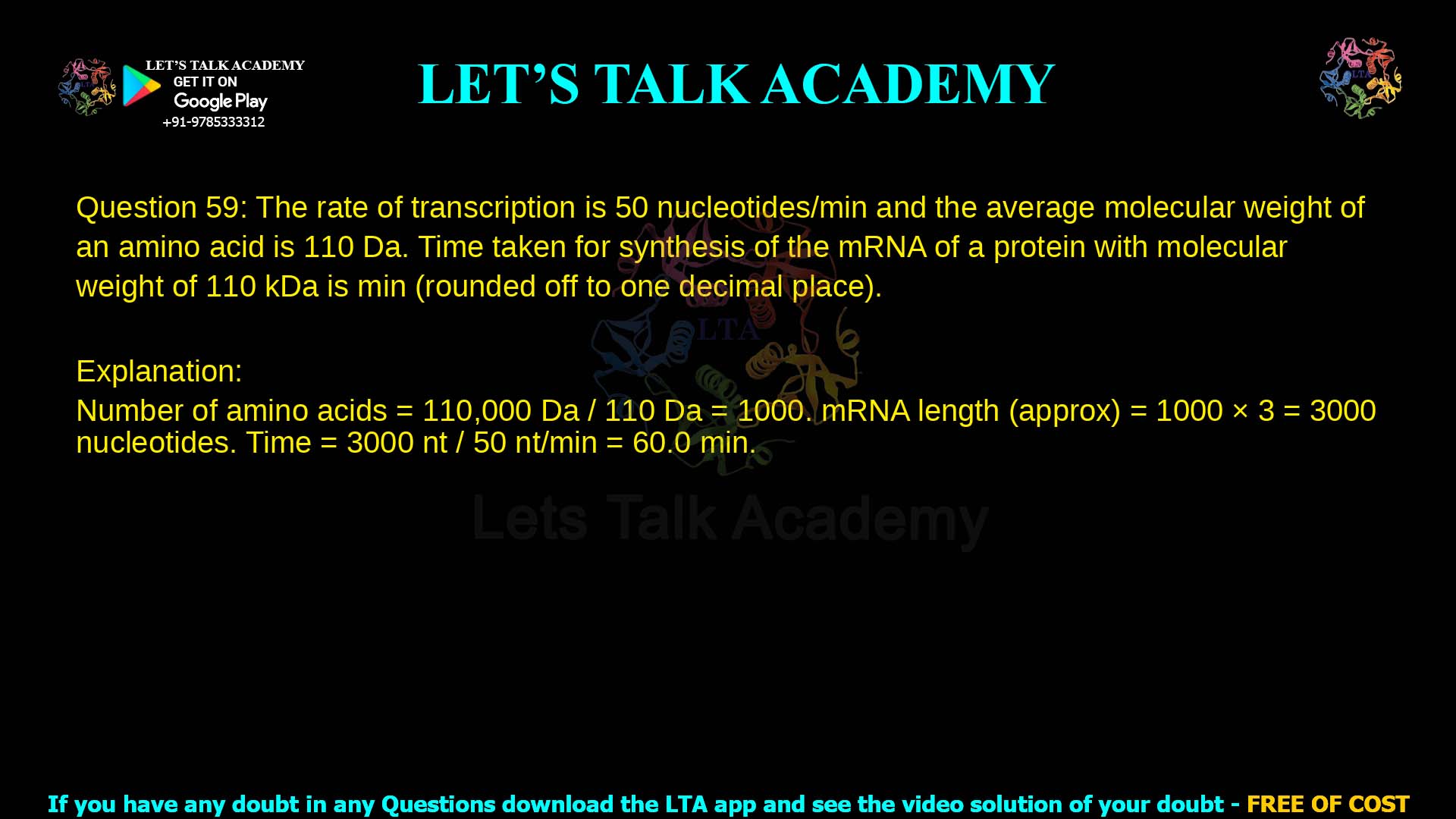
Q.59 The rate of transcription in a bacterium is 50 nucleotides/min and the average molecular weight of an amino acid is 110 Da. Time taken for synthesis of the mRNA of a protein with molecular weight of 110 kDa is _______ min. (rounded off to one decimal place) Assume no abortive transcriptions and no sequences upstream of the start codon.Q.59 The rate of transcription in a bacterium is 50 nucleotides/min and the average molecular weight of an amino acid is 110 Da. Time taken for synthesis of the mRNA of a protein with molecular weight of 110 kDa is _______ min. (rounded off to one decimal place) Assume no abortive transcriptions and no sequences upstream of the start codon.

Bacterial Transcription Rate

Q.58 If a bacterial culture with a doubling time of 30 minutes starts with two cells, then the number of cells after 4 hours are _______.

Bacterial Culture Doubling Time

Q.57 A protein solution of 1 μM has transmission of 40 % at 280 nm, when measured in a 1 cm cuvette using a UV-Visible spectrophotometer. The transmission of the same solution, when measured using a 2 cm cuvette is _______ %. (rounded off to the nearest integer)

Protein Solution Transmission in UV-Vis Spectrophotometer

Q.56 A random variable X and its probability distribution is given below. The value of P(X

Discrete Random Variable Question

Q.55 Given data consists of distinct values of 𝑥𝑖 occurring with frequencies 𝑓𝑖. The mean value for the data is _______. (rounded off to one decimal place)

Mean of Discrete Frequency Distribution

Q.54 An electron is accelerated from rest through a potential difference of 200 V. The de Broglie wavelength associated with this electron is _______ nm. (Rounded off to 2 decimal places) (Planck’s constant = 6.6 × 10⁻³⁴ J s, 1eV=1.6 × 10⁻¹⁹ J, mass of an electron = 9.1×10⁻³¹ kg)

De Broglie Wavelength of Electron Accelerated Through 200 V Potential Difference

Q.53 The heat required to convert 2 kg of water at 20 °C in a calorimeter to steam at 100 °C and at atmospheric pressure (1 atm) is _______ kJ. (Specific heat capacity of water is 4.2 kJ kg-1 K-1 and latent heat of steam is 2256 kJ kg-1)

Heat Required to Convert 2 kg Water at 20°C to Steam at 100°C

Q.52 Km and Vmax of an enzyme preparation are 5 μM and 30 μM min-1 respectively. Considering, Ki value of competitive inhibitor is 60 μM, the velocity (V0) of this enzyme-catalyzed reaction in the presence of 200 μM of substrate and 600 μM of competitive inhibitor is _______ μM min-1 (rounded off to two decimal places).

Km Vmax Competitive Inhibitor Enzyme Velocity

Q.51 The ∆G ́ and K ́eq values of ATP hydrolysis are -32.34 kJ mol-1 and 4.6 x10⁵, respectively. The ∆G ́ and K ́eq values of enzymatic hydrolysis of glucose-6- phosphate to glucose and phosphate are -13.18 kJ mol-1 and 203.8, respectively. The ∆G ́ value of reaction of glucose-6-phosphate formation from glucose and ATP by hexokinase is _______ kJ mol-1 (rounded off to 2 decimal places). [All reactions are carried out at pH 7.0 and 25 °C].

ΔG° Glucose-6-Phosphate Formation from Glucose and ATP by Hexokinase

Q.50 The value of lim (2x+6)/(x+3) is _____ .                                 x-->-3

Limit of \( \frac{2x+6}{x+3} \) as \( x \to -3 \)

Q.49 The order of differential equation 𝑑3𝑦/dx3+2d2y/dx2-3dy/dx+6x4y=0 is ______.

Order of Differential Equation

Q.48 Whales can dive undersea to depths of 2 km. The pressure on the whale at this depth (ignoring atmospheric pressure) is _______ × 106 Pa. (Density of sea water = 1 g cm-3 and g =10 m s-2)

Whales Dive Pressure at 2 km Depth

Q.47 A massless ideal spring is hanging vertically. A sphere of mass of 500 g, suspended from the spring, stretches the spring from its initial position by 50 cm when it reaches equilibrium. The force constant of the spring is _______ N m-1. (Use g=10 m s-2)

Force Constant of Hanging Spring with 500g Mass

Q.46 A restriction endonuclease has a recognition site of 3 bases. Assuming random arrangement of nucleotides, the probability that this endonuclease will cut a piece of DNA is _______ (rounded off to three decimal places).

Restriction Endonuclease 3 Base Recognition Site Probability Cut DNA Random Nucleotides

Q.45 Among the five fragments given below, the number of fragment(s) accelerated to the analyzer tube in mass spectrometer with electron ionization is/are _______.

Mass Spectrometry Electron Ionization

Q.44 Among K+, Li+, Rb+, Cs+, the number of cation(s) having ionic radii more than Na+ is/are _______.

Ionic Radii of K+ Li+ Rb+ Cs+ Compared to Na+

Q.43 Among i-BuNH2, NH3, Me2NH, EtNH2, the number of compound(s) more basic than MeNH2 is/are _______.

Basicity Order of Aliphatic Amines

Q.42 The number of possible unique combination(s) of linear tetrapeptides that can be made from four different amino acids using each amino acid only once in the chain is/are _______.

 Number of Unique Linear Tetrapeptides

Q.41 The net number of molecule(s) of NADH formed from one molecule of glucose in glycolysis under aerobic conditions is/are _______.

Net NADH Molecules from Glucose in Glycolysis Aerobic Conditions

Q.40 Which of the given statement(s) about synthetic oligonucleotides is/are correct? (A) Chemical synthesis extends the DNA chain from 3 ́→5 ́end (B) They can be utilized for site-directed mutagenesis (C) Chemical synthesis extends the DNA chain from 5 ́→3 ́end (D) They can be utilized as radiolabeled probes

 Synthetic Oligonucleotides

Q.39 Hyperventilation (breathing rapidly and deeply) causes which of the following event(s) in the arterial blood? (A) Decrease in CO2 concentration (B) Decrease in proton concentration (C) Increase in pH (D) Increase in O2 concentration

Hyperventilation Effects on Arterial Blood

Q.38 Different segments of a photosynthetic filamentous alga are exposed to different wavelengths of light as shown below. After a period of time, bacteria known to migrate towards high oxygen concentration, is spread on the surface of the alga. Which region(s) of the alga will have maximum bacterial congregation? (A) P and R (B) P and Q (C) Only P (D) Only Q

Engelmann Experiment Explained

Q.37 Which of the following option(s) represent(s) the evolutionary relationship between the bird and bat wings as structures for flying? (A) analogous (B) convergence (C) divergence (D) homologous

Evolutionary Relationship Between Bird and Bat Wings

Q.36 Which of the following is/are essential feature(s) of high-fidelity DNA polymerases used in polymerase chain reaction? (A) 5 ́→3 ́ exonuclease activity (B) Endonuclease activity (C) 3 ́→5 ́ exonuclease activity (D) Optimum temperature for activity ≥72 °C

Essential Features of High-Fidelity DNA Polymerases in PCR

Q.35 Which of the following statement(s) is/are correct for the following compound? (A) It can have a maximum of four stereoisomers (B) It can have a maximum of two stereoisomers (C) It is a chiral compound (D) It is an achiral compound

Chirality and Stereoisomers of Substituted Hexane

Q.34 Which of the following compound(s) is/are aromatic?

Aromaticity in Heterocyclic and Cyclic Compounds

Q.33 A species of fish living in a lake are separated by drying up of the lake into two separate lakes. After several hundreds of years of separation, the two groups are unable to mate. These groups are now considered to be different_______. (A) communities (B) organisms (C) populations (D) species

Fish Lake Speciation

Q.32 The characteristic morphological change(s) in cells undergoing apoptosis is/are (A) formation of blebs on cell surface (B) swelling and bursting of cells (C) collapse of the cytoskeleton (D) condensation and fragmentation of nuclear chromatin

Characteristic Morphological Changes in Cells Undergoing Apoptosis

Q.31 Which of the following statement(s) is/are correct about telophase? (A) Daughter chromosomes are yet to form (B) New nuclear envelop starts to reassemble (C) Division of cytoplasm begins (D) Nuclear membrane disappears

Telophase Stage of Mitosis

Q.30 Match the recombinant DNA products in Group I with its application in Group II Group I                                                                                    Group II P) Tissue plasminogen activator                          1) Emergency treatment of heart attack Q) Erythropoietin                                                    2) Treatment of anemia R) Superoxide dismutase                                       3) Prevents tissue damage S) Interferon                                                             4) Stimulates cells to inhibit viral replication (A) P-1, Q-2, R-3, S-4 (B) P-1, Q-3, R-4, S-2 (C) P-3, Q-1, R-4, S-2 (D) P-4, Q-3, R-1, S-2

Recombinant DNA Products Matching Applications

Q.29 The relationship between birth weight and degree of survival (log [ 𝑠𝑢𝑟𝑣𝑖𝑣𝑜𝑟𝑠 𝑛𝑜𝑛−𝑠𝑢𝑟𝑣𝑖𝑣𝑜𝑟𝑠]) in 6908 human births in an obstetric hospital is shown in the figure below. The mode of selection for birth weight is (A) directional (B) disruptive (C) diversifying (D) stabilizing

Stabilizing Selection in Human Birth Weight

Q.28 Which one of the following enzymes is required to ensure the replication of a negative-sense or negative-strand RNA virus? (A) DNA-dependent RNA polymerase (B) DNA polymerase (C) RNA-dependent DNA polymerase (D) RNA-dependent RNA polymerase

Enzyme Required for Negative-Sense RNA Virus Replication

Q.27 Class II MHC molecules are NOT expressed by (A) B-cells (B) dendritic cells (C) macrophages (D) T-cells

Class II MHC Molecules NOT Expressed by T-Cells

Q.26 A genetic linkage map represents the (A) relative locations of genes on a chromosome (B) distribution of the mutational hotspots (C) phylogenetic linkage among organisms (D) accurate physical distances among loci

Genetic Linkage Map

Q.25 The inability in humans to taste capsaicin resides in a single gene difference between two alleles P and p. The allele P for tasting is dominant over the nontasting allele. In a population of 400 individuals in Hardy-Weinberg equilibrium, 64 are nontasters. How many individuals are heterozygous for the gene? (A) 64 (B) 128 (C) 144 (D) 192

Hardy Weinberg Equilibrium Capsaicin Tasting Nontasters Heterozygous Calculation

Q.24 Determine the correctness or otherwise of the following Assertion [a] and the Reason [r]. Assertion [a]: The cardiovascular organization called double circulation provides vigorous flow of blood to the brain, muscles, and other organs. Reason [r]: The blood is pumped a second time after it loses pressure in the capillary beds of the lungs or skin. (A) Both [a] and [r] are true and [r] is the correct reason for [a] (B) Both [a] and [r] are true but [r] is not the correct reason for [a] (C) Both [a] and [r] are false (D) [a] is true but [r] is false

 Double Circulation Assertion Reason

Q.23 Which one of the following is correct in the case of conjugation of a high frequency recombination (Hfr) strain with F- strain of E. coli? (A) Recombination frequency is high, F factor transfer frequency is low (B) Recombination frequency is high, F factor transfer frequency is high (C) Recombination frequency is low, F factor transfer frequency is high (D) Recombination frequency is low, F factor transfer frequency is low

Hfr Strain Conjugation with F- E. coli

Q.22 Match the microorganisms in Group I with the human disease in Group II Group I                                                           Group II P) Treponema pallidum                     1) Sleeping sickness Q) Trypanosoma cruzi                        2) Whooping cough R) Trypanosoma gambiense              3) Chagas disease S) Bordetella pertussis                        4) Syphilis (A) P-4, Q-3, R-1, S-2 (B) P-1, Q-2, R-4, S-3 (C) P-3, Q-1, R-2, S-4 (D) P-2, Q-1, R-3, S-4

Microorganisms and Human Diseases Matching

Q.21 Which one of the following statements about photoproteins in plants is INCORRECT? (A) Phytochromes are activated by red light (B) Phytochromes are inactivated by far-red light (C) Cryptochromes are sensitive to blue light (D) Phototropins are insensitive to blue light

Photoproteins in Plants

Q.20 The pedigree given below shows individuals affected (shaded circles/rectangles) by chronic hypertension. Assuming 100% penetrance, the inheritance of this trait is (A) autosomal dominant (B) autosomal recessive (C) sex-linked dominant (D) sex-linked recessive

How to Solve Pedigree Analysis Questions

Q.19 In the ‘Southern blot’ technique, which of the following reagents is used to detect the presence of a desired DNA fragment? (A) Ethidium bromide (B) DNA probe (C) Silver nitrate (D) DNase

Southern Blot Technique

Q.18 Tetracycline binds to the (A) 30S subunit and inhibits aminoacyl-tRNA binding (B) 50S subunit and inhibits aminoacyl-tRNA binding (C) 30S subunit and prevents codon:anticodon interactions (D) 50S subunit and blocks exit of growing polypeptide chain

Tetracycline Binds to 30S Subunit and Inhibits Aminoacyl-tRNA Binding

Q.17 Match the type of DNA repair mechanism in Group I with the enzyme(s) involved in Group II Group I                                                       Group II P) Mismatch repair                        1) DNA glycosylase Q) Base excision repair               2) UvrA, UvrB, UvrC and UvrD R) Nucleotide excision repair    3) RecA S) Double strand break repair   4) MutL, MutS and MutH (A) P-4, Q-1, R-3, S-2 (B) P-4, Q-2, R-1, S-3 (C) P-4, Q-1, R-2, S-3 (D) P-2, Q-1, R-4, S-3

DNA Repair Mechanisms and Enzymes Matching

Q.16 Which one of the following statements is correct about solute transport across membranes? (A) Passive transporters decrease the activation energy and does not facilitate the transport of polar compounds (B) The direction in which a charged solute tends to move spontaneously across a membrane does not depend on the electrical gradient across the membrane (C) All ABC transporters do not have nucleotide binding domain (D) P-type ATPases get reversibly phosphorylated as a part of transport cycle

 Solute Transport Across Membranes

Q.15 What is the splitting pattern of proton Ha of the following compound in its 1H NMR spectrum? (A) Doublet (B) Doublet of doublet (C) Multiplet (D) Triplet

Detailed NMR Analysis of Proton Hᵃ

Q.14 Match the molecules in Group I with the type of bonds present in them, in Group II Group I                                                                Group II P) NaCl                                                             1) Coordination bond Q) H2                                                                2) Polar covalent bond R) Pd-P bond in Pd(PPh3)4                         3) Covalent bond S) C-Cl bond in CH3Cl                                  4) Ionic bond (A) P-4, Q-1, R-3, S-2 (B) P-2, Q-3, R-1, S-4 (C) P-4, Q-3, R-1, S-2 (D) P-4, Q-3, R-2, S-1

NaCl H2 Pd(PPh3)4 CH3Cl Bond Types Matching

Q.13 In mice, a trait is determined by a dominant allele Y and recessive allele y. What proportion of the offspring from a YY × yy cross is expected to be homozygous recessive in F1 generation? (A) 0 (B) 0.25 (C) 0.5 (D) 1

YY × yy Cross F1 Homozygous Recessive Proportion in Mice Genetics

Q.12 Determine the correctness or otherwise of the following Assertion [a] and the Reason [r]. Assertion [a]: Nitric oxide is involved in transient paracrine and autocrine signaling. Reason [r]: Nitric oxide is highly reactive, with a lifetime of few seconds, yet can diffuse freely across membranes (A) Both [a] and [r] are true and [r] is the correct reason for [a] (B) Both [a] and [r] are true but [r] is not the correct reason for [a] (C) Both [a] and [r] are false (D) Only [a] is true but [r] is false

Nitric Oxide in Transient Paracrine Autocrine Signaling

Q.11 Which one of the following statements about the G1 checkpoint of eukaryotic cell division cycle is INCORRECT? (A) Cell assures the existence of favorable extracellular environment (B) Cell assures the DNA has no damage (C) Cell assures the damaged DNAs are directed for repair mechanism (D) Cell assures complete replication of DNA

G1 Checkpoint in Eukaryotic Cell Division Cycle

Q.10 Rain is falling vertically with a speed of 40 m s-1. Wind starts blowing with a speed of 16 m s-1 in the west to east direction. How should a person, who is standing, hold his umbrella to avoid getting wet? (A) At an angle of about 22° with vertical towards east (B) At an angle of about 22° with vertical towards west (C) At an angle of about 66° with vertical towards east (D) At an angle of about 66° with vertical towards west

Rain Falling Vertically Wind West to East Umbrella Angle Physics Solution

Q.9 Given the following sets: 𝐴 = {2, 4, 6, 8, 10, 12} 𝐵 = {8, 10, 12, 14, 16, 18} 𝐶 = {7, 8, 9, 10 11, 12, 13} (𝐴 ∩ 𝐵) ∪ (𝐵 ∩ 𝐶) is (A) {8, 10, 12, 14} (B) {8, 10, 12} (C) {7, 8, 10, 11, 12, 13, 14} (D) {4, 6, 7, 8 10, 11, 12, 13}

Solve (A ∩ B) ∪ (B ∩ C) with Sets

Q.8 Which one of the following is transcribed by RNA polymerase III in eukaryotes? (A) 18S rRNA (B) 28S rRNA (C) miRNA (D) tRNA

Which RNA Polymerase III Transcribes in Eukaryotes?

Q.7 Which one of the following does NOT belong to the freshwater ecosystem? (A) Estuary (B) Lentic (C) Lotic (D) Wetland

Freshwater Ecosystem Components

Q.6 Restriction enzymes that recognize the same nucleotide sequence but cleave at different positions are called (A) heterohypekomers (B) isocaudomers (C) isoschizomers (D) neoschizomers

Restriction Enzymes That Recognize Same Sequence But Cleave Differently

Q.5 Which one of the following pairs of antibodies contains ‘J-chain’ in their multimeric form? (A) IgA and IgE (B) IgA and IgM (C) IgD and IgE (D) IgD and IgG

J-Chain in Antibodies

Q.4 A growing shoot of a germinating seedling encounters an underground obstacle. Which one of the following hormones elicits ‘triple response’ to the underground obstacle? (A) Auxin (B) Cytokinin (C) Ethylene (D) Gibberellins

Triple Response Hormone in Seedling Underground Obstacle Navigation

Q.3 Which one of the following is NOT a plant vascular tissue? (A) Phloem (B) Periderm (C) Stele (D) Xylem

Which One of the Following is NOT a Plant Vascular Tissue?

Q.2 Arrange the following elements in increasing order of their electronegativity according to the Pauling scale C, Na, Be and Br (A) Be, Na, C, Br (B) Br, C, Na, Be (C) Na, Be, C, Br (D) Na, C, Be, Br

Electronegativity Order of Na, Be, C, Br on Pauling Scale

Q.1 Which one of the following compounds inhibits the polymerization of tubulin to microtubules in animal cells? (A) ATP (B) Taxol (C) Thymosin (D) Vinblastine

Which Compound Inhibits Tubulin Polymerization to Microtubules?

Latest Courses