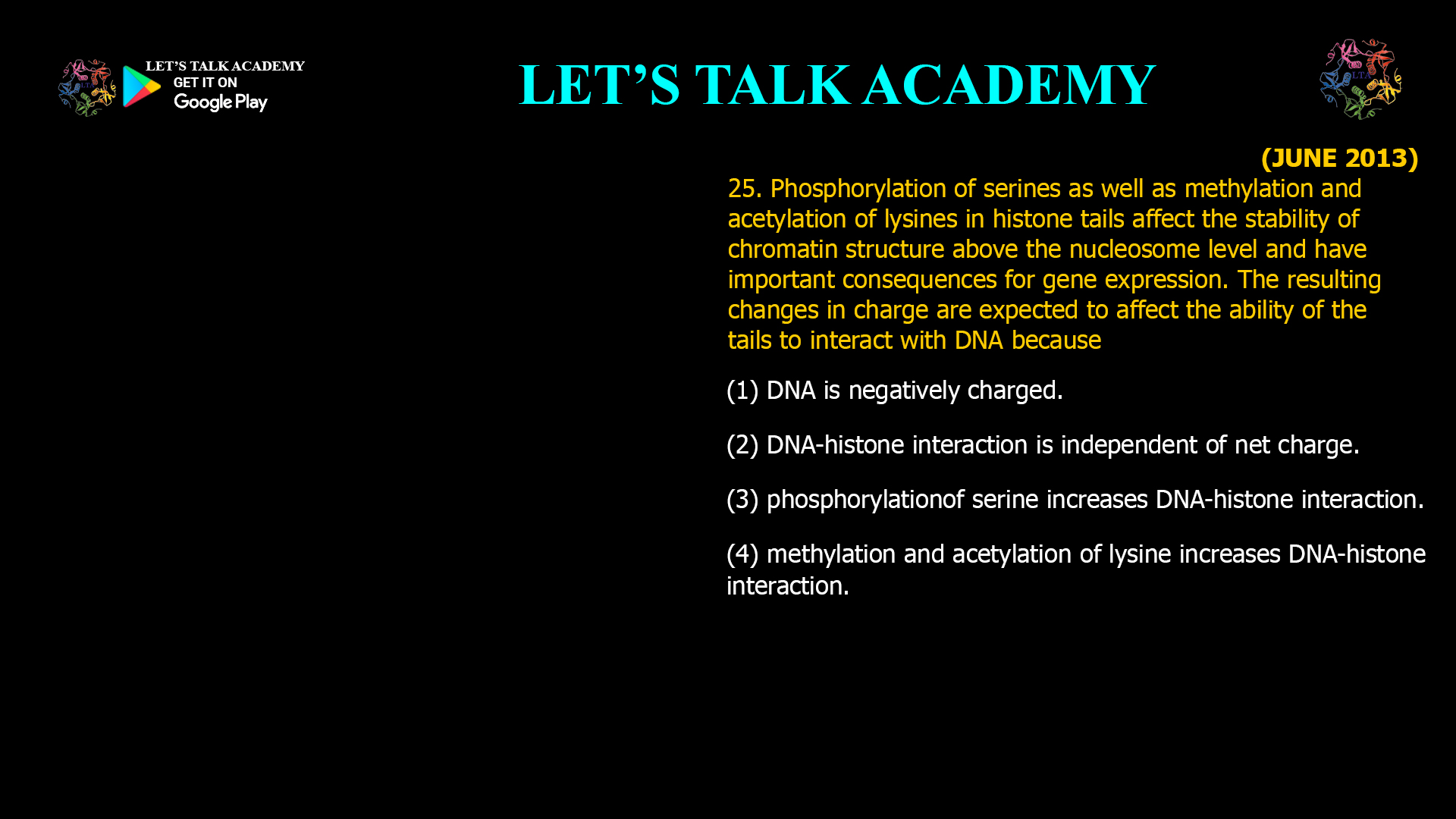
25. Phosphorylation of serines as well as methylation and acetylation of lysines in histone tails affect the stability of chromatin structure above the nucleosome level and have important consequences for gene expression. The resulting changes in charge are expected to affect the ability of the tails to interact with DNA because
(1) DNA is negatively charged.
(2) DNA-histone interaction is independent of net charge.
(3) phosphorylationof serine increases DNA-histone interaction.
(4) methylation and acetylation of lysine increases DNA-histone interaction.
Introduction
Chromatin structure and gene expression are regulated by post-translational modifications of histone proteins. These modifications alter the charge properties of histone tails, affecting their electrostatic interactions with the negatively charged DNA backbone. This article explains how changes in charge due to phosphorylation, acetylation, and methylation influence chromatin stability above the nucleosome leave
DNA’s Negative Charge and Histone Interaction
DNA carries a strong negative charge due to its phosphate groups. Histone proteins, rich in positively charged lysine and arginine residues, bind DNA through electrostatic attraction, compacting the chromatin fiber.
Impact of Histone Modifications on Charge and Interaction
-
Phosphorylation of serine residues adds negative charges to histone tails, reducing their positive charge and weakening DNA binding.
-
Acetylation of lysine residues neutralizes their positive charge, loosening chromatin and facilitating transcription.
-
Methylation of lysine residues does not change charge but influences chromatin structure by recruiting specific proteins.
These modifications modulate chromatin compaction and accessibility, thereby regulating gene expression.
Conclusion
The negatively charged DNA backbone interacts electrostatically with positively charged histone tails. Post-translational modifications that alter histone charge disrupt these interactions, leading to changes in chromatin structure and transcriptional activity.
Answer:
(1) DNA is negatively charged


