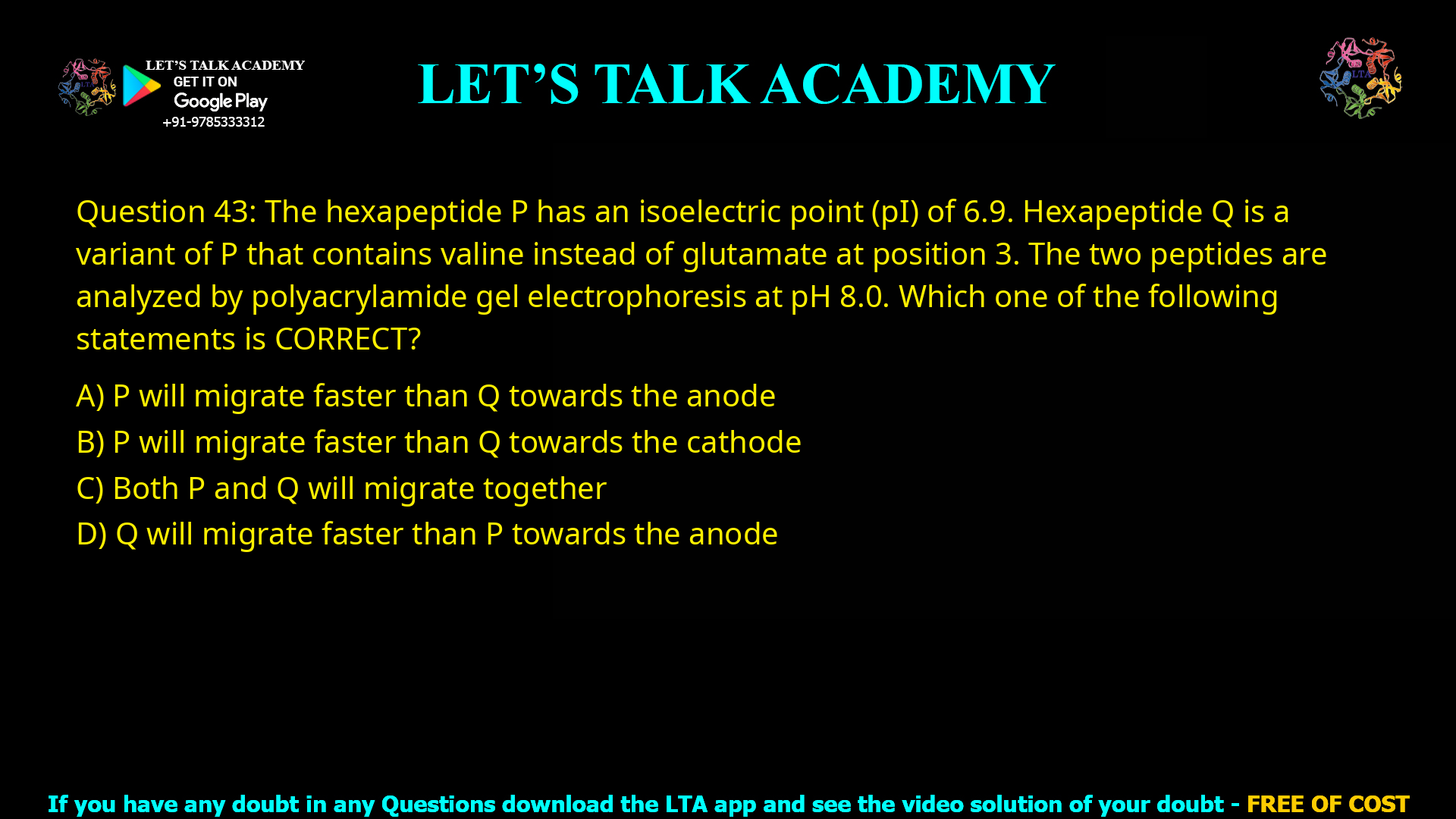
Q.43 The hexapeptide P has an isoelectric point (pI) of 6.9. Hexapeptide Q is a variant of P that
contains valine instead of glutamate at position 3. The two peptides are analyzed by
polyacrylamide gel electrophoresis at pH 8.0. Which one of the following statements is
CORRECT?
(A) P will migrate faster than Q towards the anode
(B) P will migrate faster than Q towards the cathode
(C) Both P and Q will migrate together
(D) Q will migrate faster than P towards the anode
P has a pI of 6.9, meaning it’s less negatively charged than Q at pH 8.0 due to replacing glutamate (acidic) with valine (neutral). In polyacrylamide gel electrophoresis at pH 8.0, P migrates faster toward the anode than Q.
Key Concepts
The isoelectric point (pI) is the pH where a peptide has zero net charge. At pH > pI, the peptide is negatively charged and moves to the anode (positive electrode); at pH < pI, it’s positively charged and moves to the cathode. Glutamate contributes a negative charge (pKa ~4.3 for side chain), while valine is neutral.
Peptide Analysis
Peptide P (pI 6.9) at pH 8.0 has pH > pI, so net negative charge. Q replaces Glu³ (negative) with Val (neutral), reducing negative charges and making Q less negative (higher effective pI than P). Thus, P has stronger negative charge, migrates faster to anode in electric field.
Option Evaluation
-
(A) P migrates faster to anode: Correct. P more negative, faster anodic mobility.
-
(B) P faster to cathode: Incorrect. Both negative at pH 8, move to anode, not cathode.
-
(C) Migrate together: Incorrect. Charge difference causes separation.
-
(D) Q faster to anode: Incorrect. Q less negative, slower to anode.
Introduction: Unraveling Hexapeptide P and Q in Isoelectric Point Electrophoresis
In biotechnology exams like GATE BT, questions on hexapeptide P isoelectric point (pI) 6.9 test core concepts of peptide charge and migration in polyacrylamide gel electrophoresis at pH 8.0. Hexapeptide Q, a variant replacing glutamate with valine at position 3, shifts charge dynamics. This guide breaks down why P migrates faster toward the anode, optimizing for searches on hexapeptide electrophoresis pI analysis.
Isoelectric Point (pI) Fundamentals
The isoelectric point is the pH where a peptide’s net charge is zero. For hexapeptide P (pI 6.9), at pH 8.0 (> pI), it gains negative charge from deprotonated groups like Glu carboxylates. Replacing acidic glutamate (negative side chain) with neutral valine in Q reduces anions, making Q less negative.
Electrophoresis Behavior at pH 8.0
In anionic PAGE, negative peptides move to the anode based on charge density. P’s extra negative charge from Glu accelerates it toward the anode faster than Q. This separation highlights how single substitutions alter pI and electrophoretic mobility.
Why Option A is Correct
-
P: More negative → higher anodic velocity.
-
Q: Less negative → slower.
Common pitfalls include confusing cathode/anode or ignoring pH-pI relation.


