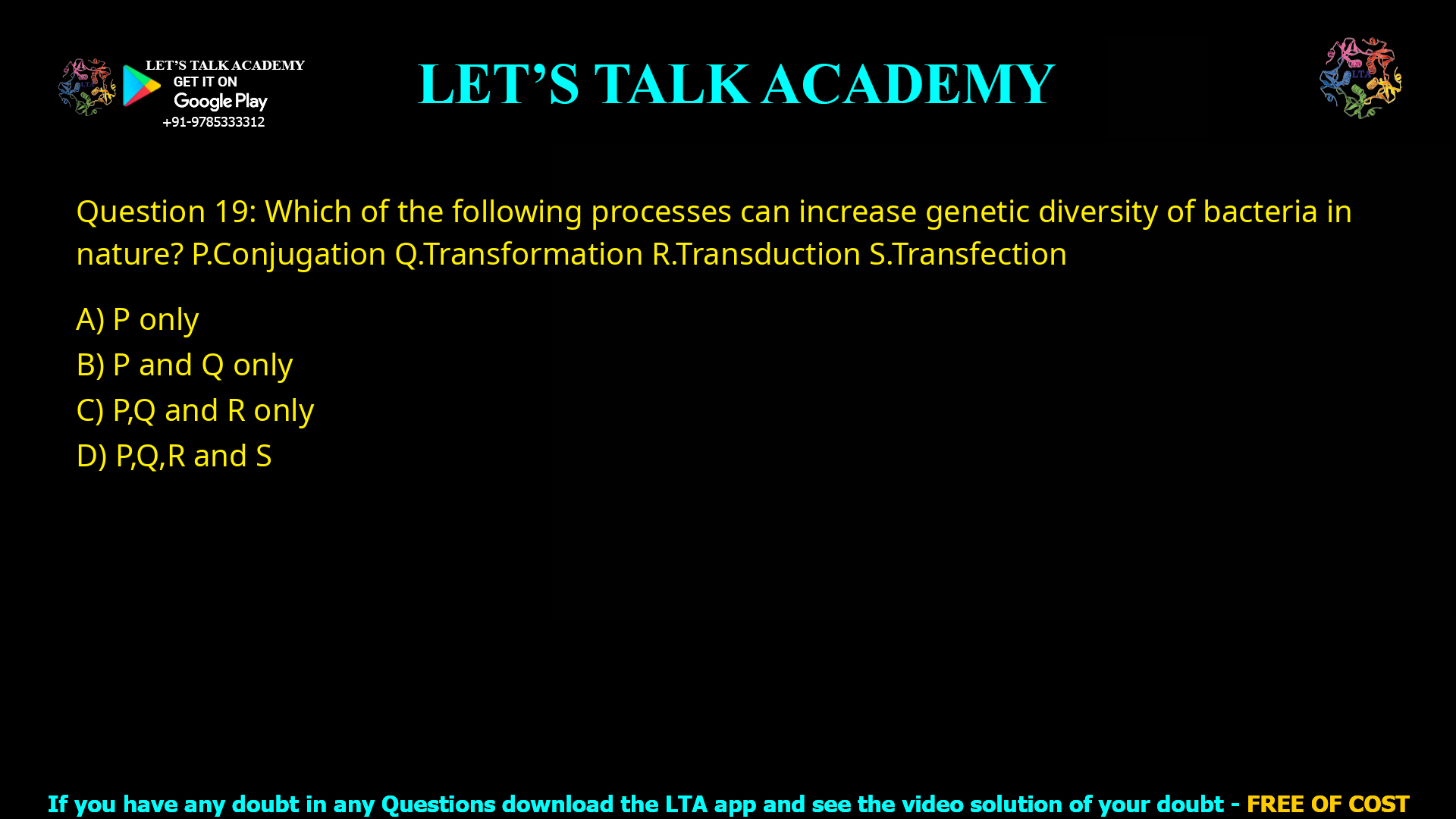
Q.19 Which of the following processes can increase genetic diversity of bacteria in nature?
P. Conjugation
Q. Transformation
R. Transduction
S. Transfection
(A) P only (B) P and Q only (C) P, Q and R only (D) P, Q, R and S
Answer: (C) P, Q and R only
Conjugation, transformation, and transduction are natural mechanisms that bacteria use to exchange genetic material, thereby increasing genetic diversity in nature. Transfection, however, is a laboratory technique and does not occur naturally in bacterial populations.
Option Analysis
Conjugation (P)
Direct cell-to-cell contact via a pilus allows transfer of plasmids or chromosomal DNA from donor to recipient bacteria. This process introduces new genes, such as antibiotic resistance, enhancing genetic variation.
Transformation (Q)
Competent bacteria take up free DNA from the environment, often released by lysed cells. Natural competence in species like Streptococcus and Bacillus integrates this DNA, promoting diversity through horizontal gene transfer.
Transduction (R)
Bacteriophages accidentally package host DNA during infection and deliver it to new hosts. Generalized transduction transfers any bacterial gene, while specialized transduction moves specific genes, both contributing to genetic mixing.
Transfection (S)
This artificial method uses chemicals or electroporation to introduce foreign DNA into cells, mainly in lab settings for eukaryotes or recombinant work. It does not happen naturally in bacteria, so it fails to increase wild genetic diversity.
Introduction to Genetic Diversity in Bacteria
Bacteria thrive through rapid genetic diversity of bacteria in nature, powered by horizontal gene transfer mechanisms like conjugation, transformation, and transduction. Unlike vertical inheritance, these processes allow quick adaptation to environments, such as antibiotic resistance spread. This article breaks down each process, explaining their role in natural bacterial evolution for competitive exam preparation.
Core Mechanisms Explained
-
Conjugation: Donor bacteria form a sex pilus to transfer plasmids (e.g., F-plasmid in E. coli) directly. It shuffles genes across strains, vital for survival traits.
-
Transformation: Naturally competent bacteria (e.g., Bacillus subtilis) absorb naked DNA from dead cells. Integration via recombination boosts allelic variety.
-
Transduction: Phages mediate DNA transfer—generalized packs random host fragments, specialized transfers prophage-adjacent genes. Key for inter-strain exchange.
Why Not Transfection?
Transfection forces DNA uptake in labs using lipofectamine or electricity, absent in nature. It suits molecular cloning, not wild bacterial populations.
Exam Relevance
This question mirrors GATE Biotechnology 2019, testing natural HGT knowledge. Options P, Q, R drive diversity; S is artificial (answer C).


