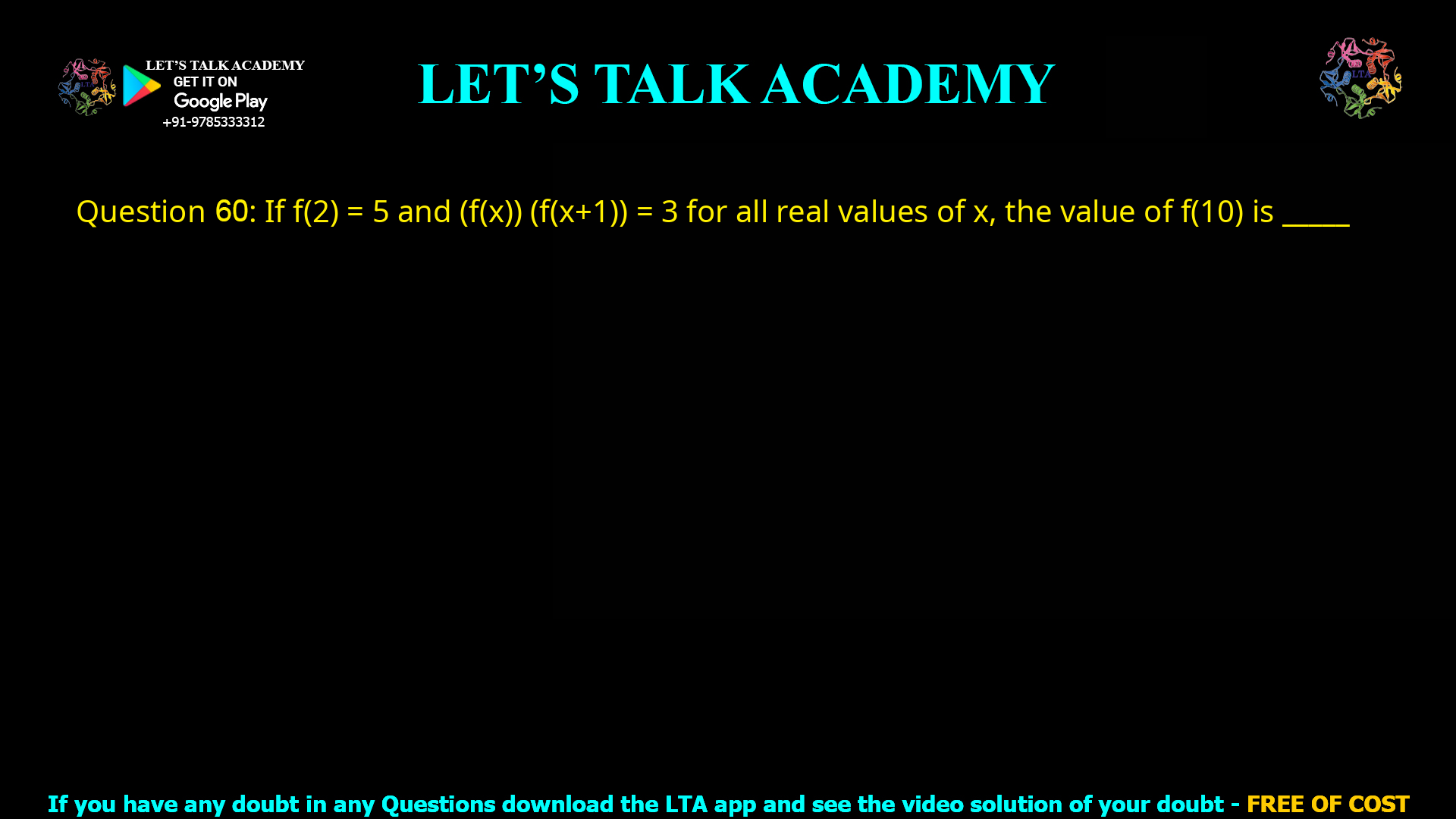
Q.60 If f(2) = 5 and (f(x))(f(x+1)) = 3 for all real values of x, the value of f(10) is ____________.
Given: f(2) = 5 and f(x) · f(x+1) = 3 for all real x. Find: f(10)
Problem Analysis
The functional equation f(x) · f(x+1) = 3 holds universally, creating a recursive product pattern. Starting from f(2) = 5, compute forward to f(10) using the relation repeatedly. This is a fill-in-the-blank numerical answer common in exams like IIT JAM Mathematics.
Step-by-Step Solution
Apply the relation iteratively from x = 2:
f(2) · f(3) = 3 → f(3) = 3/5
f(3) · f(4) = 3 → f(4) = 3/(3/5) = 5
f(4) · f(5) = 3 → f(5) = 3/5
f(5) · f(6) = 3 → f(6) = 5
f(3) · f(4) = 3 → f(4) = 3/(3/5) = 5
f(4) · f(5) = 3 → f(5) = 3/5
f(5) · f(6) = 3 → f(6) = 5
Pattern Recognition
A clear pattern emerges: f(x+2) = f(x), indicating the function has period 2.
| x | f(x) |
|---|---|
| 2 | 5 |
| 3 | 3/5 |
| 4 | 5 |
| 5 | 3/5 |
| 6 | 5 |
| 7 | 3/5 |
| 8 | 5 |
| 9 | 3/5 |
| 10 | 5 |
Periodicity Proof
Verify the period 2 property mathematically:
f(x+2) = 3 / f(x+1)
But f(x+1) = 3 / f(x)
∴ f(x+2) = 3 / (3 / f(x)) = f(x)
But f(x+1) = 3 / f(x)
∴ f(x+2) = 3 / (3 / f(x)) = f(x)
Since 10 – 2 = 8 (multiple of period 2), f(10) = f(2) = 5.
Final Answer
f(10) = 5
Key Insights for IIT JAM
- Pattern Recognition: Identify periodicity early to avoid lengthy computation
- Functional Equations: Recursive relations often yield periodic solutions
- Verification: Always prove the pattern mathematically, don’t assume
- Exam Strategy: Fill-in blanks require exact numerical values


